
Wuthering Heights: Summary
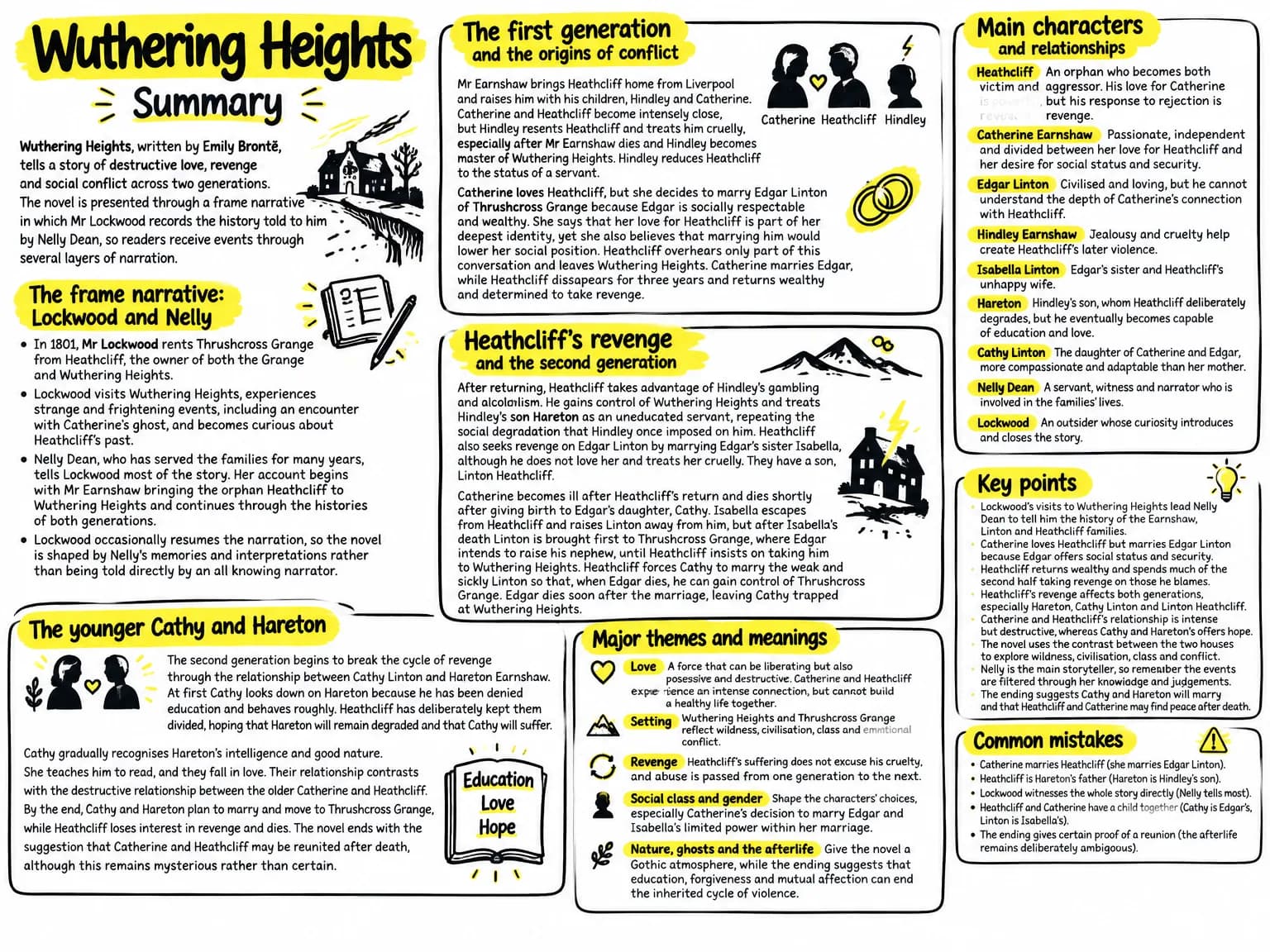
Wuthering Heights, written by Emily Brontë, tells a story of destructive love, revenge and social conflict across two generations. The novel is presented through a frame narrative in which Mr Lockwood records the history told to him by Nelly Dean, so readers receive events through several layers of narration.
Wuthering Heights: Summary at a glance
Listen: Wuthering Heights: Summary
Two hosts talking it through, 3:01. The full transcript is below, so you can read along or skip the audio.
Transcript
AnnaWhen people describe Wuthering Heights as a love story, do they miss how much of it is about revenge and social conflict?
MarcoThey can, yes. Love is central, but it is not presented as healthy or comforting. The novel follows destructive love across two generations, and it shows how suffering can become cruelty. What makes the structure especially interesting is that we do not hear the whole story directly. Lockwood records what Nelly Dean tells him.
AnnaSo Lockwood is not really an eyewitness to the family history?
MarcoNo. In eighteen oh one, he rents Thrushcross Grange from Heathcliff and visits Wuthering Heights. He experiences frightening events, including an encounter with Catherine's ghost, and becomes curious. Nelly, who has served the families for years, gives him most of the history. Lockwood sometimes resumes the narration, so Nelly's memories and judgements shape what we learn.
AnnaAnd the original conflict begins with Heathcliff's arrival?
MarcoYes. Mr Earnshaw brings the orphan Heathcliff home from Liverpool. Heathcliff becomes intensely close to Catherine, but Hindley resents him. After their father's death, Hindley becomes master of Wuthering Heights and reduces Heathcliff to a servant. That humiliation helps explain, though it does not excuse, Heathcliff's later violence.
AnnaWhy does Catherine marry Edgar if her bond with Heathcliff is so powerful?
MarcoBecause Edgar offers social respectability, wealth and security. Catherine sees Heathcliff as part of her deepest identity, but believes marrying him would lower her social position. Heathcliff overhears only part of her conversation, leaves, and returns three years later as a wealthy man determined to take revenge.
AnnaWho becomes the target of that revenge?
MarcoSeveral people. Heathcliff uses Hindley's gambling and alcoholism to gain control of Wuthering Heights. He treats Hindley's son, Hareton, as an uneducated servant, repeating the degradation once imposed on him. He also marries Edgar's sister Isabella without loving her and treats her cruelly. Their son is Linton Heathcliff.
AnnaWhat happens to Catherine and the younger generation?
MarcoCatherine dies after giving birth to Edgar's daughter, Cathy. Later, Heathcliff forces Cathy to marry his weak and sickly son, Linton, so he can gain Thrushcross Grange after Edgar's death. Cathy is then trapped at Wuthering Heights.
AnnaDoes the second generation simply repeat the first?
MarcoNot entirely. Cathy first looks down on Hareton, but gradually recognises his intelligence and good nature. She teaches him to read, and they fall in love. Their relationship offers education, forgiveness and mutual affection instead of control and revenge. They plan to marry and move to Thrushcross Grange.
AnnaAnd what does Heathcliff's ending suggest?
MarcoHe loses interest in revenge and dies. The novel suggests that Catherine and Heathcliff may be reunited after death, but it does not prove this. That ambiguity fits its Gothic atmosphere of nature, ghosts and possible life after death. Ultimately, the contrast between the harsh Heights and orderly Grange reflects the novel's conflicts over class, wildness and civilisation.
The notes
The frame narrative: Lockwood and Nelly
The novel begins in 1801, when Mr Lockwood rents Thrushcross Grange from Heathcliff, the owner of both the Grange and Wuthering Heights. Lockwood visits Wuthering Heights, experiences strange and frightening events, including an encounter with Catherine's ghost, and becomes curious about Heathcliff's past.
Nelly Dean, who has served the families for many years, tells Lockwood most of the story. Her account begins with Mr Earnshaw bringing the orphan Heathcliff to Wuthering Heights and continues through the histories of both generations. Lockwood occasionally resumes the narration, so the novel is shaped by Nelly's memories and interpretations rather than being told directly by an all knowing narrator.
The first generation and the origins of conflict
Mr Earnshaw brings Heathcliff home from Liverpool and raises him with his children, Hindley and Catherine. Catherine and Heathcliff become intensely close, but Hindley resents Heathcliff and treats him cruelly, especially after Mr Earnshaw dies and Hindley becomes master of Wuthering Heights. Hindley reduces Heathcliff to the status of a servant.
Catherine loves Heathcliff, but she decides to marry Edgar Linton of Thrushcross Grange because Edgar is socially respectable and wealthy. She famously says that her love for Heathcliff is part of her deepest identity, yet she also believes that marrying him would lower her social position. Heathcliff overhears only part of this conversation and leaves Wuthering Heights. Catherine marries Edgar, while Heathcliff disappears for three years and returns wealthy and determined to take revenge.
Heathcliff's revenge and the second generation
After returning, Heathcliff takes advantage of Hindley's gambling and alcoholism. He gains control of Wuthering Heights and treats Hindley's son Hareton as an uneducated servant, repeating the social degradation that Hindley once imposed on him. Heathcliff also seeks revenge on Edgar Linton by marrying Edgar's sister Isabella, although he does not love her and treats her cruelly. They have a son, Linton Heathcliff.
Catherine becomes ill after Heathcliff's return and dies shortly after giving birth to Edgar's daughter, Cathy. Isabella escapes from Heathcliff and raises Linton away from him, but after Isabella's death Linton is brought first to Thrushcross Grange, where Edgar intends to raise his nephew, until Heathcliff insists on taking him to Wuthering Heights. Heathcliff forces Cathy to marry the weak and sickly Linton so that, when Edgar dies, Heathcliff can gain control of Thrushcross Grange. Edgar dies soon after the marriage, leaving Cathy trapped at Wuthering Heights.
The younger Cathy and Hareton
The second generation begins to break the cycle of revenge through the relationship between Cathy Linton and Hareton Earnshaw. At first Cathy looks down on Hareton because he has been denied education and behaves roughly. Heathcliff has deliberately kept them divided, hoping that Hareton will remain degraded and that Cathy will suffer.
Cathy gradually recognises Hareton's intelligence and good nature. She teaches him to read, and they fall in love. Their relationship contrasts with the destructive relationship between the older Catherine and Heathcliff. By the end, Cathy and Hareton plan to marry and move to Thrushcross Grange, while Heathcliff loses interest in revenge and dies. The novel ends with the suggestion that Catherine and Heathcliff may be reunited after death, although this remains mysterious rather than certain.
Main characters and relationships
Heathcliff is an orphan who becomes both victim and aggressor. His love for Catherine is powerful, but his response to rejection is revenge against several people who are connected with her or with his humiliation. Catherine Earnshaw is passionate, independent and divided between her emotional bond with Heathcliff and her desire for social status and security. Edgar Linton is civilised and loving, but he cannot understand the depth of Catherine's connection with Heathcliff.
Hindley Earnshaw's jealousy and cruelty help create Heathcliff's later violence. Isabella Linton is Edgar's sister and Heathcliff's unhappy wife. Hareton is Hindley's son, whom Heathcliff deliberately degrades, but he eventually becomes capable of education and love. Cathy Linton, the daughter of Catherine and Edgar, is more compassionate and adaptable than her mother. Nelly Dean is a servant, witness and narrator who is involved in the families' lives, while Lockwood is an outsider whose curiosity introduces and closes the story.
Major themes and meanings
The novel explores love as a force that can be liberating but also possessive and destructive. Catherine and Heathcliff experience an intense emotional connection, but they cannot build a healthy life together. Their relationship is shaped by pride, social class, separation and the desire for control. The contrast between Wuthering Heights and Thrushcross Grange also reflects different environments, with the Heights associated with harsh nature and emotional violence, and the Grange associated with comfort, order and social refinement.
Revenge is another central theme. Heathcliff's suffering does not excuse the cruelty he inflicts on Hindley, Isabella, Hareton, Cathy and Linton, but the novel shows how abuse can be passed from one generation to the next. Social class and gender also shape the characters' choices, especially Catherine's decision to marry Edgar and Isabella's limited power within her marriage. Nature, ghosts and the possibility of life after death give the novel a Gothic atmosphere, while the ending suggests that education, forgiveness and mutual affection can end the inherited cycle of violence.
What to remember
- Lockwood's visits to Wuthering Heights lead Nelly Dean to tell him the history of the Earnshaw, Linton and Heathcliff families.
- Catherine loves Heathcliff but marries Edgar Linton because Edgar offers social status and security.
- Heathcliff returns wealthy and spends much of the second half of the novel taking revenge on those he blames for his suffering.
- Heathcliff's revenge affects both generations, especially Hareton, Cathy Linton and Linton Heathcliff.
- Catherine and Heathcliff's relationship is intense but destructive, whereas Cathy and Hareton's relationship offers hope of renewal.
- The novel uses the contrast between Wuthering Heights and Thrushcross Grange to explore wildness, civilisation, class and emotional conflict.
- Nelly is the main storyteller, so readers must remember that the events are filtered through her knowledge and judgements.
- The ending suggests that Cathy and Hareton will marry and that Heathcliff and Catherine may find peace after death.
Wuthering Heights: Summary as a mind map
- Wuthering Heights
- Frame Narrative
- Emily Brontë's novel of destructive love, revenge, and social conflict
- Lockwood rents Thrushcross Grange in 1801
- Lockwood visits Wuthering Heights and encounters supernatural events
- Nelly Dean tells most of the family history
- Events filtered through Nelly's memories and judgments
- First Generation and Origins of Conflict
- Mr Earnshaw brings orphan Heathcliff from Liverpool
- Catherine and Heathcliff form an intense emotional bond
- Hindley resents Heathcliff and reduces him to a servant
- Catherine marries Edgar for status, security, and social respectability
- Heathcliff leaves after overhearing part of Catherine's conversation
- Heathcliff's Revenge
- Heathcliff returns wealthy after three years
- He gains control of Wuthering Heights through Hindley's gambling and alcoholism
- Hareton is degraded as an uneducated servant
- Heathcliff marries Isabella and treats her cruelly
- Heathcliff forces Cathy to marry Linton to gain Thrushcross Grange
- Catherine dies after giving birth to Cathy
- Second Generation and Renewal
- Linton Heathcliff is the son of Isabella and Heathcliff
- Cathy Linton is the daughter of Catherine and Edgar
- Cathy initially looks down on poorly educated Hareton
- Cathy teaches Hareton to read
- Cathy and Hareton fall in love and plan to marry
- Their relationship contrasts with Catherine and Heathcliff's destructive bond
- Heathcliff loses interest in revenge and dies
- Major Characters and Relationships
- Heathcliff: victim who becomes an aggressor
- Catherine: passionate, divided between love and social ambition
- Edgar: loving and civilized, but unable to understand Catherine's bond with Heathcliff
- Hindley: jealous and cruel; Hareton's father
- Nelly: servant, witness, and principal narrator
- Lockwood: outsider whose curiosity frames the story
- Themes and Symbols
- Love, pride, separation, and control
- Revenge and inherited cycles of abuse
- Social class and gender shape personal choices
- Wuthering Heights: wildness, harsh nature, and emotional violence
- Frame Narrative
Flashcards
- Who wrote *Wuthering Heights*?
- Emily Brontë wrote *Wuthering Heights*.
- What narrative structure does *Wuthering Heights* use?
- It uses a frame narrative: Lockwood records the history told mainly by Nelly Dean. The events are therefore filtered through Nelly’s knowledge and judgments.
- Why does Lockwood become interested in Heathcliff’s past?
- After renting Thrushcross Grange from Heathcliff, Lockwood visits Wuthering Heights and experiences frightening events, including an encounter with Catherine’s ghost.
- How does Heathcliff’s relationship with Catherine begin?
- Mr. Earnshaw brings the orphan Heathcliff to Wuthering Heights, where he and Catherine become intensely close. Hindley resents Heathcliff and later reduces him to a servant.
- Why does Catherine marry Edgar Linton instead of Heathcliff?
- Catherine loves Heathcliff but chooses Edgar because he offers social status, wealth, and security. She believes marrying Heathcliff would lower her social position.
- What causes Heathcliff to seek revenge?
- Heathcliff is deeply hurt by Catherine’s marriage, Hindley’s abuse, and his social humiliation. After returning wealthy, he takes revenge on those connected to his suffering.
- How does Heathcliff gain control of Wuthering Heights?
- He exploits Hindley’s gambling and alcoholism, eventually taking control of the estate. He then treats Hindley’s son Hareton as an uneducated servant.
- How does Heathcliff try to gain Thrushcross Grange?
- He forces his son Linton to marry Cathy, Edgar Linton’s daughter. Heathcliff intends to control the Grange after Edgar’s death.
- Who are Cathy Linton and Hareton Earnshaw?
- Cathy is the daughter of Catherine Earnshaw and Edgar Linton. Hareton is Hindley Earnshaw’s son, whom Heathcliff deliberately degrades.
- How do Cathy and Hareton break the cycle of violence?
- Cathy gradually recognises Hareton’s intelligence and kindness, teaches him to read, and falls in love with him. Their relationship offers hope, education, forgiveness, and renewal.
- What do Wuthering Heights and Thrushcross Grange symbolise?
- Wuthering Heights represents harsh nature, wildness, and emotional violence, while Thrushcross Grange represents comfort, order, refinement, and social status.
- What is ambiguous about the novel’s ending?
- Cathy and Hareton plan to marry and move to Thrushcross Grange. Heathcliff dies, and the novel suggests—but does not prove—that he and Catherine may be reunited after death.
Test yourself
Who tells most of the history of Heathcliff and the two families?
Nelly Dean provides most of the story through her memories, while Lockwood records and occasionally resumes the narration.
Why does Catherine choose to marry Edgar Linton rather than Heathcliff?
Catherine loves Heathcliff deeply but believes marrying him would lower her social position, whereas Edgar offers wealth and respectability.
How does Heathcliff gain control of Wuthering Heights?
Heathcliff exploits Hindley’s financial and personal decline, eventually gaining control of Wuthering Heights.
How does Heathcliff use Cathy’s marriage to Linton to advance his revenge?
Heathcliff forces Cathy to marry Linton so that Edgar’s death will allow him to control Thrushcross Grange.
Why is the relationship between Cathy and Hareton important to the novel’s ending?
Cathy and Hareton overcome division through mutual affection and education, suggesting that the cycle of abuse and revenge can end.
Common mistakes
- Saying that Catherine marries Heathcliff is incorrect, because she marries Edgar Linton.
- Saying that Heathcliff is Hareton's father is incorrect, because Hareton is Hindley Earnshaw's son.
- Saying that Lockwood witnesses the whole story directly is incorrect, because Nelly tells most of the past events to him.
- Saying that Heathcliff and Catherine have a child together is incorrect, because Catherine's daughter Cathy is Edgar Linton's child, while Heathcliff's son Linton is the child of Isabella.
- Saying that the novel ends with certain proof that Catherine and Heathcliff are reunited is too definite, because the ghosts and the afterlife remain deliberately ambiguous.
Make this for your own notes
Everything on this page came from one source, generated in about a minute. Paste a chapter, upload a PDF or photograph your notes and get the same set back.
Try it freeNo credit card. Free every month.