
The Great Gatsby uses a small set of recurring images to carry its critique of the American dream, and three of the most important are the green light at the end of Daisy's dock, the enormous eyes of the faded advertisement for Doctor T. J. Eckleburg, and the valley of ashes between West Egg and New York. Understanding what each one stands for, and how Fitzgerald links them, is the key to reading the novel as a critique rather than a love story alone.
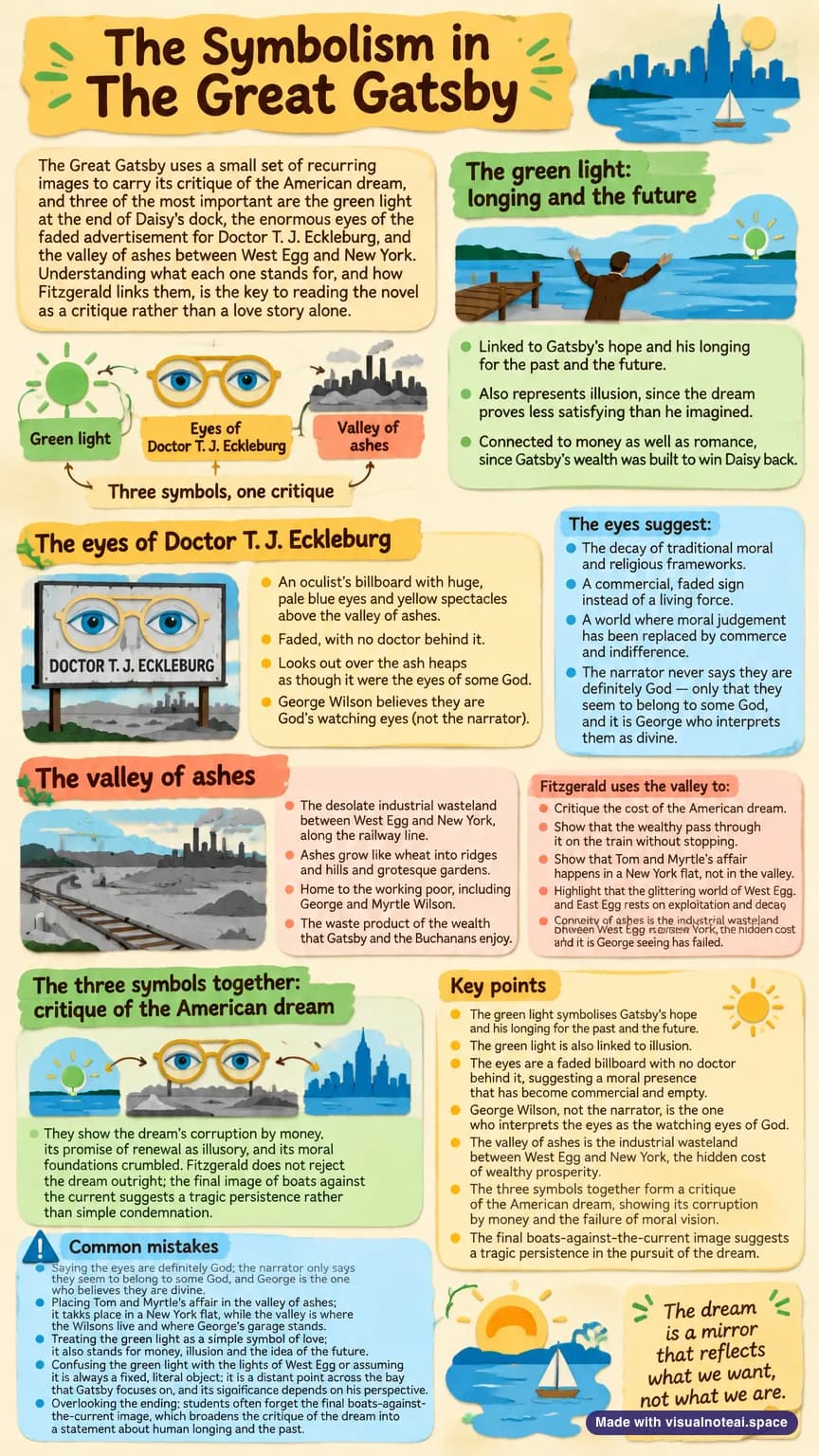
The whole topic on one page. Made with VisualNote.
★What to remember
- The green light at the end of Daisy's dock symbolises Gatsby's hope and his longing for the past and the future.
- The green light is also linked to illusion, since Gatsby's dream proves less satisfying than he imagined when he reaches it.
- The eyes of Doctor T. J. Eckleburg are a faded billboard with no doctor behind it, suggesting a moral presence that has become commercial and empty.
- George Wilson, not the narrator, is the character who interprets the eyes as the watching eyes of God.
- The valley of ashes is the industrial wasteland between West Egg and New York, the hidden cost of wealthy prosperity.
- The three symbols together form a critique of the American dream, showing its corruption by money and the failure of moral vision.
- Fitzgerald's final image of boats against the current suggests a tragic persistence in the pursuit of the dream rather than simple rejection of it.
🎧Listen1:47 · transcript
AnnaMarco, I want to start with the green light. Most people see it as a love symbol. Is that too simple?
MarcoI think so. The source says it stands for Gatsby's hope and his longing for the past and the future. But it also ties into money, because his wealth was built to win Daisy back.
AnnaRight, so the light is a dream that depends on material success as much as romance. Does it change meaning across the novel?
MarcoYes. When Gatsby finally reaches Daisy, the dream turns out smaller than he imagined. The light itself never changes, but its meaning moves from hope to disappointment.
AnnaThat's a good point. Now the eyes. The billboard has no doctor behind it, so who actually sees God in those eyes?
MarcoGeorge Wilson. Nick only presents them as a faded advertisement. George is the one who interprets them as divine, after he discovers Myrtle's affair.
AnnaSo the moral presence is real in the characters' minds but empty in fact. Does that connect to the valley of ashes?
MarcoAbsolutely. Both sit above the lives of the poor. The eyes watch over the valley, and the valley shows the waste that wealth leaves behind.
AnnaAnd the wealthy characters pass through the valley on their way to the city. Nobody there is really seeing it.
MarcoExactly. That's the critique. Moral seeing has failed, and those who suffer most are the least visible to those who benefit.
AnnaSo what do the three images say about the American dream overall? Is Fitzgerald rejecting it?
MarcoNot outright. The ending, with boats against the current, suggests a tragic persistence. The dream is corrupted by money, but people keep striving toward it anyway.
AnnaThat feels like the right note to end on, Marco. The dream is corrupted, yet still felt.
MarcoAgreed, Anna. Thanks for the conversation.
Study in Paper · The Symbolism in The Great GatsbyWatch on YouTube
!Common mistakes
- Saying that the eyes of Doctor T. J. Eckleburg are definitely God; the narrator presents them only as a faded advertisement, and George is the one who believes they are divine.
- Placing Tom and Myrtle's affair in the valley of ashes; their meetings take place in a New York flat, while the valley is where the Wilsons live and where George's garage stands.
- Treating the green light as a simple symbol of love; it also stands for money, illusion and the idea of the future, and it changes meaning as the novel progresses.
- Confusing the green light with the lights of West Egg or assuming it is always a fixed, literal object; it is a distant point across the bay that Gatsby focuses on, and its significance depends on his perspective.
- Overlooking the ending; students often forget the final boats-against-the-current image, which broadens the critique of the dream into a statement about human longing and the past.
🧠Explore the map29 ideas
The mind map VisualNote made for this topic. Drag to pan, scroll to zoom.
- Symbolism in The Great Gatsby
- Green light
- Longing and the future
- Gatsby's hope for Daisy
- Recover the past
- Dutch sailors and the New World dream
- Illusion
- Hope turns to disappointment
- Desire greater than its object
- Linked to money
- Wealth built to win Daisy
- Longing and the future
- Eyes of Doctor T. J. Eckleburg
- Faded billboard, no doctor
- Moral presence without authority
- George Wilson interprets them as God
- Decay of moral frameworks
- Commerce replaces morality
- Valley of ashes
- Industrial wasteland
- Home of the working poor
- George and Myrtle Wilson
- Cost of the American dream
- Wealthy pass through without seeing
- Prosperity rests on exploitation
- Critique of the American dream
- Dream corrupted by money
- Illusory promise of renewal
- Boats against the current ending
- Tragic persistence, not rejection
- Green light
🃏Flashcards14 cards
- What does the green light at the end of Daisy's dock symbolise?
- Gatsby's hope, his longing for Daisy and the past, and his yearning for the future.
- Why is the green light also linked to illusion?
- It is a distant point Gatsby can never truly grasp, and when he reaches Daisy the dream proves less satisfying than he imagined.
- How is the green light connected to money?
- Gatsby built his wealth to win Daisy back, so the light represents a dream dependent on material success as well as love.
- What is Doctor T. J. Eckleburg?
- A faded oculist's billboard showing huge pale blue eyes in yellow spectacles, with no doctor behind it, placed above the valley of ashes.
- What do the eyes of Doctor T. J. Eckleburg suggest?
- A moral presence that has become commercial and empty, suggesting that traditional moral and religious frameworks have decayed.
- Who interprets the eyes as the eyes of God?
- George Wilson, who believes God has seen what Myrtle has done; the narrator presents them only as a faded advertisement.
- What is the valley of ashes?
- A desolate industrial wasteland between West Egg and New York City, where the working poor live and the waste of wealthy prosperity accumulates.
- Where does Tom and Myrtle's affair take place?
- In a flat in New York City, not in the valley of ashes itself, though the Wilsons' garage is located there.
- What does the valley of ashes reveal about the American dream?
- That the glittering world of West Egg and East Egg rests on exploitation and decay, with the poor paying the cost of wealth.
- What do the three symbols together critique?
- The American dream as Fitzgerald saw it in the 1920s, showing it corrupted by money, its promise of renewal illusory, and its moral foundations crumbled.
- Who is Gatsby, in terms of the American dream?
- A man who reinvented himself from James Gatz of North Dakota into a wealthy man in order to win Daisy, embodying the belief in self-invention.
- What does the final image of boats against the current suggest?
- A tragic persistence in humanity's endless striving forward while being borne back into the past, rather than simple condemnation of the dream.
- What does the eyes-and-valley pairing show about moral vision?
- Both sit above the lives of the poor, showing a world where moral seeing has failed and those who suffer most are least visible.
- How does the green light change meaning across the novel?
- It moves from hope to disappointment without changing its physical form, showing that desire is more powerful than its object.
✅Test yourself5 questions
What does the green light at the end of Daisy's dock most directly symbolise for Gatsby?
Nick reads the light as a symbol of Gatsby's hope and his yearning for Daisy, which is the longing the light stands for throughout the novel.
Why does George Wilson come to believe the eyes of Doctor T. J. Eckleburg belong to God?
George interprets the faded eyes as a divine witness to Myrtle's affair, while Nick presents them only as a faded advertisement.
What does the valley of ashes represent in the novel?
The valley is the physical result of the wealth enjoyed by the eastern elite, and its grey, lifeless landscape exposes the cost of their prosperity.
Why does the green light also function as a symbol of illusion?
The light is a distant point Gatsby cannot grasp, and when he finally reaches Daisy the dream proves less than he imagined.
What overall critique of the American dream do the three symbols reinforce together?
Taken together, the light, the eyes and the valley suggest the dream has been corrupted by money, its promise of renewal is illusory, and its moral basis has decayed.
📝The notes
The green light: longing and the future
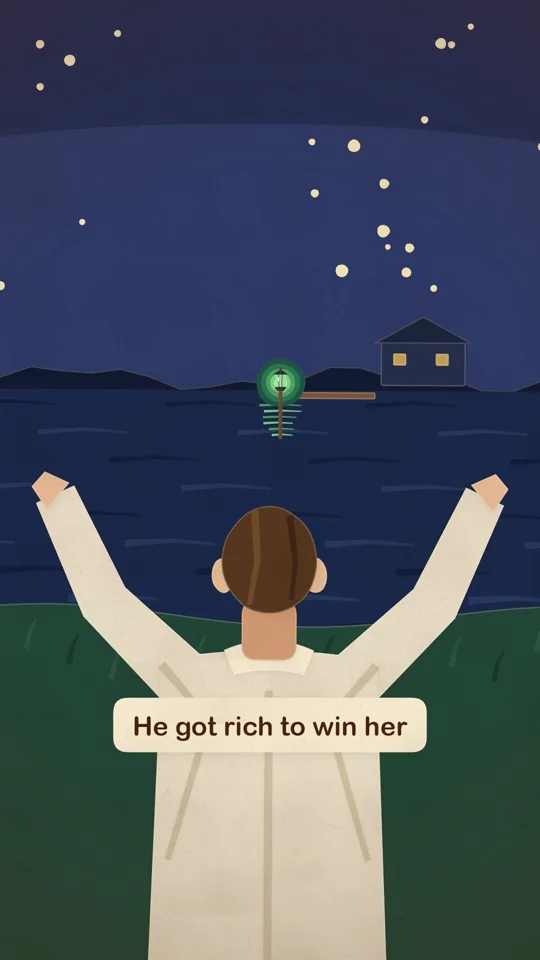
The green light appears at the end of the dock belonging to Daisy Buchanan's house across the bay from Gatsby's mansion. Gatsby stretches his arms towards it at the end of Chapter 1, and Nick Carraway, the narrator, notes that it seemed to him a symbol of Gatsby's hope and his yearning for Daisy. Fitzgerald ties the light to the idea of the future, since Gatsby believes that if he reaches it he can recover the past. In the closing paragraphs Nick describes the Dutch sailors who first saw the New World and were held spellbound by its promise, a passage that turns the green light into a symbol of the wonder and the dream that drew Americans westward.
The light is also a symbol of illusion. It is a distant point that Gatsby keeps focusing on, but it is never something he can actually grasp. When he finally reaches Daisy in the novel, the dream proves less than he imagined, which is part of Fitzgerald's point: the desire is more powerful than its object. The light's meaning therefore moves from hope to disappointment without changing its physical form.
Students should note that the green light is linked to money as well as romance. Gatsby's wealth was built to win Daisy back, so the light represents a dream that depends on material success as much as on love.
The eyes of Doctor T. J. Eckleburg
Doctor T. J. Eckleburg is an oculist's billboard, showing a pair of huge, pale blue eyes wearing yellow spectacles, placed above the valley of ashes. The sign has faded and has no doctor behind it, and Nick describes the eyes as brooding on over the solemn dumping ground. George Wilson, whose garage sits in the valley, comes to believe that God has seen what Myrtle has done. The eyes therefore represent a moral presence that watches the characters, though it is a presence without real authority.
Fitzgerald uses the eyes to suggest that the traditional moral and religious frameworks of America have decayed. The billboard is commercial, a piece of advertising, and its God is a faded sign rather than a living force. The fact that the eyes watch over a place of poverty and waste, and that they seem to witness every crime but do nothing, reinforces the novel's sense that moral judgement has been replaced by commerce and indifference.
It is worth remembering that the eyes are never explicitly named as God by the narrator. Nick presents them only as a faded advertisement, and it is George who interprets them as divine. Students should be precise about who holds this belief and about what the text actually says.
The valley of ashes
The valley of ashes is the desolate industrial wasteland lying between West Egg and New York City, along the railway line. Nick describes it as a fantastic farm where ashes grow like wheat into ridges and hills and grotesque gardens, with men moving through it like grey dust. It is the place where the working poor live, including George and Myrtle Wilson, and it is the physical result of the wealth that the eastern elite enjoy. The ashes are the waste product of the prosperity that Gatsby and the Buchanans represent.
Fitzgerald uses the valley as a critique of the cost of the American dream. The wealthy characters pass through it on their way to the city and stop only for their own purposes, and Tom's affair with Myrtle takes place in a flat in New York, not in the valley itself, though the Wilsons' garage is there. The valley shows that the glittering world of West Egg and East Egg rests on exploitation and decay. Its grey, lifeless landscape stands in stark contrast to the bright promises of the green light.
The valley also connects to the eyes. Both sit above and around the lives of the poor, and both show a world in which moral seeing has failed. Together they present a picture of an America where the dream of prosperity produces waste and where those who suffer most are least visible to those who benefit.
The three symbols together: critique of the American dream
Read together, the green light, the eyes and the valley form a sustained critique of the American dream as Fitzgerald saw it in the 1920s. The green light represents the dream of self-invention and the pursuit of an idealised future, the belief that a person can remake themselves and recapture the past through effort and money. Gatsby embodies this belief, having built himself from James Gatz of North Dakota into a wealthy man in order to win Daisy.
The valley of ashes shows what that pursuit costs and who pays for it. The eyes show that moral vision has been reduced to advertising and that no authority remains to judge the characters. Between them, the three images suggest that the dream has been corrupted by money, that its promise of renewal is illusory, and that its moral foundations have crumbled. Fitzgerald does not reject the dream outright; the final image of boats against the current, which Nick uses to describe our endless striving forward while being borne back into the past, suggests a tragic persistence rather than simple condemnation.
When revising, students should try to connect each symbol to a specific theme such as wealth, class, time, morality or illusion, and to show how the symbols reinforce one another across the novel.
Make this for your own notes
Paste a chapter or a PDF and get the sheet, map, cards, quiz and episode back in about a minute. No credit card.