
Waves can be classified in two different ways: by the direction in which particles or fields oscillate, and by whether the wave needs a material medium to travel. These classifications describe different features, so a wave can be both mechanical and transverse, for example.
★What to remember
- Transverse oscillations are perpendicular to the direction of wave travel.
- Longitudinal oscillations are parallel to the direction of wave travel.
- Compressions and rarefactions are features of longitudinal waves.
- Mechanical waves need a material medium and cannot travel through a vacuum.
- Electromagnetic waves can travel through a vacuum and are transverse there.
- Mechanical and electromagnetic describe what carries a wave, while transverse and longitudinal describe the direction of oscillation.
- Sound in air is a mechanical longitudinal wave, while light in a vacuum is an electromagnetic transverse wave.
🎧Listen3:01 · transcript
AnnaWhen people classify waves, they sometimes treat “transverse” and “mechanical” as competing labels. Are they?
MarcoNo. They describe different things. Transverse and longitudinal tell us the direction of oscillation compared with the wave’s travel. Mechanical and electromagnetic tell us what carries the wave, and whether it needs a material medium.
AnnaSo a wave can have one label from each pair. What makes a wave transverse?
MarcoIts oscillations are perpendicular to its direction of travel. Imagine a wave moving horizontally along a rope. Points on the rope move up and down, at right angles to the wave’s progress.
AnnaAnd if the motion is along the same line as the wave’s travel, that’s longitudinal?
MarcoExactly. The particles move back and forth parallel to the direction the wave travels. Sound moving through air is a familiar example. Air particles form compressions, where they’re close together, and rarefactions, where they’re farther apart.
AnnaDo those air particles move all the way along with the sound?
MarcoNot over a long distance. They mainly vibrate back and forth around their positions. The compressions and rarefactions move through the air, passing the disturbance along.
AnnaThat sounds like the role of a medium. What counts as a mechanical wave?
MarcoA disturbance that travels through material, such as a solid, liquid, or gas. Parts of the medium interact to carry it along. Without material, there’s no medium to pass the disturbance, so a mechanical wave cannot travel through a vacuum.
AnnaWhich means sound can’t travel through a vacuum. But mechanical doesn’t tell us whether the motion is transverse or longitudinal, right?
MarcoRight. Sound in air is mechanical and longitudinal. A wave along a stretched rope is mechanical and transverse. The motion of the medium determines which direction label fits.
AnnaThen what carries an electromagnetic wave?
MarcoChanging electric and magnetic fields. An electromagnetic wave doesn’t need a material medium, so it can travel through a vacuum. Light, radio waves, microwaves, and X-rays are examples.
AnnaAnd in a vacuum, those waves are transverse?
MarcoYes. Their electric and magnetic fields oscillate perpendicular to the direction of travel. That field motion is not the movement of material particles.
AnnaWhat about a diagram? If I see crests and troughs, can I just call it transverse?
MarcoNot without checking. First identify the direction the wave pattern travels. Then look for the medium’s motion or the fields’ oscillation. Motion at right angles means transverse; motion along the direction of travel means longitudinal. A wave shape by itself may not show that motion, so check the labels or description.
AnnaAnd to distinguish mechanical from electromagnetic, ask whether matter is needed?
MarcoThat’s the key question. If the wave needs material to carry it, it’s mechanical. If it can travel through a vacuum as changing electric and magnetic fields, it’s electromagnetic. Keep the two classifications separate, and you avoid assuming that every wave with crests and troughs is transverse, or that every wave carrying energy is mechanical.
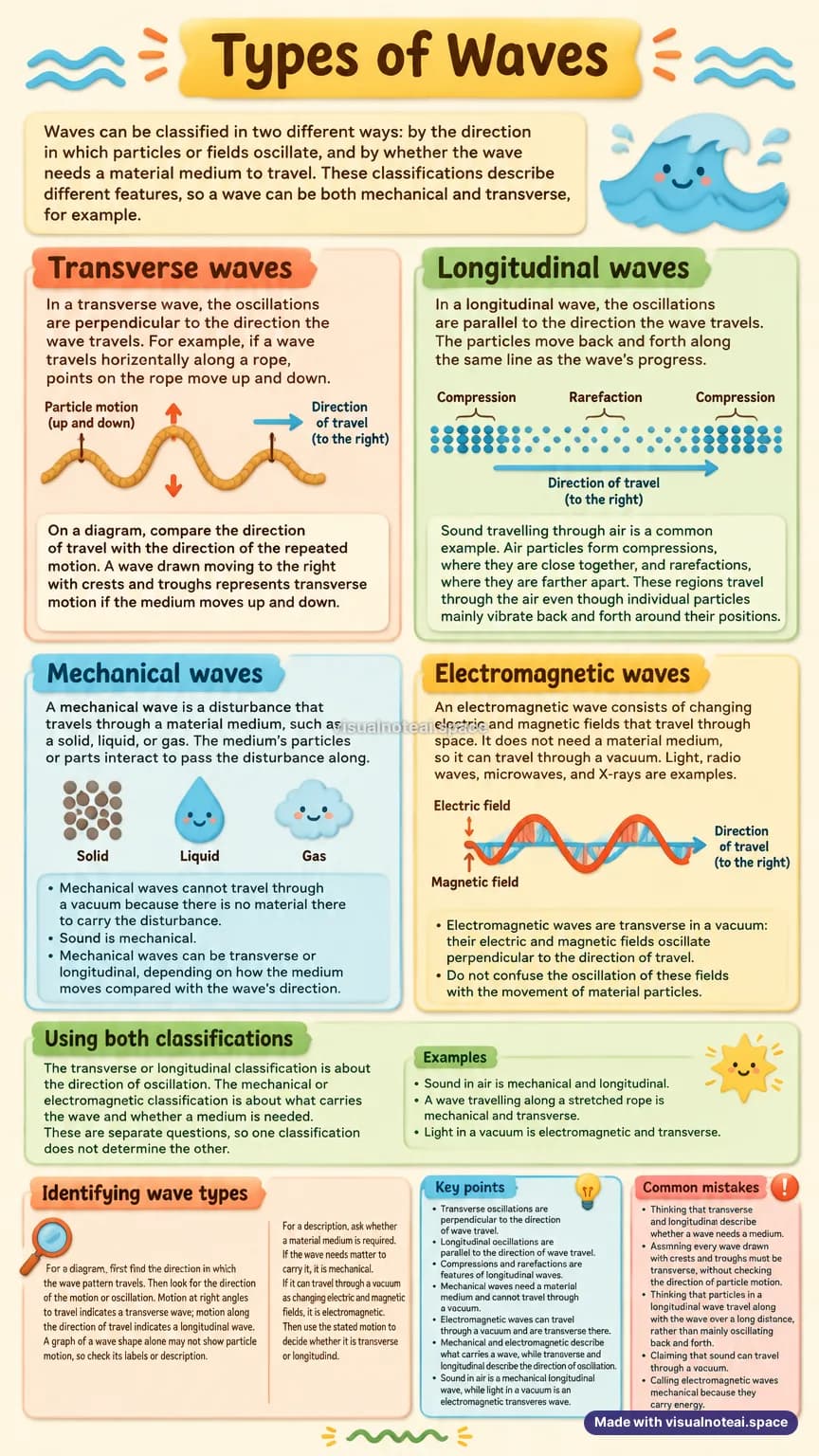
The whole topic on one page. Made with VisualNote.
!Common mistakes
- Thinking that transverse and longitudinal describe whether a wave needs a medium.
- Assuming every wave drawn with crests and troughs must be transverse, without checking the direction of particle motion.
- Thinking that particles in a longitudinal wave travel along with the wave over a long distance, rather than mainly oscillating back and forth.
- Claiming that sound can travel through a vacuum.
- Calling electromagnetic waves mechanical because they carry energy.
🧠Explore the map36 ideas
The mind map VisualNote made for this topic. Drag to pan, scroll to zoom.
- Types of Waves
- Oscillation Direction
- Transverse Waves
- Oscillations perpendicular to travel
- Rope wave: medium moves up and down
- Longitudinal Waves
- Oscillations parallel to travel
- Compressions and rarefactions
- Particles vibrate around their positions
- Transverse Waves
- Wave-Carrying Mechanism
- Mechanical Waves
- Require a material medium
- Cannot travel through a vacuum
- Can be transverse or longitudinal
- Electromagnetic Waves
- Changing electric and magnetic fields
- Can travel through a vacuum
- Transverse in a vacuum
- Examples: light, radio, microwaves, X-rays
- Mechanical Waves
- Examples and Classifications
- Sound in air: mechanical and longitudinal
- Light in a vacuum: electromagnetic and transverse
- Rope wave: mechanical and transverse
- Identifying Wave Types
- Find the direction of wave travel
- Compare oscillation direction with travel
- Right-angle motion: transverse
- Along-travel motion: longitudinal
- Check whether a material medium is required
- Check diagram labels; shape alone may not show particle motion
- Common Misconceptions
- The two classifications describe separate features
- Crests and troughs alone do not prove transverse motion
- Longitudinal particles do not travel with the wave
- Sound cannot travel through a vacuum
- Carrying energy does not make a wave mechanical
- Oscillation Direction
🃏Flashcards12 cards
- What are the two ways waves are classified?
- By the direction of oscillation (transverse or longitudinal) and by what carries the wave (mechanical or electromagnetic). These are separate classifications.
- What is a transverse wave?
- A wave in which the oscillations are perpendicular to the direction of travel.
- What is a longitudinal wave?
- A wave in which the oscillations are parallel to the direction of travel.
- What are compressions and rarefactions?
- Compressions are regions where particles are close together; rarefactions are regions where particles are farther apart. They occur in longitudinal waves.
- Do particles in a longitudinal wave travel along with the wave?
- No. They mainly oscillate back and forth around their positions while the disturbance travels through the medium.
- What is a mechanical wave?
- A disturbance that travels through a material medium, such as a solid, liquid, or gas, as parts of the medium interact to pass it along.
- Can mechanical waves travel through a vacuum?
- No. A mechanical wave requires matter to carry the disturbance.
- What is an electromagnetic wave?
- A wave consisting of changing electric and magnetic fields that does not require a material medium and can travel through a vacuum.
- How do electromagnetic waves oscillate in a vacuum?
- Their electric and magnetic fields oscillate perpendicular to the direction of travel, so they are transverse.
- What type of wave is sound in air?
- Sound in air is a mechanical longitudinal wave: it needs air as a medium and travels through compressions and rarefactions.
- What type of wave is light in a vacuum?
- Light in a vacuum is an electromagnetic transverse wave.
- How can you identify a wave type from a diagram or description?
- Compare oscillation direction with travel direction: perpendicular means transverse, parallel means longitudinal. Then check whether the wave needs a material medium: if so it is mechanical; if it can travel through a vacuum as changing fields, it is electromagnetic.
✅Test yourself5 questions
A wave travels horizontally along a rope while the rope moves up and down. How is the wave classified by its oscillation direction?
The rope moves at right angles to the direction the wave travels, which defines a transverse wave.
As sound travels through air, how do the air particles mainly move?
Sound in air is longitudinal, so its particles oscillate back and forth parallel to the wave's travel.
Why can a mechanical wave not travel through a vacuum?
A mechanical wave passes a disturbance through interacting parts of a material medium, which a vacuum lacks.
Which statement correctly describes the relationship between the two ways of classifying waves?
Mechanical or electromagnetic describes what carries a wave, while transverse or longitudinal describes its oscillation direction.
Which statement about light travelling through a vacuum is correct?
Light can travel through a vacuum as an electromagnetic wave, and electromagnetic waves are transverse there.
📝The notes
Transverse waves
In a transverse wave, the oscillations are perpendicular to the direction the wave travels. For example, if a wave travels horizontally along a rope, points on the rope move up and down.
On a diagram, compare the direction of travel with the direction of the repeated motion. A wave drawn moving to the right with crests and troughs represents transverse motion if the medium moves up and down.
Longitudinal waves
In a longitudinal wave, the oscillations are parallel to the direction the wave travels. The particles move back and forth along the same line as the wave's progress.
Sound travelling through air is a common example. Air particles form compressions, where they are close together, and rarefactions, where they are farther apart. These regions travel through the air even though individual particles mainly vibrate back and forth around their positions.
Mechanical waves
A mechanical wave is a disturbance that travels through a material medium, such as a solid, liquid, or gas. The medium's particles or parts interact to pass the disturbance along.
Mechanical waves cannot travel through a vacuum because there is no material there to carry the disturbance. Sound is mechanical. Mechanical waves can be transverse or longitudinal, depending on how the medium moves compared with the wave's direction.
Electromagnetic waves
An electromagnetic wave consists of changing electric and magnetic fields that travel through space. It does not need a material medium, so it can travel through a vacuum. Light, radio waves, microwaves, and X-rays are examples.
Electromagnetic waves are transverse in a vacuum: their electric and magnetic fields oscillate perpendicular to the direction of travel. Do not confuse the oscillation of these fields with the movement of material particles.
Using both classifications
The transverse or longitudinal classification is about the direction of oscillation. The mechanical or electromagnetic classification is about what carries the wave and whether a medium is needed. These are separate questions, so one classification does not determine the other.
For example, sound in air is mechanical and longitudinal. A wave travelling along a stretched rope is mechanical and transverse. Light in a vacuum is electromagnetic and transverse.
Identifying wave types
For a diagram, first find the direction in which the wave pattern travels. Then look for the direction of the motion or oscillation. Motion at right angles to travel indicates a transverse wave; motion along the direction of travel indicates a longitudinal wave. A graph of a wave shape alone may not show particle motion, so check its labels or description.
For a description, ask whether a material medium is required. If the wave needs matter to carry it, it is mechanical. If it can travel through a vacuum as changing electric and magnetic fields, it is electromagnetic. Then use the stated motion to decide whether it is transverse or longitudinal.
Make this for your own notes
Paste a chapter or a PDF and get the sheet, map, cards, quiz and episode back in about a minute. No credit card.