
The wave speed equation links a wave’s speed to its frequency and wavelength. Use v = fλ to calculate one of these quantities when you know the other two, taking care to use consistent units.
★What to remember
- Wave speed is given by v = fλ.
- Frequency is measured in hertz, and wavelength is measured in metres.
- Wave speed is usually measured in metres per second.
- At a fixed speed, increasing frequency decreases wavelength.
- Use f = v/λ to find frequency and λ = v/f to find wavelength.
- Sound speed depends on the medium and conditions.
- Light in a vacuum travels at approximately 3.00 × 10⁸ m/s.
- When a wave enters a new medium, its frequency stays the same but its speed and wavelength may change.
🎧Listen3:13 · transcript
AnnaLet’s start with the basic question. What does the wave speed equation tell us?
MarcoIt connects three things: wave speed, frequency, and wavelength. In words, wave speed equals frequency multiplied by wavelength. Frequency tells us how many complete waves pass a point each second. Wavelength is the distance between matching points on neighbouring waves, like crest to crest.
AnnaSo if I know any two of those, I can work out the third?
MarcoExactly. The usual form is v equals f times lambda. Speed is usually in metres per second, frequency in hertz, and wavelength in metres. The units matter, so we need to make them consistent before calculating.
AnnaLet’s make that concrete. If the frequency is five hertz and the wavelength is two metres, what do we get?
MarcoMultiply five by two, and the speed is ten metres per second. If you wanted frequency instead, divide speed by wavelength. For wavelength, divide speed by frequency. One useful units check is that metres per second divided by hertz gives metres, since one hertz means one per second.
AnnaPeople sometimes hear “higher frequency” and assume that means a faster wave. Is that always right?
MarcoNo. For a wave travelling at a fixed speed in the same medium, frequency and wavelength move in opposite directions. Raise the frequency, and the wavelength gets shorter. Lower the frequency, and it gets longer. Their product still equals the speed. The speed depends on the medium and the type of wave, not on frequency alone.
AnnaAnd what happens if the wave crosses into a different medium?
MarcoIts frequency stays the same at the boundary, but its speed can change. The wavelength then changes to fit that new speed. That’s why we shouldn’t assume a wave keeps the same speed everywhere.
AnnaLet’s try the sound example. A sound wave in air has a frequency of four hundred forty hertz and a wavelength of zero point seven eight metres. How do we find its speed?
MarcoMultiply four hundred forty by zero point seven eight. That gives three hundred forty-three point two metres per second, or about three hundred forty-three metres per second to an appropriate number of significant figures. If we instead know the speed is three hundred forty-three metres per second and the frequency is five hundred hertz, dividing gives a wavelength of zero point six eight six metres.
AnnaWhat about light? The vacuum speed can look intimidating in scientific notation.
MarcoIt’s approximately three point zero zero times ten to the eighth metres per second. With a frequency of six point zero zero times ten to the fourteenth hertz, wavelength equals speed divided by frequency. The result is five point zero zero times ten to the minus seventh metres, which is five hundred nanometres. That’s in the visible range. But that vacuum speed applies only in a vacuum. Light travels more slowly in materials such as glass.
AnnaSo what’s the reliable routine when we face a problem?
MarcoWrite down what’s given, identify what you need, choose the equation or rearrange it, substitute, then calculate with units. Convert first if needed. For example, centimetres must become metres when you need speed in metres per second. And remember: multiply frequency and wavelength, don’t add them. If the answer needs a different unit, convert it before you finish.
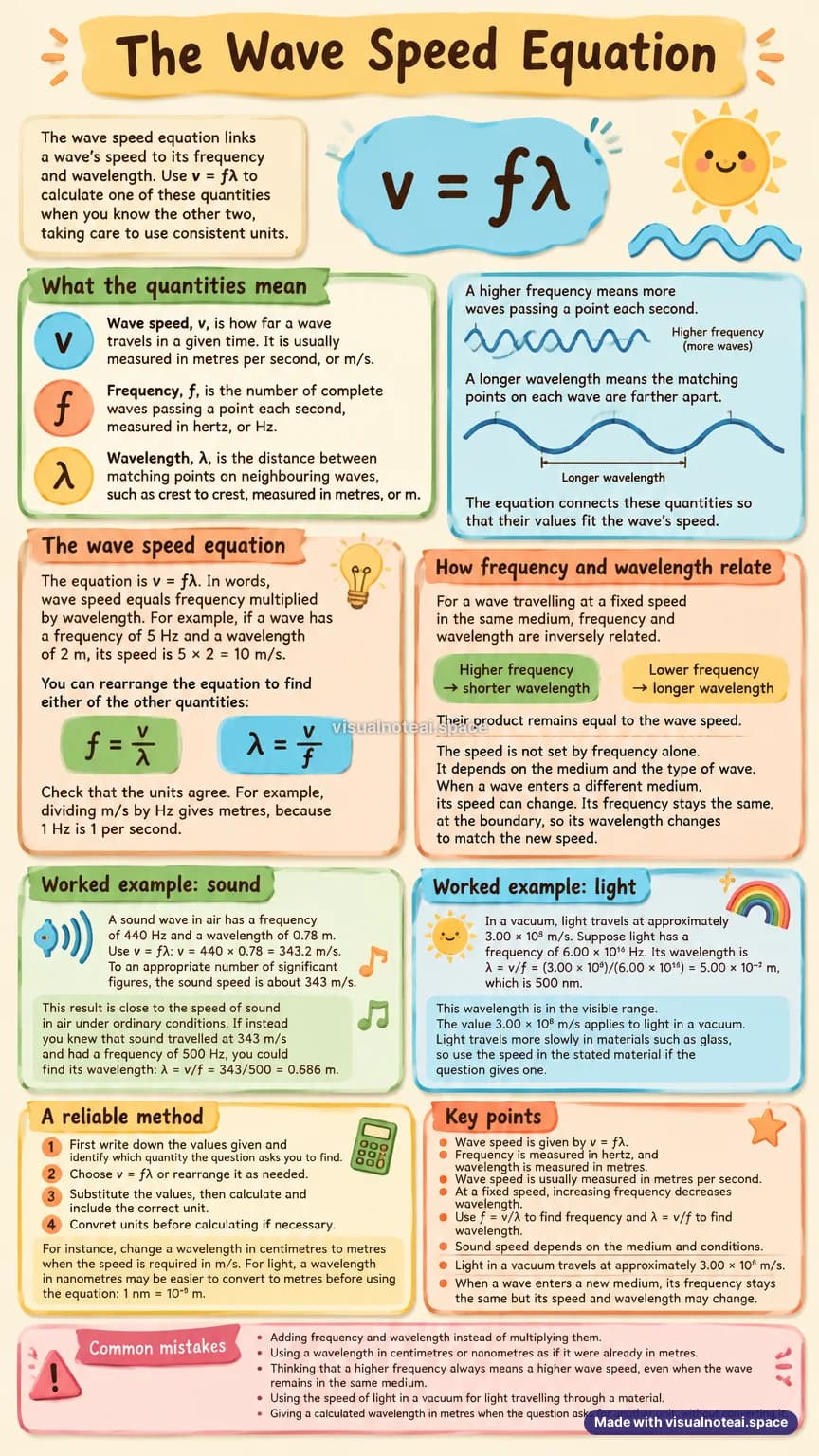
The whole topic on one page. Made with VisualNote.
!Common mistakes
- Adding frequency and wavelength instead of multiplying them.
- Using a wavelength in centimetres or nanometres as if it were already in metres.
- Thinking that a higher frequency always means a higher wave speed, even when the wave remains in the same medium.
- Using the speed of light in a vacuum for light travelling through a material.
- Giving a calculated wavelength in metres when the question asks for another unit, without converting it.
🧠Explore the map32 ideas
The mind map VisualNote made for this topic. Drag to pan, scroll to zoom.
- Wave Speed Equation
- Quantities and Units
- Wave speed (v)
- Distance travelled per time; metres per second (m/s)
- Frequency (f)
- Complete waves passing per second; hertz (Hz)
- Wavelength (λ)
- Distance between matching points; metres (m)
- Wave speed (v)
- Equation and Rearrangements
- Wave speed equals frequency times wavelength
- v = fλ
- f = v/λ
- λ = v/f
- Consistent units required
- Wave speed equals frequency times wavelength
- Frequency and Wavelength Relationship
- At fixed speed, frequency and wavelength are inversely related
- Higher frequency means shorter wavelength
- Their product remains equal to wave speed
- Medium and Wave Examples
- Wave speed depends on medium and wave type
- At a boundary, frequency stays constant; speed and wavelength may change
- Sound in air: 440 Hz × 0.78 m ≈ 343 m/s
- Light in vacuum: approximately 3.00 × 10⁸ m/s
- Light at 6.00 × 10¹⁴ Hz: wavelength 500 nm
- Calculation Method and Common Errors
- List known values and identify the unknown
- Choose the equation, substitute values, calculate with units
- Convert centimetres or nanometres to metres when needed
- Multiply frequency and wavelength; do not add them
- Do not assume higher frequency always means higher speed
- Use the material's light speed, not vacuum speed
- Convert the final result to the requested unit
- Quantities and Units
🃏Flashcards12 cards
- What is the wave speed equation?
- Wave speed equals frequency multiplied by wavelength: v = fλ.
- What does wave speed (v) measure, and what is its usual unit?
- It measures how far a wave travels per unit time. Its usual unit is metres per second (m/s).
- What is frequency (f), and what is its unit?
- Frequency is the number of complete waves passing a point each second. It is measured in hertz (Hz).
- What is wavelength (λ), and what is its usual unit?
- Wavelength is the distance between matching points on neighbouring waves, such as crest to crest. It is usually measured in metres (m).
- How can you rearrange v = fλ to find frequency or wavelength?
- Use f = v/λ to find frequency and λ = v/f to find wavelength.
- A wave has frequency 5 Hz and wavelength 2 m. What is its speed?
- v = fλ = 5 × 2 = 10 m/s.
- How are frequency and wavelength related when wave speed is fixed?
- They are inversely related: increasing frequency decreases wavelength, and decreasing frequency increases wavelength. Their product remains equal to the wave speed.
- What happens when a wave enters a different medium?
- Its speed may change, while its frequency stays the same at the boundary. Its wavelength changes to match the new speed.
- A sound wave has frequency 440 Hz and wavelength 0.78 m. What is its approximate speed?
- v = 440 × 0.78 = 343.2 m/s, or about 343 m/s to an appropriate number of significant figures.
- Sound travels at 343 m/s and has frequency 500 Hz. What is its wavelength?
- λ = v/f = 343/500 = 0.686 m.
- What wavelength corresponds to light in a vacuum at 6.00 × 10¹⁴ Hz? Use 3.00 × 10⁸ m/s for its speed.
- λ = v/f = 5.00 × 10⁻⁷ m, which is 500 nm and lies in the visible range.
- What unit and medium checks are important when using v = fλ?
- Use consistent units, converting wavelengths such as centimetres or nanometres to metres when needed. Use the wave speed for the stated medium; 3.00 × 10⁸ m/s applies to light in a vacuum, not materials such as glass.
✅Test yourself5 questions
A wave has a frequency of 5 Hz and a wavelength of 2 m. What is its speed?
Wave speed equals frequency multiplied by wavelength, so 5 × 2 = 10 m/s.
A wave travels at 24 m/s and has a wavelength of 3 m. What is its frequency?
Rearranging v = fλ gives f = v/λ, so 24/3 = 8 Hz.
A wave continues travelling at the same speed in the same medium. If its frequency doubles, what happens to its wavelength?
At fixed speed, frequency and wavelength are inversely related, so doubling frequency halves wavelength.
A wave enters a different medium, where its speed changes. Which quantity remains the same at the boundary?
A wave’s frequency stays the same at a boundary, while its speed and wavelength may change.
A wave has a frequency of 4 Hz and a wavelength of 50 cm. What is its speed in m/s?
Convert 50 cm to 0.50 m, then calculate v = 4 × 0.50 = 2 m/s.
📝The notes
What the quantities mean
Wave speed, v, is how far a wave travels in a given time. It is usually measured in metres per second, or m/s. Frequency, f, is the number of complete waves passing a point each second, measured in hertz, or Hz. Wavelength, λ, is the distance between matching points on neighbouring waves, such as crest to crest, measured in metres, or m.
A wave with a higher frequency has more waves passing a point each second. A longer wavelength means the matching points on each wave are farther apart. The equation connects these quantities so that their values fit the wave’s speed.
The wave speed equation
The equation is v = fλ. In words, wave speed equals frequency multiplied by wavelength. For example, if a wave has a frequency of 5 Hz and a wavelength of 2 m, its speed is 5 × 2 = 10 m/s.
You can rearrange the equation to find either of the other quantities: f = v/λ and λ = v/f. Check that the units agree. For example, dividing m/s by Hz gives metres, because 1 Hz is 1 per second.
How frequency and wavelength relate
For a wave travelling at a fixed speed in the same medium, frequency and wavelength are inversely related. If the frequency increases, the wavelength must decrease; if the frequency decreases, the wavelength must increase. Their product remains equal to the wave speed.
The speed is not set by frequency alone. It depends on the medium and the type of wave. When a wave enters a different medium, its speed can change. Its frequency stays the same at the boundary, so its wavelength changes to match the new speed.
Worked example: sound
A sound wave in air has a frequency of 440 Hz and a wavelength of 0.78 m. Use v = fλ: v = 440 × 0.78 = 343.2 m/s. To an appropriate number of significant figures, the sound speed is about 343 m/s.
This result is close to the speed of sound in air under ordinary conditions. If instead you knew that sound travelled at 343 m/s and had a frequency of 500 Hz, you could find its wavelength: λ = v/f = 343/500 = 0.686 m.
Worked example: light
In a vacuum, light travels at approximately 3.00 × 10⁸ m/s. Suppose light has a frequency of 6.00 × 10¹⁴ Hz. Its wavelength is λ = v/f = (3.00 × 10⁸)/(6.00 × 10¹⁴) = 5.00 × 10⁻⁷ m, which is 500 nm.
This wavelength is in the visible range. The value 3.00 × 10⁸ m/s applies to light in a vacuum. Light travels more slowly in materials such as glass, so use the speed in the stated material if the question gives one.
A reliable method
First write down the values given and identify which quantity the question asks you to find. Choose v = fλ or rearrange it as needed. Substitute the values, then calculate and include the correct unit.
Convert units before calculating if necessary. For instance, change a wavelength in centimetres to metres when the speed is required in m/s. For light, a wavelength in nanometres may be easier to convert to metres before using the equation: 1 nm = 10⁻⁹ m.
Make this for your own notes
Paste a chapter or a PDF and get the sheet, map, cards, quiz and episode back in about a minute. No credit card.