
The Outsiders, S. E. Hinton's 1967 novel, is narrated by fourteen-year-old Ponyboy Curtis, a greaser from the east side of an unnamed Oklahoma city. Its central themes are class conflict between greasers and Socs, and the loyalty and growing up that Ponyboy must learn to understand as the violence around him escalates. Revision should focus on how Ponyboy's narration shapes what the reader sees of both themes.
★What to remember
- The greasers are poor east-side boys, and the Socs are wealthy west-side boys, and the rivalry between them reflects a larger class divide.
- Ponyboy is an honest but partial narrator whose opinion of the Socs changes, most clearly through his conversation with Cherry Valance.
- Loyalty in the novel is shown through the greasers' bonds, especially Johnny's willingness to sacrifice himself for Ponyboy.
- Growing up for Ponyboy means facing death and responsibility early, and his relationship with Darry shifts from resentment to understanding.
- Johnny's request that Ponyboy stay gold, drawn from Frost's poem, is an invitation to keep innocence and goodness despite hardship.
- The church fire and the rumble show that violence costs both sides and does not resolve the underlying inequality.
- Cherry Valance shows that Socs also face pressures, but the novel never denies the advantages the Socs hold because of money.
- The ending does not remove the class divide; it offers personal understanding rather than social change.
🎧Listen2:21 · transcript
AnnaWelcome back. Today we're talking about S. E. Hinton's The Outsiders, the 1967 novel. So Marco, where do you want to start?
MarcoLet's start with the divide. The greasers are poor kids from the east side, and the Socs are rich kids from the west side. Why does the book make that gap so central?
AnnaBecause it isn't only about money. The greasers feel society values them less from the start. When Bob and his friends jump Ponyboy and Johnny, the Socs face no real consequences, but the greasers get treated as criminals.
MarcoRight, and that's what makes it feel unfair. But Cherry Valance complicates things, doesn't she? She's a Soc, and she's more sympathetic than most.
AnnaYes, and that's the interesting part. She admits the Socs have their own pressures, like parents who care about appearances. But she never denies that her side has advantages the greasers lack.
MarcoSo how much should we trust Ponyboy's view of all this? He's fourteen, and he's the narrator.
AnnaThat's the key question. He's honest but partial. At the start he sees the Socs mainly as enemies. Later, through Cherry, he starts to see them as people. You can actually trace that shift through the book.
MarcoThen loyalty must be the other half of the story. Ponyboy, Johnny, Dallas, Two-Bit and Steve form a kind of substitute family.
AnnaExactly, and the loyalty is tied to class. The wider world doesn't protect them, so they have to protect each other. Johnny killing Bob to protect Ponyboy is the clearest example of that.
MarcoAnd growing up runs through all of it. Ponyboy has to face death and responsibility far earlier than boys from wealthier families would.
AnnaHis relationship with Darry shows that well. At first Ponyboy resents how harsh Darry is. By the end he sees what Darry has given up. The night Darry breaks down in tears is a big moment, because the adult who seemed invulnerable turns out to be scared.
MarcoJohnny's request that Ponyboy stay gold seems to sum that up. It's a reference to Frost's poem, right?
AnnaIt is. Nothing gold can stay. Johnny is asking Ponyboy to hold on to his innocence and goodness even after the hard things he's seen.
MarcoSo does the ending solve the class problem?
AnnaNo, and that's important. Ponyboy's realization that the greasers and Socs are not so different underneath is personal. The social inequality is still there at the end. The book offers understanding, not social change.
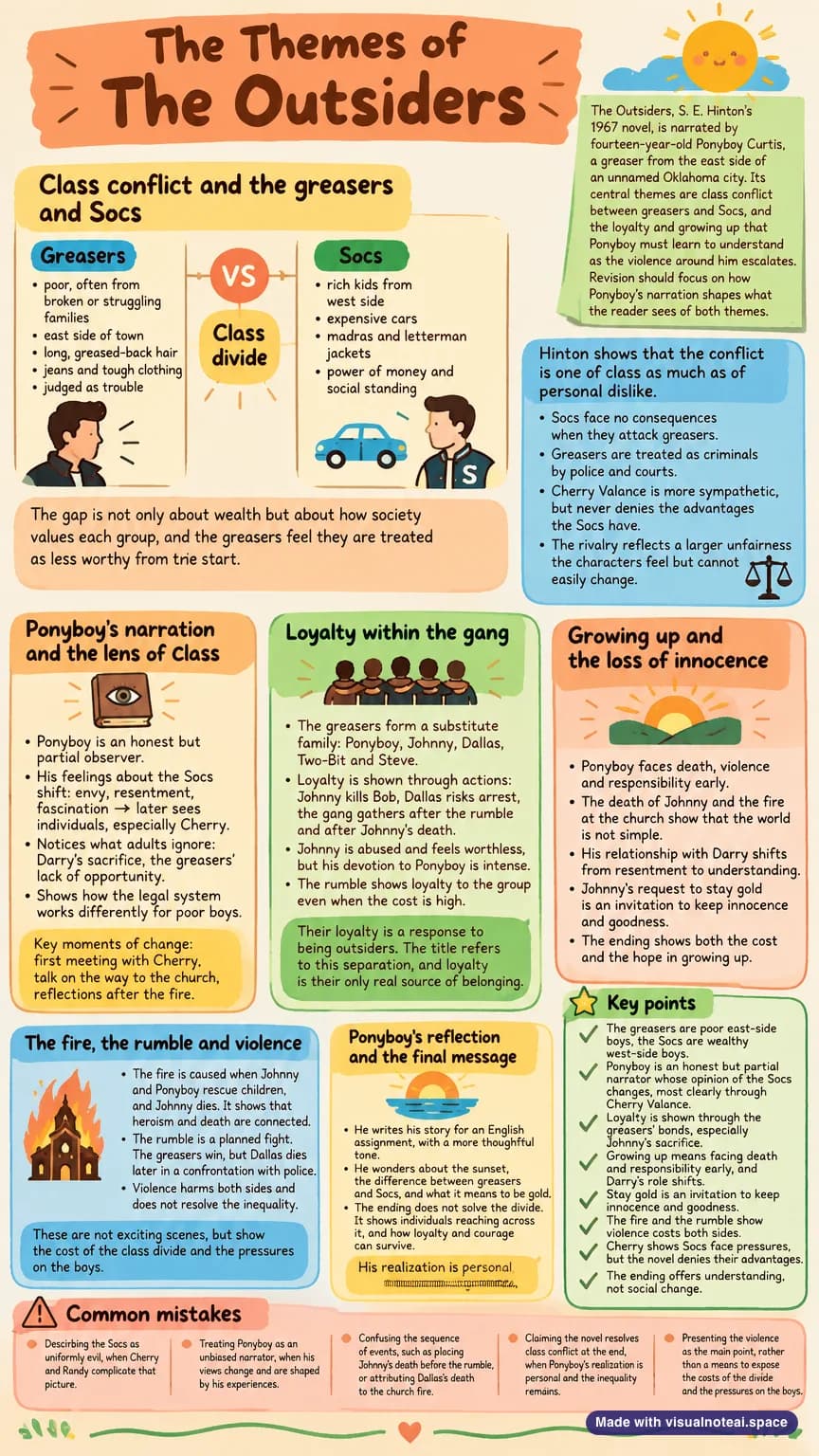
The whole topic on one page. Made with VisualNote.
!Common mistakes
- Describing the Socs as uniformly evil, when Cherry and Randy complicate that picture and the novel asks the reader to see individuals.
- Treating Ponyboy as an unbiased narrator, when his views of the Socs change and his account is shaped by his own experiences and feelings.
- Confusing the sequence of events, such as placing Johnny's death before the rumble, or attributing Dallas's death to the church fire rather than to his later confrontation with police.
- Claiming that the novel resolves class conflict at the end, when Ponyboy's realization is personal and the social inequality remains.
- Presenting the violence as the main point of the book, rather than as a means by which Hinton exposes the costs of the class divide and the pressures on the boys.
🧠Explore the map21 ideas
The mind map VisualNote made for this topic. Drag to pan, scroll to zoom.
- The Outsiders: Themes
- Class conflict
- Greasers: poor east-side boys
- Socs: wealthy west-side boys
- Bob and Randy: Soc cruelty
- Cherry Valance complicates the divide
- Ponyboy's narration
- Honest but partial narrator
- Opinion of Socs shifts
- Key moments with Cherry
- Loyalty
- Greasers as substitute family
- Johnny kills Bob to protect Ponyboy
- Dallas risks arrest to help
- Growing up and loss of innocence
- Ponyboy and Darry relationship
- Johnny's death as turning point
- Stay gold (Frost reference)
- Violence: fire and rumble
- Church fire rescue and Johnny's death
- Rumble: violence settles nothing
- Class conflict
🃏Flashcards13 cards
- Who narrates The Outsiders and how old is he?
- Ponyboy Curtis, a fourteen-year-old greaser from the east side of an unnamed Oklahoma city.
- What is the central class conflict in The Outsiders?
- The rivalry between the poor, east-side greasers and the wealthy, west-side Socs, reflecting a larger social unfairness.
- Who are the Socs?
- Rich kids from the west side of town who drive expensive cars, wear madras and letterman jackets, and hold the power of money and social standing.
- Why do the Socs face no real consequences when they attack the greasers?
- Their families have influence, so police and courts treat the Socs leniently while treating the greasers as criminals.
- How does Ponyboy's opinion of the Socs change?
- He moves from seeing them mainly as enemies to seeing individuals as people, most clearly through Cherry Valance.
- How is loyalty shown in the novel?
- Through the bonds among the greasers, especially Johnny killing Bob to protect Ponyboy and Dallas risking arrest to help the boys.
- What does Johnny's request that Ponyboy 'stay gold' mean?
- It is an invitation to remain innocent and good despite hardship, drawn from Robert Frost's poem about how nothing gold can stay.
- How does Ponyboy's relationship with Darry develop?
- It shifts from resentment toward Darry's harshness to understanding of the sacrifices Darry made to keep the family together.
- Why is the church fire significant?
- Johnny and Ponyboy rescue children from the burning church, an act of courage that ends in Johnny's death and shows heroism and death are linked.
- What is the rumble?
- A planned gang fight between the greasers and Socs to settle control of territory; the greasers win, but the victory is bittersweet and violence settles little.
- What does the ending suggest about class division?
- It does not resolve the social inequality; Ponyboy's realization that both groups suffer is personal rather than a change to the social structure.
- What is the significance of Cherry Valance?
- As a sympathetic Soc, she shows that the Socs also face pressures, while never denying the advantages their wealth gives them.
- What is a common mistake when analyzing Randy and the Socs?
- Describing the Socs as uniformly villainous, when Randy's moment of conscience and Cherry's sympathy complicate that picture.
✅Test yourself5 questions
Whose point of view shapes what the reader learns about class conflict in The Outsiders?
The novel is narrated by Ponyboy, so everything the reader learns about class comes through his partial, changing perspective.
Which group in The Outsiders lives on the east side of town and is judged as trouble by the wealthier part of the city?
The greasers are poor boys from the east side, and the wealthier west side judges them as trouble.
After Bob and his friends jump Ponyboy and Johnny, why do the Socs face no real consequences?
Ponyboy notes that the Socs get away with things because their families have influence, while the greasers are treated as criminals.
Why does Johnny kill Bob in the novel?
Johnny kills Bob to protect Ponyboy, which shows the depth of the loyalty that binds the greasers together.
Why is loyalty so important to the greasers according to the theme discussion?
Since mainstream society does not protect the greasers, loyalty to one another becomes their only real source of belonging.
📝The notes
Class conflict and the greasers and Socs
The novel is built on a divide between two groups of teenage boys who come from different social classes. The greasers are poor, mostly from broken or struggling families, and they live on the east side of town. They wear their hair long and greased back, dress in jeans and tough clothing, and are judged by the wealthier part of the city as trouble. The Socs, short for Socials, are rich kids from the west side who drive expensive cars, wear madras and letterman jackets, and have the power of money and social standing. The gap between them is not only about wealth but about how society values each group, and the greasers feel they are treated as less worthy from the start.
Hinton shows that the conflict is one of class as much as of personal dislike. When Bob Sheldon and his friends jump Ponyboy and Johnny, the Socs face no real consequences, while the greasers are treated as criminals by police and courts. Ponyboy notes that the Socs can get away with things because their families have influence. Cherry Valance, a Soc, is more sympathetic than most, and she explains that the Socs have their own pressures, including parents who care about appearances, but she never denies that the boys on her side have advantages the greasers lack. The rivalry therefore reflects a larger unfairness that the characters feel but cannot easily change.
The ending complicates the picture without removing the class divide. Earlier, Ponyboy and Cherry share a moment of understanding about how alike the two groups are in their sorrows and hopes, and by the end Ponyboy writes that the greasers and Socs are not so different underneath. Yet the story does not resolve the inequality. Ponyboy's realization is personal and does not change the social structure, and the reader is left aware that the boys will still be divided by money and reputation.
In revision, note that Hinton makes the Socs' cruelty concrete through Bob and Randy, but she also gives Randy a moment of conscience after Johnny and Dallas are caught up in the fire and the death of Bob. Students should avoid treating the Socs as uniformly villainous.
Ponyboy's narration and the lens of class
Ponyboy is the narrator, so everything the reader learns about class comes through his eyes. He is an honest but partial observer. He describes the Socs with a mixture of envy, resentment and fascination, and his feelings about them shift over the course of the book. At the start he sees them mainly as enemies who hurt his friends. Later he begins to see individual Socs as people, most clearly through Cherry, whose words make him question his assumptions.
Because Ponyboy is a fourteen-year-old who loves to read and watch sunsets, his narration also brings out the emotional cost of class. He notices things that adults around him ignore, such as the way Darry has given up his own future to keep the family together, and the way the greasers are never allowed to forget where they come from. His account of being hauled into court and treated as a delinquent shows how the legal system works differently for poor boys. The narration is therefore not just a story about a gang fight but a record of how class shapes every stage of a boy's life.
Students should be able to point to specific passages where Ponyboy's opinion changes, and explain what caused the change. The key moments are his first encounter with Cherry at the drive-in, his talk with her on the walk home from the drive-in, and his reflections after the fire. Being able to trace this development is a strong way to show understanding of how the narration works.
Loyalty within the gang
Loyalty is one of the most important values in the novel, and it is shown most strongly in the bonds between Ponyboy, Johnny, Dallas, Two-Bit and Steve. The greasers form a kind of substitute family. Their loyalty is expressed through actions as much as words: Johnny kills Bob to protect Ponyboy, Dallas risks arrest to help the boys, and the gang gathers around Ponyboy after the rumble and after Johnny's death. Hinton presents this loyalty as the one thing the greasers can rely on when everything else fails them.
The novel also tests loyalty, especially through Johnny's situation. Johnny is abused at home and has been made to feel worthless, and his devotion to Ponyboy is intense. When he and Ponyboy flee after the killing, Johnny's willingness to sacrifice himself reflects the depth of his attachment. Dallas, who has been hardened by a violent life, also shows loyalty by coming back to help. The rumble itself, which the greasers fight to protect their territory, shows loyalty to the group even when the cost is high.
The question of loyalty is linked to class because the greasers' loyalty to one another is a response to being outsiders. Because the wider world does not protect them, they must protect each other. Students should note that the title itself refers to this sense of being separated from mainstream society, and that loyalty becomes the greasers' only real source of belonging.
Growing up and the loss of innocence
The theme of growing up runs through Ponyboy's story. He is young, but he is forced by circumstances to face death, violence and responsibility far earlier than boys in more fortunate families would. The death of Johnny, and the fire at the church that nearly kills a group of children, bring home to him that the world is not simple. The novel traces how he moves from a boy who is nearly unconscious of his own vulnerability to someone who understands loss and the need to take responsibility.
Ponyboy's relationship with Darry is central to this development. Darry is older and has taken on the role of head of the family after their parents' death, and he is often harsh because he is exhausted and afraid of losing Ponyboy and Sodapop. Ponyboy resents this at first, but by the end he begins to recognize what Darry has sacrificed. The night Ponyboy returns from hiding and Darry breaks down in tears at the hospital is an important moment, because it shows that the adult who seemed invulnerable is also scared and grieving.
Johnny's death is the turning point. Johnny asks Ponyboy to stay gold, a reference to Robert Frost's poem about how nothing gold can stay, and this request is an invitation to remain innocent. Ponyboy's completion of the novel, in which he writes his story and hopes to be able to stay gold, shows that he has grown up in some ways but has tried to hold on to the best parts of himself. Students should be able to explain both the cost and the hope in this ending.
The fire, the rumble and violence
The church fire and the rumble are the two major episodes of violence, and each marks a stage in the boys' growth. During the fire, Johnny and Ponyboy rescue children trapped in the burning church, and Johnny is badly burned and later dies. The rescue is a moment of courage and selflessness, but it is also a tragedy, because it ends Johnny's life. The event shows that heroism and death are closely connected in the world of the novel.
The rumble is a planned gang fight between the greasers and the Socs, meant to settle who holds the territory. The greasers win, but the victory is bittersweet. Dallas dies in a later confrontation with police, and Bob's death in the park has already set the tragedy in motion. The rumble shows that violence rarely settles anything. Ponyboy's injuries and the deaths around him make clear that the conflict harms both sides.
These episodes are not simply exciting scenes. They carry the book's argument that the class conflict damages everyone and that the boys are forced into violence by circumstances they did not choose. Students should avoid describing the violence as glamorous or as the main point of the book, because Hinton uses it to expose the cost of the divide.
Ponyboy's reflection and the final message
Ponyboy's narration in the closing chapters is reflective. He is writing his story for an English assignment, and his tone is more thoughtful than in the opening pages. He wonders about the sunset, about the difference between greasers and Socs, and about what it means to be gold. The final pages, in which he rereads Johnny's words about sunsets and thinks about the future, suggest that he has begun to find a way to live with what has happened.
The novel does not offer a neat solution to class division. Instead, it shows individuals reaching across that divide, as Ponyboy does with Cherry, and it shows how loyalty and courage can survive even in hard conditions. Ponyboy's realization that people on both sides suffer is the closest the book comes to a moral conclusion.
In an exam essay, a strong answer will connect Ponyboy's reflection to the themes of class and growing up, and will show that his understanding is hard-won and incomplete rather than final.
Make this for your own notes
Paste a chapter or a PDF and get the sheet, map, cards, quiz and episode back in about a minute. No credit card.