
Specific heat capacity describes how much energy is needed to change the temperature of a substance. The equation q = mcΔT lets you calculate energy transferred when you know the mass, specific heat capacity, and temperature change.
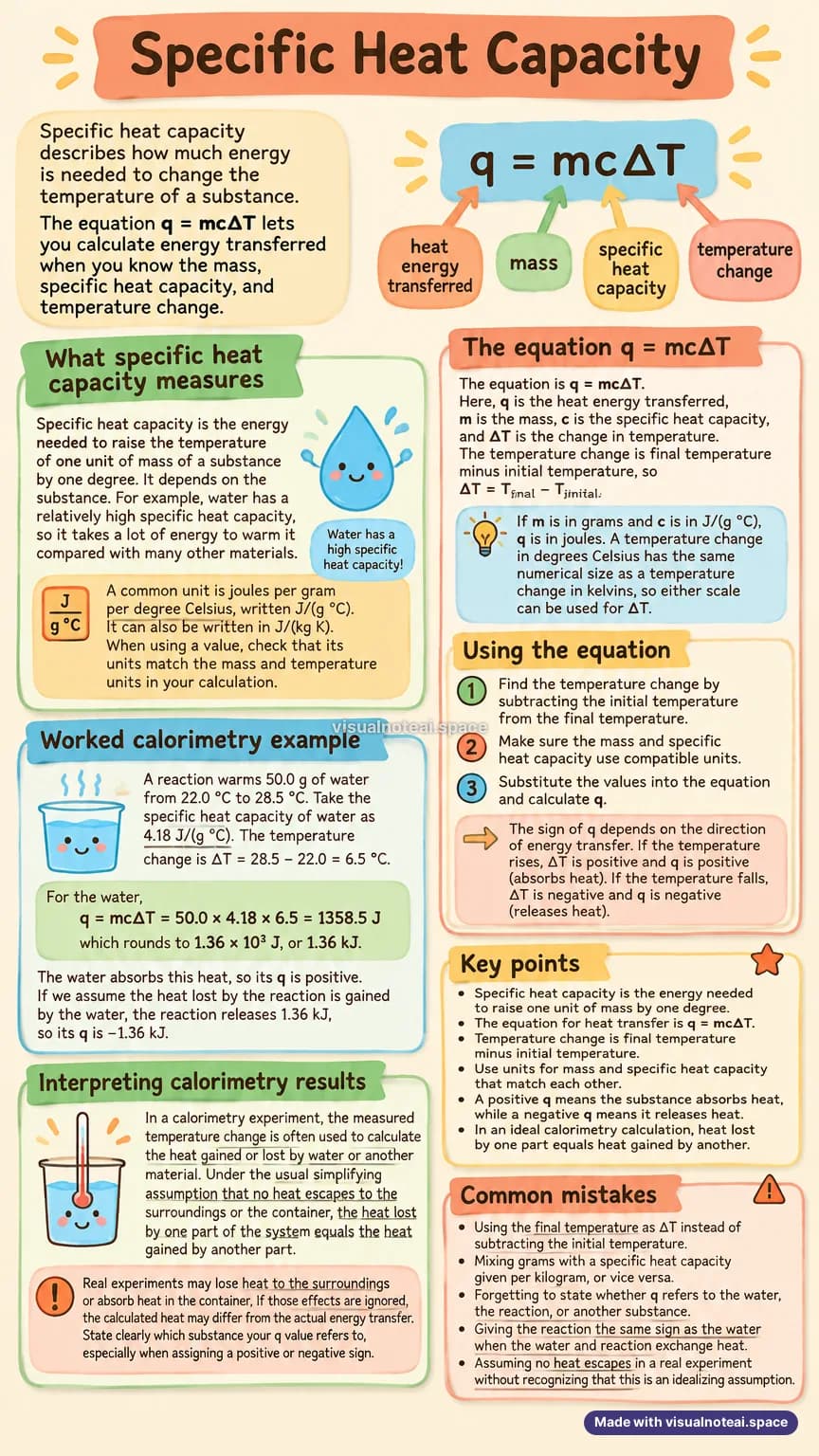
The whole topic on one page. Made with VisualNote.
★What to remember
- Specific heat capacity is the energy needed to raise one unit of mass by one degree.
- The equation for heat transfer is q = mcΔT.
- Temperature change is final temperature minus initial temperature.
- Use units for mass and specific heat capacity that match each other.
- A positive q means the substance absorbs heat, while a negative q means it releases heat.
- In an ideal calorimetry calculation, heat lost by one part equals heat gained by another.
🎧Listen2:56 · transcript
AnnaWhen people hear “specific heat capacity,” what are they actually measuring?
MarcoThey’re describing how much energy it takes to raise the temperature of a unit of mass of a substance by one degree. And it depends on the substance. Water, for instance, has a relatively high specific heat capacity, so it takes a lot of energy to warm compared with many materials.
AnnaSo it’s not just about how hot something gets. The material matters too. How do we calculate the energy transferred?
MarcoWe use the equation “q equals m c delta T.” Here, q is heat energy transferred, m is mass, c is specific heat capacity, and delta T is the temperature change.
AnnaAnd delta T means final temperature minus initial temperature, right? Not simply the final temperature?
MarcoExactly. That subtraction is an easy step to miss. You also need compatible units. If mass is in grams and specific heat capacity is in joules per gram per degree Celsius, q comes out in joules. Specific heat capacity can also be given in joules per kilogram per kelvin, so check what units you have before calculating.
AnnaWhat if the temperature change is in Celsius, but the specific heat capacity uses kelvins?
MarcoA temperature change has the same numerical size in Celsius degrees and kelvins. So either scale can be used for delta T. The important unit match is between the mass and the specific heat capacity.
AnnaLet’s work through the water example. A reaction warms fifty point zero grams of water from twenty-two point zero degrees Celsius to twenty-eight point five. What happens first?
MarcoSubtract the initial temperature from the final one. Twenty-eight point five minus twenty-two point zero gives a change of six point five degrees. Then use water’s specific heat capacity, four point one eight joules per gram per degree Celsius.
AnnaSo q is fifty point zero times four point one eight times six point five. That gives one thousand three hundred fifty-eight point five joules, or one point three six kilojoules when rounded. Since the water warmed, its q is positive. Is that also the reaction’s q?
MarcoNo. We have to say which substance q refers to. The water absorbs heat, so its q is positive. If we assume the heat lost by the reaction is gained by the water, then the reaction releases one point three six kilojoules, so its q is negative one point three six kilojoules.
AnnaThat assumption sounds important. Does it always hold in an experiment?
MarcoIt’s an idealizing assumption. In the simplified calculation, heat lost by one part equals heat gained by another. But a real experiment can lose heat to the surroundings, or the container can absorb some. If we ignore those effects, our calculated heat may differ from the actual transfer.
AnnaSo the reliable routine is: calculate final minus initial, match the units, and identify what the sign refers to. A rising temperature means positive q and heat absorbed; a falling temperature means negative q and heat released.

Study in Paper · Specific Heat CapacityWatch on YouTube
!Common mistakes
- Using the final temperature as ΔT instead of subtracting the initial temperature.
- Mixing grams with a specific heat capacity given per kilogram, or vice versa.
- Forgetting to state whether q refers to the water, the reaction, or another substance.
- Giving the reaction the same sign as the water when the water and reaction exchange heat.
- Assuming no heat escapes in a real experiment without recognizing that this is an idealizing assumption.
🧠Explore the map30 ideas
The mind map VisualNote made for this topic. Drag to pan, scroll to zoom.
- Specific Heat Capacity
- Definition and Units
- Energy to raise one unit of mass by one degree
- Depends on the substance
- Water has relatively high specific heat capacity
- J/(g °C) or J/(kg K)
- Heat Transfer Equation
- q = mcΔT
- q: heat energy transferred
- m: mass
- c: specific heat capacity
- ΔT = Tfinal − Tinitial
- Temperature change in °C or K
- Calculation Steps
- Subtract initial temperature from final temperature
- Match mass and specific heat capacity units
- Substitute values and calculate q
- Signs of Heat Transfer
- Positive q: heat absorbed; temperature rises
- Negative q: heat released; temperature falls
- Specify which substance q refers to
- Calorimetry
- Ideal assumption: heat lost equals heat gained
- Real experiments may exchange heat with container or surroundings
- Ignored heat exchange can make calculated q inaccurate
- Example: Water and Reaction
- 50.0 g water warms from 22.0 °C to 28.5 °C
- c = 4.18 J/(g °C); ΔT = 6.5 °C
- Water absorbs 1.36 kJ; q = +1.36 kJ
- Reaction releases 1.36 kJ; q = −1.36 kJ
- Definition and Units
🃏Flashcards12 cards
- What does specific heat capacity measure?
- The energy required to raise one unit of mass of a substance by one degree.
- What is the heat-transfer equation?
- q = mcΔT, where q is heat transferred, m is mass, c is specific heat capacity, and ΔT is temperature change.
- How is temperature change calculated?
- ΔT = Tfinal − Tinitial.
- What are common units for specific heat capacity?
- J/(g °C) and J/(kg K). Match the units to the mass used in the calculation.
- What units does q have when m is in grams and c is in J/(g °C)?
- q is in joules.
- Can a temperature difference in Celsius be used in the equation with a value in J/(g °C)?
- Yes. A temperature change has the same numerical size in degrees Celsius and kelvins.
- What does positive q mean for a substance?
- The substance absorbs heat; its temperature rises and ΔT is positive.
- What does negative q mean for a substance?
- The substance releases heat; its temperature falls and ΔT is negative.
- How do you calculate heat transfer using q = mcΔT?
- Find ΔT, ensure the mass and specific heat capacity units are compatible, then substitute the values into the equation.
- In the water example, how much heat does 50.0 g of water absorb?
- Warmed from 22.0 °C to 28.5 °C with c = 4.18 J/(g °C), it absorbs 1.36 × 10³ J, or 1.36 kJ.
- If water gains 1.36 kJ from a reaction, what is the reaction’s q under the ideal assumption?
- The reaction releases 1.36 kJ, so its q is −1.36 kJ.
- What is the ideal heat-balance assumption in calorimetry, and what can affect real results?
- Ideally, heat lost by one part equals heat gained by another. In reality, heat may escape to the surroundings or be absorbed by the container.
✅Test yourself5 questions
What does a substance’s specific heat capacity measure?
Specific heat capacity is the energy required to raise one unit of a substance’s mass by one degree.
An object cools from 80 °C to 25 °C; what is its temperature change, ΔT?
ΔT is final temperature minus initial temperature, so 25 − 80 = −55 °C.
A specific heat capacity is given in J/(g °C); which mass unit should be used directly in q = mcΔT?
A value in joules per gram per degree Celsius is compatible with mass measured in grams.
Water absorbs 500 J of heat from a reaction; what is the reaction’s heat transfer, assuming no heat escapes?
Under the stated assumption, the reaction loses the same amount of heat that the water gains, so its q is negative.
In an ideal calorimetry calculation, what is assumed about heat exchange with the surroundings and container?
The ideal simplifying assumption is that heat does not escape to the surroundings or enter the container.
📝The notes
What specific heat capacity measures
Specific heat capacity is the energy needed to raise the temperature of one unit of mass of a substance by one degree. It depends on the substance. For example, water has a relatively high specific heat capacity, so it takes a lot of energy to warm it compared with many other materials.
A common unit is joules per gram per degree Celsius, written J/(g °C). It can also be written in J/(kg K). When using a value, check that its units match the mass and temperature units in your calculation.
The equation q = mcΔT
The equation is q = mcΔT. Here, q is the heat energy transferred, m is the mass, c is the specific heat capacity, and ΔT is the change in temperature. The temperature change is final temperature minus initial temperature, so ΔT = Tfinal − Tinitial.
If m is in grams and c is in J/(g °C), q is in joules. A temperature change in degrees Celsius has the same numerical size as a temperature change in kelvins, so either temperature scale can be used for ΔT.
Using the equation
First, find the temperature change by subtracting the initial temperature from the final temperature. Then make sure the mass and specific heat capacity use compatible units. Substitute the values into the equation and calculate q.
The sign of q depends on the direction of energy transfer for the object or substance you are considering. If its temperature rises, ΔT is positive and q is positive, meaning it absorbs heat. If its temperature falls, ΔT is negative and q is negative, meaning it releases heat.
Worked calorimetry example
A reaction warms 50.0 g of water from 22.0 °C to 28.5 °C. Take the specific heat capacity of water as 4.18 J/(g °C). The temperature change is ΔT = 28.5 − 22.0 = 6.5 °C.
For the water, q = mcΔT = 50.0 × 4.18 × 6.5 = 1358.5 J, which rounds to 1.36 × 10³ J, or 1.36 kJ. The water absorbs this heat, so its q is positive. If we assume the heat lost by the reaction is gained by the water, the reaction releases 1.36 kJ, so its q is −1.36 kJ.
Interpreting calorimetry results
In a calorimetry experiment, the measured temperature change is often used to calculate the heat gained or lost by water or another material. Under the usual simplifying assumption that no heat escapes to the surroundings or the container, the heat lost by one part of the system equals the heat gained by another part.
Real experiments may lose heat to the surroundings or absorb heat in the container. If those effects are ignored, the calculated heat may differ from the actual energy transfer. State clearly which substance your q value refers to, especially when assigning a positive or negative sign.
Make this for your own notes
Paste a chapter or a PDF and get the sheet, map, cards, quiz and episode back in about a minute. No credit card.