
Sex linked traits are controlled by genes on a sex chromosome, most often the X chromosome. X linked recessive traits, such as the common forms of red green color blindness, often appear more often in males because males usually have only one X chromosome.
★What to remember
- An X linked gene is carried on the X chromosome.
- A male usually has one X chromosome, so a recessive allele on it can be expressed.
- A female usually needs two copies of an X linked recessive allele to show the trait.
- A female with one recessive allele for an X linked trait is usually a carrier.
- A father passes his X chromosome to every daughter and his Y chromosome to every son.
- A mother passes one of her X chromosomes to each child.
- In a carrier mother and unaffected father cross, half the sons are expected to show an X linked recessive trait.
🎧Listen3:15 · transcript
AnnaToday we’re talking about sex-linked traits. Marco, what does “sex-linked” mean?
MarcoIt means a gene is carried on a sex chromosome. In humans, sex chromosomes are usually XX in females and XY in males. Many examples taught in school involve genes on the X chromosome.
AnnaAnd why does an X-linked recessive trait often show up more in males?
MarcoA male usually has just one X chromosome. If it carries a recessive allele, the Y chromosome usually has no matching version of that gene to mask it. So the trait can show. This is called being hemizygous for that gene.
AnnaWhereas a female usually has two X chromosomes. So she generally needs the recessive allele on both to show the trait. With one usual allele and one recessive one, she is usually an unaffected carrier.
MarcoRight. Let’s use the red-green color blindness model. We can write the usual color vision allele as X superscript N, and the color blindness allele as X superscript C. A male with X superscript C and Y is color blind. A female with X superscript N and X superscript C is usually a carrier with typical color vision. A female with two X superscript C alleles is color blind.
AnnaBut that’s a simplified model, isn’t it?
MarcoYes. Color vision can involve more than one gene, and not every kind of color vision difference follows this exact pattern. But for a school cross about red-green color blindness, this is usually the intended model.
AnnaLet’s work through a cross. Suppose the mother is a carrier, X superscript N X superscript C, and the father is unaffected, X superscript N Y. What can each parent pass on?
MarcoThe mother can pass either of her X chromosomes. The father can pass his X to daughters or his Y to sons. Combine those possibilities and we get four outcomes: X superscript N X superscript N, X superscript N X superscript C, X superscript N Y, and X superscript C Y. Each has a one-in-four chance if the combinations are equally likely.
AnnaSo half the daughters are carriers, but none are color blind in this model. And half the sons are color blind. That distinction matters: half of sons is not the same as half of all children.
MarcoExactly. If there’s an equal chance of a son or daughter, one quarter of all children are expected to be color blind. Here’s another case. An affected father has X superscript C Y, and the mother is an unaffected noncarrier, X superscript N X superscript N. What happens?
AnnaEvery daughter gets the father’s X and the mother’s usual X, so all daughters are carriers and usually not color blind. Every son gets the father’s Y and the mother’s usual X, so no sons are color blind in this model. A father does not pass his X-linked allele directly to his sons.
MarcoThat’s a common mistake. Sons get their X chromosome from their mother and their Y from their father. And when writing the cross, don’t put a matching allele on the Y unless the question says the gene is there.
AnnaSo the key is to track which chromosome each parent can pass on, then use the offspring’s genotype to work out the trait. And remember: a carrier usually isn’t affected, and chances for sons may differ from chances for all children.
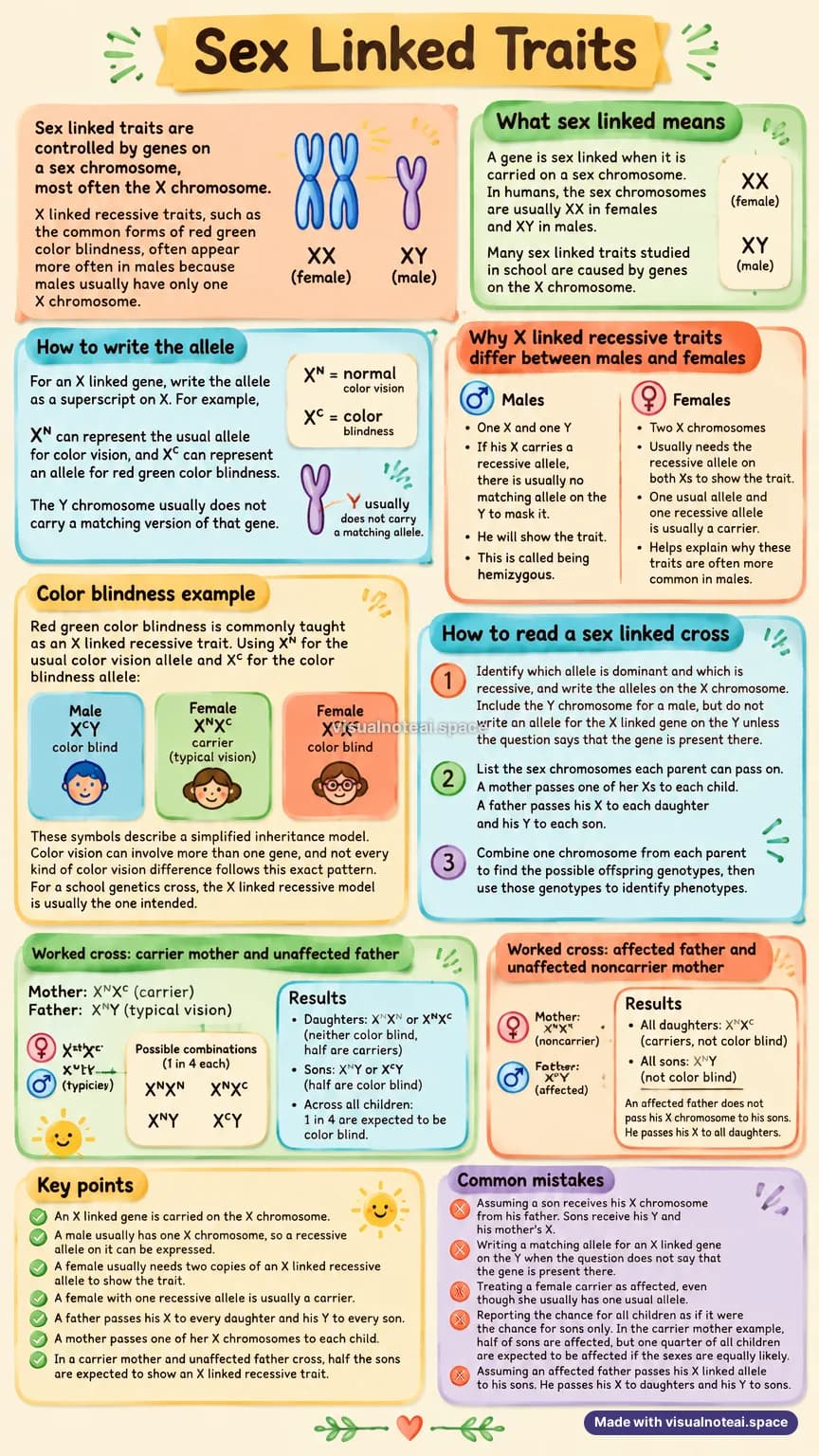
The whole topic on one page. Made with VisualNote.
!Common mistakes
- Assuming a son receives his X chromosome from his father. Sons receive their father's Y chromosome and their mother's X chromosome.
- Writing a matching allele for an X linked gene on the Y chromosome when the question does not say that the gene is present there.
- Treating a female carrier of a recessive X linked trait as affected, even though she usually has one usual allele.
- Reporting the chance for all children as if it were the chance for sons only. In the carrier mother example, half of sons are affected, but one quarter of all children are expected to be affected if the sexes are equally likely.
- Assuming an affected father passes his X linked allele to his sons. He passes his X chromosome to daughters and his Y chromosome to sons.
🧠Explore the map37 ideas
The mind map VisualNote made for this topic. Drag to pan, scroll to zoom.
- X-Linked Traits
- Definition and Notation
- Genes on sex chromosomes
- Most studied examples involve the X chromosome
- Write alleles as superscripts on X
- Y usually lacks a matching allele
- Different Effects by Sex
- Males are usually XY
- One recessive X allele can be expressed
- Hemizygous for the X-linked gene
- Females are usually XX
- Usually need two recessive alleles to be affected
- One recessive allele usually means carrier
- Males are usually XY
- X-Linked Recessive Color Blindness
- Xᴺ: usual color vision allele
- Xᶜ: color blindness allele
- XᶜY male: affected
- XᴺXᶜ female: usually carrier
- XᶜXᶜ female: affected
- Inheritance and Crosses
- Identify dominant and recessive alleles
- Mother passes one X to each child
- Father passes X to daughters and Y to sons
- Combine parental chromosomes to find genotypes
- Use genotypes to determine phenotypes
- Worked Cross Outcomes
- Carrier mother × unaffected father
- Half of sons affected; half of daughters carriers
- One quarter of all children affected if sexes are equally likely
- Affected father × unaffected noncarrier mother
- All daughters carriers; no sons affected
- Carrier mother × unaffected father
- Common Misconceptions
- Sons receive their X chromosome from their mother
- Do not assign a matching X-linked allele to Y without evidence
- A carrier is usually not affected
- Distinguish risk among sons from risk among all children
- Affected fathers pass their X-linked allele to daughters, not sons
- Definition and Notation
🃏Flashcards12 cards
- What is a sex-linked trait?
- A trait controlled by a gene carried on a sex chromosome. Many commonly studied sex-linked traits are X-linked.
- What are the usual human sex chromosome patterns?
- Females usually have XX and males usually have XY.
- How are alleles for an X-linked gene written?
- They are written as superscripts on X, such as Xᴺ or Xᶜ. Usually, no matching allele is written on Y.
- Why are X-linked recessive traits often more common in males?
- Males usually have only one X chromosome, so a recessive allele on it is often expressed because the Y chromosome usually has no corresponding allele to mask it.
- What does hemizygous mean for an X-linked gene?
- A male is hemizygous for an X-linked gene because he usually has only one copy of that gene, on his single X chromosome.
- When does a female usually show an X-linked recessive trait?
- Usually when she has the recessive allele on both X chromosomes. A female with one usual allele and one recessive allele is typically an unaffected carrier.
- In the color blindness model, what do Xᴺ and Xᶜ represent?
- Xᴺ represents the usual color vision allele, and Xᶜ represents the red-green color blindness allele.
- Which genotypes are color blind in the simplified X-linked recessive model?
- XᶜY males and XᶜXᶜ females are color blind. XᴺXᶜ females are usually carriers with typical color vision.
- Which sex chromosomes does a father pass to his children?
- He passes his X chromosome to every daughter and his Y chromosome to every son.
- Which chromosome does a mother pass to each child?
- A mother passes one of her X chromosomes to each child.
- What are the outcomes of a carrier mother (XᴺXᶜ) and unaffected father (XᴺY)?
- The four genotypes XᴺXᴺ, XᴺXᶜ, XᴺY, and XᶜY each have a one-in-four chance. Half of the sons are expected to be color blind, and one quarter of all children are expected to be color blind if the sexes are equally likely.
- What are the outcomes of an affected father (XᶜY) and an unaffected noncarrier mother (XᴺXᴺ)?
- All daughters are XᴺXᶜ carriers, and all sons are XᴺY and unaffected. The father does not pass his X-linked allele directly to his sons.
✅Test yourself5 questions
Why can a recessive allele on the X chromosome be expressed in a male who carries it?
A male usually has one X chromosome, and the Y chromosome usually lacks a matching allele for the X-linked gene.
In the simplified X-linked recessive model, what is the usual phenotype of a female with genotype XᴺXᶜ?
One usual allele generally prevents a female with one recessive allele from showing the trait, though she can pass the recessive allele on.
In an X-linked inheritance pattern, which sex chromosome does a father pass to each son?
A father passes his Y chromosome to his sons and his X chromosome to his daughters.
An affected father (XᶜY) has children with an unaffected noncarrier mother (XᴺXᴺ). What is expected for their daughters in this model?
Every daughter receives the father's Xᶜ and the mother's Xᴺ, giving each daughter the carrier genotype XᴺXᶜ.
A carrier mother (XᴺXᶜ) and an unaffected father (XᴺY) have children. Assuming equal chances of either sex, what fraction of all children are expected to be color blind?
Half of the sons are expected to be affected, and sons make up half of all children, so one quarter of all children are expected to be affected.
📝The notes
What sex linked means
A gene is sex linked when it is carried on a sex chromosome. In humans, the sex chromosomes are usually XX in females and XY in males. Many sex linked traits studied in school are caused by genes on the X chromosome.
For an X linked gene, write the allele as a superscript on X. For example, Xᴺ can represent the usual allele for color vision, and Xᶜ can represent an allele for red green color blindness. The Y chromosome usually does not carry a matching version of that gene.
Why X linked recessive traits differ between males and females
A male usually has one X chromosome and one Y chromosome. If his X carries a recessive allele for an X linked trait, there is usually no corresponding allele on the Y chromosome to mask it. He will therefore show the trait. This is called being hemizygous for the X linked gene.
A female usually has two X chromosomes. For an X linked recessive trait, she generally needs the recessive allele on both X chromosomes to show the trait. A female with one usual allele and one recessive allele is usually an unaffected carrier. This pattern helps explain why X linked recessive traits are often more common in males, though the exact frequency depends on the alleles in a population.
Color blindness example
Red green color blindness is commonly taught as an X linked recessive trait. Using Xᴺ for the usual color vision allele and Xᶜ for the color blindness allele, a male with XᶜY is color blind. A female with XᴺXᶜ is usually a carrier with typical color vision, while a female with XᶜXᶜ is color blind.
These symbols describe a simplified inheritance model. Color vision can involve more than one gene, and not every kind of color vision difference follows this exact pattern. For a school genetics cross about red green color blindness, however, the X linked recessive model is usually the one intended.
How to read a sex linked cross
First identify which allele is dominant and which is recessive, and write the alleles on the X chromosome. Include the Y chromosome for a male, but do not write an allele for the X linked gene on the Y unless the question specifically says that the gene is present there. Then write each parent's sex chromosome genotype.
Next, list the sex chromosomes each parent can pass on. A mother passes one of her X chromosomes to each child. A father passes his X chromosome to each daughter and his Y chromosome to each son. Combine one chromosome from each parent to find the possible offspring genotypes, then use those genotypes to identify phenotypes.
Worked cross: carrier mother and unaffected father
Let the mother be XᴺXᶜ, a carrier, and the father be XᴺY, with typical color vision. The mother can pass Xᴺ or Xᶜ. The father can pass Xᴺ or Y.
The possible combinations are XᴺXᴺ, XᴺXᶜ, XᴺY, and XᶜY, each with a one in four chance if each combination is equally likely. The daughters are XᴺXᴺ or XᴺXᶜ, so neither is color blind in this model, and half of the daughters are carriers. The sons are XᴺY or XᶜY, so half of the sons are color blind. Across all children, one quarter are expected to be color blind, assuming equal chances of having a son or a daughter.
Worked cross: affected father and unaffected noncarrier mother
Let the father be XᶜY and the mother be XᴺXᴺ. The father passes Xᶜ to every daughter and Y to every son. The mother passes Xᴺ to every child.
All daughters will be XᴺXᶜ carriers and are usually not color blind. All sons will be XᴺY and will not be color blind. An affected father does not pass his X chromosome to his sons, so he does not pass an X linked allele directly to them. He passes his X chromosome to all of his daughters.
Make this for your own notes
Paste a chapter or a PDF and get the sheet, map, cards, quiz and episode back in about a minute. No credit card.