
Romeo and Juliet is driven by three linked themes: love, fate and family conflict. Shakespeare shows love as both a source of joy and a force that overrides reason, fate as a sense that the lovers are doomed from the start, and family feud as the social pressure that makes their deaths possible. Revision works best if you can trace each theme through specific scenes and lines and see how they interact.
★What to remember
- The Prologue calls the lovers 'star-cross'd', establishing that the tragedy is fated from the start.
- The balcony scene in Act 2, Scene 2 is the main expression of the love theme, with Juliet asking 'wherefore art thou Romeo?'.
- Romeo's line 'O, I am fortune's fool!' in Act 3, Scene 1 presents him as a plaything of chance.
- The opening brawl in Act 1, Scene 1 shows that the Montague and Capulet hatred has spread to servants and the whole city.
- Mercutio's dying words 'A plague o' both your houses!' blame the feud for the deaths.
- Capulet's anger at Juliet in Act 3, Scene 5 shows that family conflict operates inside the household as well as between houses.
- The final reconciliation, with the golden statues, happens only after the lovers' deaths.
- The themes interact: the feud creates obstacles, love drives defiance, and fate frames the outcome.
🎧Listen2:35 · transcript
AnnaWelcome back. Today we're looking at Romeo and Juliet, and the three themes that drive it: love, fate and family conflict. Marco, where do you want to start?
MarcoLet's start with fate, because the Prologue gives the game away straight away. The lovers are called star-crossed. So doesn't that mean the ending is already decided?
AnnaThat's the interesting part. The audience knows the outcome, so the tension comes from how the deaths happen, not whether they happen. But Romeo says he's fortune's fool. Does he really believe he has no control?
MarcoHe says it, yes. But look at what actually happens. Some things are pure chance, like the letter that never reaches him. Other things are choices, like him killing Tybalt. So fate and choice both seem to be doing the work.
AnnaRight, and that's the key for an essay. Shakespeare seems to combine predestination with character and accident. Which brings me to the feud. Marco, the brawl in the first scene shows how far the hatred has spread, even to servants.
MarcoAnd it isn't only between the two houses. Capulet is a great example. He goes from reluctant, to pushing Juliet toward Paris, to furious when she refuses. So the family conflict happens inside the household too.
AnnaGood point. Then think about Mercutio's dying words, a plague o' both your houses. Is he blaming the feud itself for killing him?
MarcoI think so, and it's the play making the theme explicit. The feud has destroyed innocent people. Which leads to the ending, where the families make peace with a golden statue. Isn't that a bitter kind of reconciliation?
AnnaVery bitter. They only come together through the loss of their children. And that links back to love. Does their love bring the families together, or is it simply destructive?
MarcoI'd say both. It's redemptive for the families, but it costs both lives. Shakespeare doesn't let love be simply pure or simply foolish. It's intense, sincere and impulsive at once.
AnnaAnd that ambiguity is why the play still provokes debate about responsibility. Friar Laurence's plan depends on timing and messages, so good intentions meet a hostile world. Would you say he's as responsible as Romeo?
MarcoNot quite, but his risky plan is part of the chain. Fate, family pressure and impulsiveness all meet in his scheme. That's the lesson for students: don't treat the themes as separate boxes.
AnnaAgreed. Trace each theme through specific scenes and lines, and see how they interact. That's the best way to revise. Thanks for listening, and see you next time.
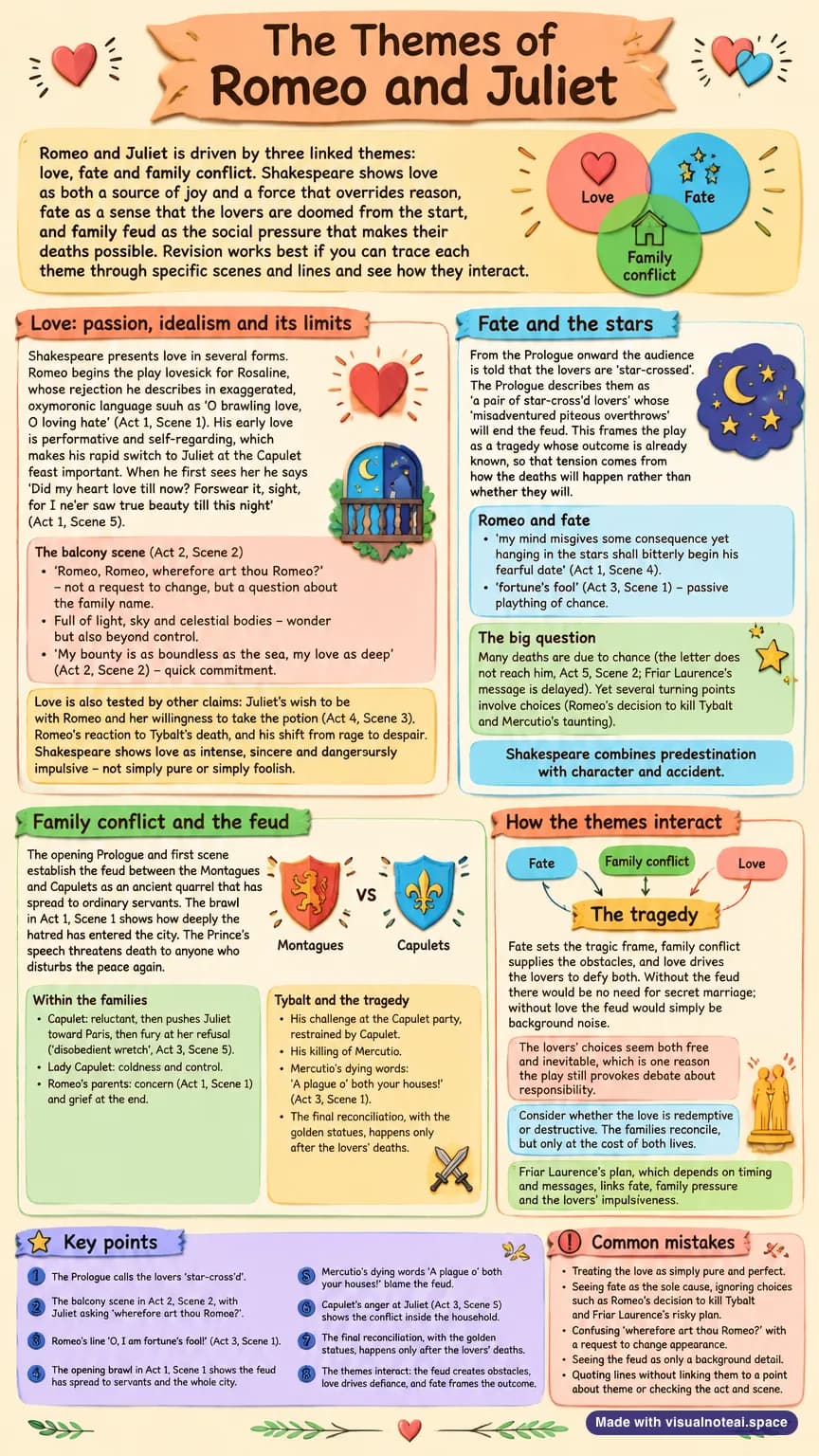
The whole topic on one page. Made with VisualNote.
!Common mistakes
- Treating Romeo and Juliet's love as simply pure and perfect, when Shakespeare also shows its impulsiveness and its role in the deaths.
- Describing fate as the sole cause of the tragedy, while ignoring the choices made by characters such as Romeo's decision to kill Tybalt and Friar Laurence's risky plan.
- Confusing Juliet's 'wherefore art thou Romeo?' with a request for Romeo to change his appearance; she is questioning why his family name must divide them.
- Writing about the feud as only a background detail, rather than analysing how it shapes the choices and fates of the lovers and of Tybalt, Mercutio and Capulet.
- Quoting lines without tying them to a point about theme, or failing to check that a quotation actually comes from the act and scene cited.
🧠Explore the map23 ideas
The mind map VisualNote made for this topic. Drag to pan, scroll to zoom.
- Romeo and Juliet themes
- Love
- Romeo's infatuation with Rosaline
- Love at first sight at the Capulet feast
- Balcony scene imagery of light and sky
- Love as impulsive and destabilising
- Fate
- Prologue: star-crossed lovers
- Romeo: 'fortune's fool'
- Chance: letter fails to reach Romeo
- Choices: Romeo kills Tybalt
- Family conflict and feud
- Brawl in Act 1, Scene 1
- Prince's threat of death
- Capulet's anger at Juliet
- Tybalt's aggressive pride
- Mercutio: 'A plague o' both your houses'
- Golden statues reconciliation after deaths
- Interaction of themes
- Feud creates obstacles
- Love drives defiance
- Fate frames the outcome
- Friar Laurence's risky plan
- Love
🃏Flashcards13 cards
- What are the three linked themes of Romeo and Juliet?
- Love, fate and family conflict. Shakespeare shows how each theme interacts with the others across the play.
- What does the Prologue call the lovers, and what does this establish?
- They are 'star-cross'd lovers', establishing that the tragedy is fated from the start so tension comes from how the deaths happen, not whether they will.
- What does Juliet's 'wherefore art thou Romeo?' really ask?
- She is not asking him to change who he is; she is asking why his name must belong to her family's enemy, the Montagues.
- Where is the balcony scene and why is it important?
- Act 2, Scene 2. It is the centrepiece of the love theme, full of light and celestial imagery giving the love a sense of wonder beyond ordinary control.
- What does Romeo mean by 'O, I am fortune's fool'?
- Spoken in Act 3, Scene 1 right after he kills Tybalt, it presents Romeo as a passive plaything of chance rather than an agent of his own choices.
- What does the opening brawl in Act 1, Scene 1 show about the feud?
- That the Montague and Capulet hatred has spread to ordinary servants and entered the whole city.
- What does Prince Escalus threaten in Act 1, Scene 1?
- Death to anyone who disturbs the peace again, setting up the civic and legal framework the lovers will break.
- How does Capulet's anger at Juliet show family conflict?
- In Act 3, Scene 5 he calls her a 'disobedient wretch' after she refuses Paris, showing that family conflict operates inside the household as well as between houses.
- What do Mercutio's dying words, 'A plague o' both your houses!', reveal?
- They make the theme explicit in Act 3, Scene 1: the feud has destroyed innocent people and is to blame for the deaths.
- How do Tybalt's actions drive the central catastrophe?
- His challenge to Romeo and his killing of Mercutio lead directly to Romeo killing Tybalt, which sets the tragedy in motion.
- What does the final reconciliation show?
- Montague and Capulet agree to raise golden statues of Juliet and Romeo, showing the families only come together through the loss of their children.
- Why is Friar Laurence's plan an example of how the themes interact?
- Its success depends on timing and messages, so good intentions combined with a hostile world and fate produce disaster, linking fate, family pressure and the lovers' impulsiveness.
- Why is the letter to Romeo significant for the theme of fate?
- The letter does not reach him (Act 5, Scene 2), showing chance playing a role, though turning points like Romeo's choices suggest character also drives events.
✅Test yourself5 questions
How does Romeo first describe his feelings at the start of the play?
In Act 1, Scene 1 Romeo is pining for Rosaline and describes his feelings in oxymorons such as 'O brawling love, O loving hate'.
What is Juliet really asking when she says 'Romeo, Romeo, wherefore art thou Romeo?'
Juliet is questioning why Romeo's name must be a Montague name, since that name makes their love impossible, not asking him to change who he is.
What effect does the Prologue's description of the lovers as 'star-cross'd' have on the audience?
The Prologue tells the audience the lovers will die, so the drama focuses on how the tragedy unfolds rather than whether it will happen.
What does Mercutio's dying line 'A plague o' both your houses!' make explicit about the feud?
Mercutio, an innocent kinsman of the Prince, is killed in the feud, and his curse condemns both houses for the harm the quarrel has caused.
How does Capulet's attitude to Juliet's marriage change across the play?
Capulet first hesitates, then presses Juliet to marry Paris, and in Act 3, Scene 5 calls her a 'disobedient wretch' when she refuses.
📝The notes
Love: passion, idealism and its limits
Shakespeare presents love in several forms. Romeo begins the play lovesick for Rosaline, whose rejection he describes in exaggerated, oxymoronic language such as 'O brawling love, O loving hate' (Act 1, Scene 1). His early love is shown as performative and self-regarding, which makes his rapid switch to Juliet at the Capulet feast important. When he first sees her he says 'Did my heart love till now? Forswear it, sight, for I ne'er saw true beauty till this night' (Act 1, Scene 5), a line that marks the turn from infatuation to something he believes is real.
The balcony scene (Act 2, Scene 2) is the centrepiece of the love theme. Juliet's 'Romeo, Romeo, wherefore art thou Romeo?' is often misread as a request for him to be someone else; in context she is asking why his name must be the name of her family's enemy. The scene is full of images of light, sky and celestial bodies, which give the love a sense of wonder but also of something beyond ordinary control. Juliet's 'My bounty is as boundless as the sea, my love as deep' (Act 2, Scene 2) shows how quickly the lovers commit themselves.
The play also tests love against other claims on the characters. Juliet's later lines about her wish to be with Romeo, and her willingness to take the potion in Act 4, Scene 3, show love becoming a reason to defy both family and religion. Romeo's reaction to Tybalt's death, and his shift from rage to despair, shows that love can be destabilising as well as fulfilling. Students should note that Shakespeare does not present the love as simply pure or simply foolish; it is intense, sincere and dangerously impulsive at once.
Fate and the stars
From the Prologue onward the audience is told that the lovers are 'star-crossed'. The Prologue describes them as 'a pair of star-cross'd lovers' whose 'misadventured piteous overthrows' will end the feud. This frames the whole play as a tragedy whose outcome is already known, so that tension comes from how the deaths will happen rather than whether they will.
Romeo repeatedly expresses a belief that fate controls him. Before going to the Capulet feast he says 'my mind misgives some consequence yet hanging in the stars shall bitterly begin his fearful date' (Act 1, Scene 4). Later, right after he kills Tybalt, he cries that he is 'fortune's fool' (Act 3, Scene 1). The phrase 'fortune's fool' is a key line for this theme, because it presents Romeo as a passive plaything of chance rather than an agent of his own choices.
The question for an essay is how far fate really determines events. Many of the deaths result from chance: Friar Laurence's letter to Romeo does not reach him because the messenger, Friar John, is delayed (Act 5, Scene 2). Yet several turning points involve choices, such as Romeo's decision to kill Tybalt and Mercutio's taunting. A strong answer will argue that Shakespeare combines a sense of predestination with a sense that character and accident together produce the tragedy.
Family conflict and the feud
The opening Prologue and the first scene establish the feud between the Montagues and Capulets as an ancient quarrel that has spread to ordinary servants. The brawl in Act 1, Scene 1, where servants of both houses fight in the streets, shows how deeply the hatred has entered the city. The Prince's speech, which threatens death to anyone who disturbs the peace again, sets up the legal and civic framework the lovers will break.
The feud is not only between the two houses but within them. Capulet's changing attitude to Juliet's marriage is a clear example. He is initially reluctant to let Juliet marry, then pushes her toward Paris, and finally responds with fury when she refuses, calling her a 'disobedient wretch' (Act 3, Scene 5). Lady Capulet's coldness and Juliet's sense of isolation show that the family itself is a site of control. Likewise, Romeo's parents are only lightly sketched, but his father's concern for his son in Act 1, Scene 1 and his grief at the end show the family's stake in the feud.
Tybalt embodies the feud's aggressive pride. His challenge to Romeo at the Capulet party, which Capulet restrains, and his killing of Mercutio, lead directly to the central catastrophe. Mercutio's dying words, 'A plague o' both your houses!' (Act 3, Scene 1), make the theme explicit: the feud has destroyed innocent people. The reconciliation at the end, where Montague and Capulet agree to raise golden statues of Juliet and Romeo, shows that the families only come together through the loss of their children.
How the themes interact
The three themes are most powerful when read together. Fate sets the tragic frame, family conflict supplies the obstacles, and love is the force that drives the lovers to defy both. Without the feud there would be no need for secret marriage; without love the feud would simply be background noise. Shakespeare makes the lovers' choices seem both free and inevitable, which is one reason the play still provokes debate about responsibility.
Students should be able to discuss whether the love is redemptive or destructive. Romeo and Juliet's love brings the families to reconcile, but only at the cost of both lives. This ambiguity is central to the play's effect. Friar Laurence's plan, which depends on timing and messages, is a good example of how good intentions combined with a hostile world produce disaster; it links fate, family pressure and the lovers' impulsiveness.
When writing about themes, avoid treating them as separate boxes. Move between them in a single paragraph: for instance, you could discuss Romeo's 'O, I am fortune's fool' (Act 3, Scene 1) as a moment that combines fate, family pressure and love. Good answers use precise quotations and show how the language, imagery and dramatic situation carry the theme rather than simply naming it.
Make this for your own notes
Paste a chapter or a PDF and get the sheet, map, cards, quiz and episode back in about a minute. No credit card.