
Refraction is the change in direction of light as it passes from one material into another. It happens because light travels at different speeds in different materials, and Snell’s law relates the angles to the materials’ refractive indices.
★What to remember
- Refraction is the change in direction of light as it crosses between materials at an angle.
- Light changes direction because its speed changes at the boundary.
- A higher refractive index means light travels more slowly in that material.
- Light bends towards the normal when it enters a slower material, and away from the normal when it enters a faster material.
- Angles in Snell’s law are measured from the normal.
- Snell’s law is n₁ sin θ₁ = n₂ sin θ₂.
- Light’s frequency stays constant when it crosses a boundary, but its speed and wavelength change.
🎧Listen2:48 · transcript
AnnaWhen light crosses from one material into another, it can change direction. That change is called refraction. But what actually makes the ray turn?
MarcoLight travels at different speeds in different materials. When a wavefront reaches a boundary at an angle, one part enters the new material before another. The speed changes across the wavefront, so it turns, and the ray changes direction.
AnnaSo the ray’s direction depends on whether it slows down or speeds up. How do we describe that?
MarcoIf light enters a material where it travels more slowly, it bends towards the normal. If it enters one where it travels faster, it bends away from the normal. The normal is an imaginary line at right angles to the boundary. And if the ray travels along the normal, its speed changes, but its direction does not.
AnnaThat last point is easy to miss. What tells us how fast light travels in a material?
MarcoThe refractive index, written as n. It is the speed of light in a vacuum divided by its speed in the material. So a higher refractive index means light travels more slowly. Refraction depends on both materials’ refractive indices, not just the one the light enters.
AnnaAnd when the light crosses the boundary, does everything about the wave change?
MarcoNo. Its frequency stays the same. Its speed and wavelength change. To work out the change in direction, we use Snell’s law. The angles in that law are measured from the normal, not from the surface.
AnnaCan you walk me through the law and an example?
MarcoSnell’s law says n one times sine theta one equals n two times sine theta two. The first refractive index and angle belong to the first material; the second pair belong to the second. For air into glass, the indices are one point zero zero and one point five zero. If the angle of incidence is thirty degrees, we get one point zero zero times sine thirty equals one point five zero times sine theta two. Rearranging gives sine theta two equal to zero point three three three. Taking the inverse sine gives about nineteen point five degrees.
AnnaThat angle is smaller than thirty degrees, which fits the ray bending towards the normal as it enters slower-moving glass. What happens in the other direction, from water into air?
MarcoWith water at one point three three, air at one point zero zero, and an incident angle of forty degrees, Snell’s law gives sine theta two about zero point eight five five. The inverse sine gives about fifty-eight point eight degrees. The refracted angle is larger, so the ray bends away from the normal as it enters the material with the lower refractive index.
AnnaWhat are the mistakes people should watch for when using this?
MarcoFirst, don’t measure from the boundary. Measure from the normal. Don’t assume light always bends towards it; that depends on whether the light slows down or speeds up. Include both refractive indices, keep each angle matched to its material, and use inverse sine, not ordinary sine, to find the angle after rearranging.
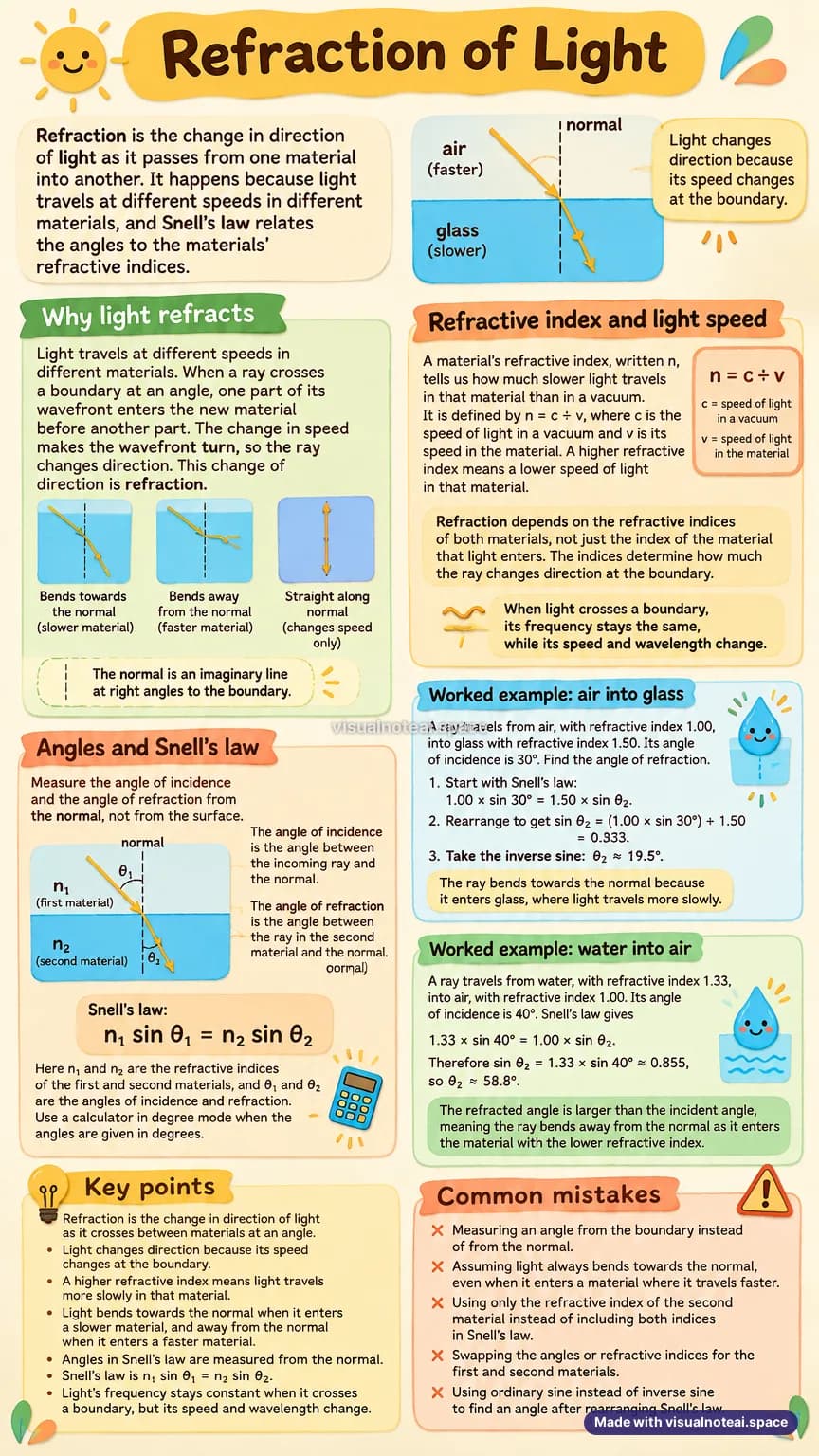
The whole topic on one page. Made with VisualNote.
!Common mistakes
- Measuring an angle from the boundary instead of from the normal.
- Assuming light always bends towards the normal, even when it enters a material where it travels faster.
- Using only the refractive index of the second material instead of including both indices in Snell’s law.
- Swapping the angles or refractive indices for the first and second materials.
- Using ordinary sine instead of inverse sine to find an angle after rearranging Snell’s law.
🧠Explore the map34 ideas
The mind map VisualNote made for this topic. Drag to pan, scroll to zoom.
- Refraction of Light
- Why Refraction Happens
- Change in light speed at boundary
- Wavefront turns when crossing at an angle
- Normal: perpendicular to boundary
- Slower material: bends toward normal
- Faster material: bends away from normal
- Along the normal: speed changes, direction does not
- Refractive Index and Light Speed
- Refractive index: n = c ÷ v
- c: speed of light in vacuum
- v: speed of light in material
- Higher index means lower light speed
- Both materials' indices affect refraction
- Angles and Snell's Law
- Incidence and refraction angles measured from normal
- θ₁: angle of incidence
- θ₂: angle of refraction
- n₁ sin θ₁ = n₂ sin θ₂
- Use inverse sine to find an angle
- Use degree mode for degree inputs
- Worked Examples
- Air to glass: 30° incidence, 19.5° refraction
- Bends toward normal; glass has higher index
- Water to air: 40° incidence, 58.8° refraction
- Bends away from normal; air has lower index
- Air to glass: 30° incidence, 19.5° refraction
- What Changes at a Boundary
- Frequency stays constant
- Speed and wavelength change
- Common Mistakes
- Measuring angles from the surface
- Assuming light always bends toward the normal
- Using only one refractive index or swapping indices and angles
- Using sine instead of inverse sine to find the angle
- Why Refraction Happens
🃏Flashcards12 cards
- What is refraction?
- Refraction is the change in direction of light as it crosses from one material into another at an angle.
- Why does light refract?
- Light travels at different speeds in different materials. When part of a wavefront enters a new material before the rest, the change in speed turns the wavefront and changes the ray’s direction.
- What is the normal to a boundary?
- The normal is an imaginary line perpendicular to the boundary where the light ray meets it.
- How does light bend when it enters a slower or faster material?
- It bends towards the normal when it enters a material where it travels more slowly, and away from the normal when it enters a faster material.
- What happens when light travels along the normal?
- Its speed changes at the boundary, but its direction does not.
- What is refractive index, and how is it related to light speed?
- Refractive index, n, is defined as n = c ÷ v, where c is the speed of light in a vacuum and v is its speed in the material. A higher refractive index means light travels more slowly.
- Which refractive indices affect refraction at a boundary?
- The indices of both the first and second materials determine how much the ray changes direction.
- What happens to light’s frequency, speed, and wavelength at a boundary?
- Frequency stays the same, while speed and wavelength change.
- From where are the angles of incidence and refraction measured?
- Both angles are measured from the normal, not from the boundary surface.
- What is Snell’s law?
- Snell’s law is n₁ sin θ₁ = n₂ sin θ₂, where n₁ and n₂ are the refractive indices and θ₁ and θ₂ are the angles of incidence and refraction.
- A ray enters glass (n = 1.50) from air (n = 1.00) at 30°. What is its refracted angle?
- Using Snell’s law, θ₂ ≈ 19.5°. The ray bends towards the normal as it enters the slower material.
- A ray enters air (n = 1.00) from water (n = 1.33) at 40°. What is its refracted angle?
- Using Snell’s law, θ₂ ≈ 58.8°. The ray bends away from the normal as it enters the faster material.
✅Test yourself5 questions
A ray enters a material where light travels more slowly. How does the ray bend?
Light bends towards the normal when it enters a material where it travels more slowly.
What does a higher refractive index indicate about light’s speed in a material?
Since n = c ÷ v, a higher refractive index corresponds to a lower speed in the material.
From which reference line should the angles in Snell’s law be measured?
Both the incidence and refraction angles are defined relative to the normal, which is perpendicular to the boundary.
Which equation correctly relates the refractive indices and angles on either side of a boundary?
Snell’s law equates the first refractive index multiplied by the sine of its angle with the corresponding product for the second material.
Which statement describes what happens to light’s frequency when it crosses into another material?
Light’s frequency remains constant across a boundary, although its speed and wavelength change.
📝The notes
Why light refracts
Light travels at different speeds in different materials. When a ray crosses a boundary at an angle, one part of its wavefront enters the new material before another part. The change in speed makes the wavefront turn, so the ray changes direction. This change of direction is refraction.
If light enters a material in which it travels more slowly, it bends towards the normal. If it enters a material in which it travels faster, it bends away from the normal. The normal is an imaginary line at right angles to the boundary. A ray travelling straight along the normal changes speed but does not change direction.
Refractive index and light speed
A material’s refractive index, written n, tells us how much slower light travels in that material than in a vacuum. It is defined by n = c ÷ v, where c is the speed of light in a vacuum and v is its speed in the material. A higher refractive index means a lower speed of light in that material.
Refraction depends on the refractive indices of both materials, not just the index of the material that light enters. The indices determine how much the ray changes direction at the boundary. When light crosses a boundary, its frequency stays the same, while its speed and wavelength change.
Angles and Snell’s law
Measure the angle of incidence and the angle of refraction from the normal, not from the surface. The angle of incidence is the angle between the incoming ray and the normal. The angle of refraction is the angle between the ray in the second material and the normal.
Snell’s law is n₁ sin θ₁ = n₂ sin θ₂. Here n₁ and n₂ are the refractive indices of the first and second materials, and θ₁ and θ₂ are the angles of incidence and refraction. Use a calculator in degree mode when the angles are given in degrees.
Worked example: air into glass
A ray travels from air, with refractive index 1.00, into glass with refractive index 1.50. Its angle of incidence is 30°. Find the angle of refraction. Begin with Snell’s law: 1.00 × sin 30° = 1.50 × sin θ₂.
Rearrange to get sin θ₂ = (1.00 × sin 30°) ÷ 1.50 = 0.333. Taking the inverse sine gives θ₂ ≈ 19.5°. The ray bends towards the normal because it enters glass, where light travels more slowly.
Worked example: water into air
A ray travels from water, with refractive index 1.33, into air, with refractive index 1.00. Its angle of incidence is 40°. Snell’s law gives 1.33 × sin 40° = 1.00 × sin θ₂.
Therefore sin θ₂ = 1.33 × sin 40° ≈ 0.855, so θ₂ ≈ 58.8°. The refracted angle is larger than the incident angle, meaning the ray bends away from the normal as it enters the material with the lower refractive index.
Make this for your own notes
Paste a chapter or a PDF and get the sheet, map, cards, quiz and episode back in about a minute. No credit card.