
Pressure describes how much force acts on each unit of area. The basic formula applies to solids, liquids and gases, although pressure in fluids can also be calculated from depth and density.
★What to remember
- Pressure equals perpendicular force divided by area, P = F/A.
- One pascal is equal to one newton per square metre.
- A smaller area produces greater pressure when the force stays the same.
- For a liquid, pressure due to depth is p = ρgh.
- Liquid pressure increases with depth and density.
- Gas pressure is caused by moving particles colliding with container walls.
- The liquid pressure calculated using ρgh is gauge pressure and excludes atmospheric pressure.
🎧Listen3:10 · transcript
AnnaLet’s start with the basic idea. Pressure tells us how much force acts on each unit of area. Marco, what’s the formula?
MarcoPressure equals the force acting perpendicular to a surface divided by the area of that surface. In words, pressure is force divided by area. You can rearrange that to find force by multiplying pressure by area, or area by dividing force by pressure.
AnnaWhy does the area matter so much?
MarcoKeep the force the same and make the contact area smaller, and pressure goes up. Keep the area the same and increase the force, and pressure goes up too. The force is measured in newtons, and area in square metres.
AnnaAnd the unit for pressure is the pascal. One pascal is one newton acting on one square metre. A kilopascal is one thousand pascals. So unit conversion matters: thirty square centimetres is zero point zero zero three square metres, not thirty square metres.
MarcoCan we test the formula with the box example?
AnnaSure. A box pushes down on the floor with a force of two hundred newtons, and its base covers zero point five square metres. Divide two hundred by zero point five, and the pressure is four hundred pascals.
MarcoThen if it rests on a smaller face, with an area of zero point one square metres, the same force gives two thousand pascals. So the box hasn’t become heavier. The pressure rises because the contact area is smaller.
AnnaWhat changes when we move from a solid to a liquid?
MarcoA liquid exerts pressure because of its weight. In a still liquid, pressure increases with depth and with density. To calculate the pressure increase due to the liquid, multiply density by gravitational field strength and depth. Density is in kilograms per cubic metre, gravitational field strength in newtons per kilogram, and depth in metres.
AnnaAt two metres deep in water, using a density of one thousand kilograms per cubic metre and gravitational field strength of nine point eight newtons per kilogram, that gives nineteen thousand six hundred pascals, or nineteen point six kilopascals. That’s gauge pressure. It leaves out atmospheric pressure at the surface.
MarcoSo if a question asks for total, or absolute, pressure, we shouldn’t mistake that liquid-only result for the whole answer. What about gases?
AnnaGas particles move randomly and collide with the walls of their container. Those collisions exert force and produce pressure. Gas pressure acts in all directions. A force of one hundred and twenty newtons on a piston area of zero point zero three square metres gives four thousand pascals.
MarcoAnd compression or heating can also change gas pressure, because they change the particle collisions with the container walls. One last check: what mistakes should we watch for?
AnnaDon’t multiply force by area when the formula calls for division. Convert square centimetres to square metres when needed. Don’t say pressure rises with area if force stays fixed. And don’t use an object’s mass as the force in the formula without first finding its weight.
MarcoAlso, pressure is a scalar: it has size but no direction. In a fluid at rest, pressure at a point acts equally in all directions. And always label the units, keeping pascals for pressure and newtons for force.
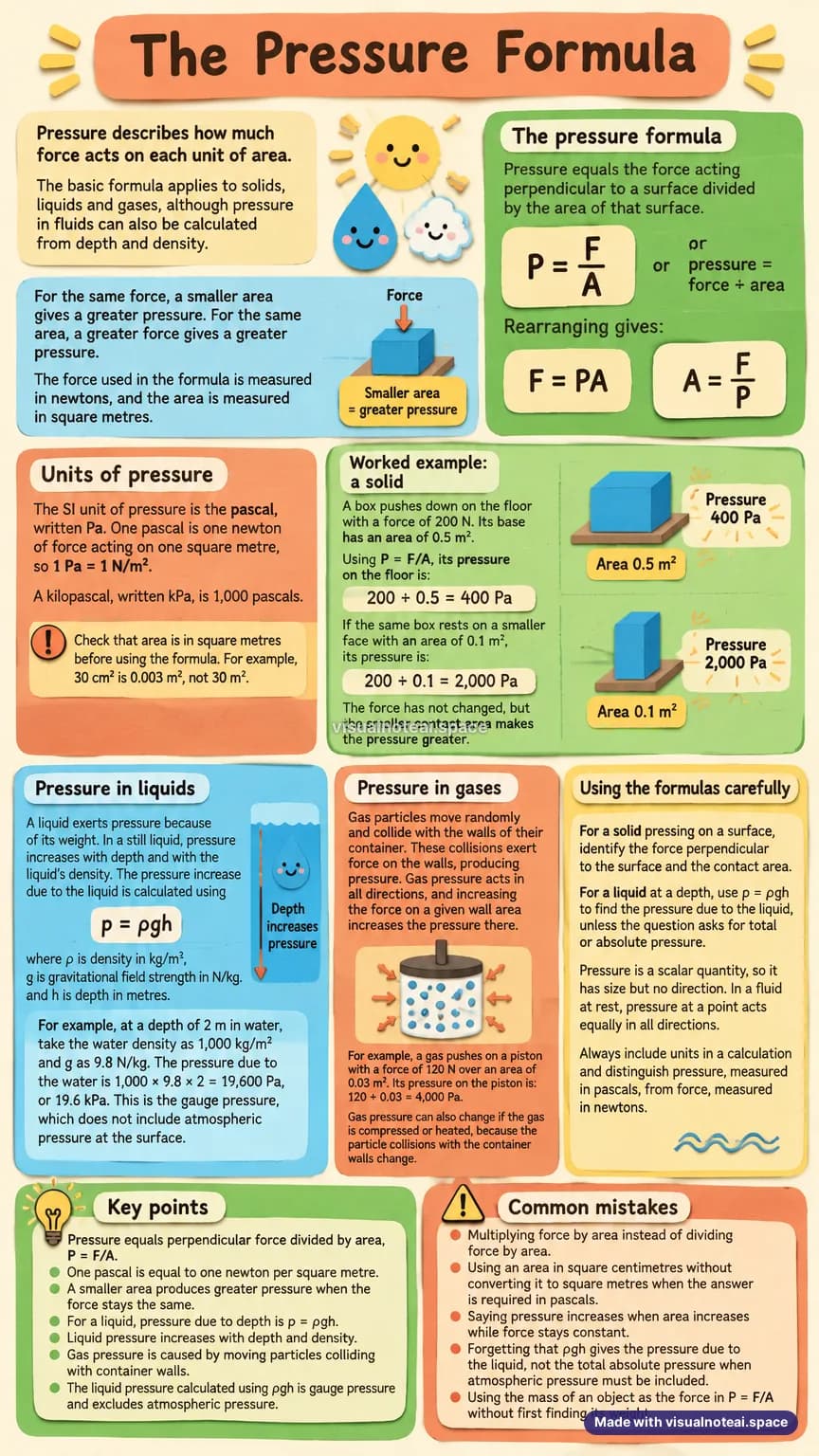
The whole topic on one page. Made with VisualNote.
!Common mistakes
- Multiplying force by area instead of dividing force by area.
- Using an area in square centimetres without converting it to square metres when the answer is required in pascals.
- Saying pressure increases when area increases while force stays constant.
- Forgetting that ρgh gives the pressure due to the liquid, not the total absolute pressure when atmospheric pressure must be included.
- Using the mass of an object as the force in P = F/A without first finding its weight.
🧠Explore the map36 ideas
The mind map VisualNote made for this topic. Drag to pan, scroll to zoom.
- Pressure
- Definition and Formula
- Force per unit area
- P = F ÷ A
- Rearrangements: F = PA; A = F/P
- Force perpendicular to surface
- Units
- SI unit: pascal (Pa)
- 1 Pa = 1 N/m²
- 1 kPa = 1,000 Pa
- Force in newtons; area in square metres
- Convert cm² to m²
- Pressure in Solids
- Smaller area means greater pressure at same force
- Greater force means greater pressure at same area
- Example: 200 N on 0.5 m² = 400 Pa
- Example: 200 N on 0.1 m² = 2,000 Pa
- Pressure in Liquids
- Pressure due to depth: p = ρgh
- ρ: density (kg/m³)
- g: gravitational field strength (N/kg)
- h: depth (m)
- Pressure increases with depth and density
- ρgh gives gauge pressure, excluding atmospheric pressure
- Example: 2 m depth in water = 19.6 kPa gauge
- Pressure due to depth: p = ρgh
- Pressure in Gases
- Moving particles collide with container walls
- Collisions exert force and produce pressure
- Gas pressure acts in all directions
- Compression or heating can change pressure
- Careful Use
- Pressure is scalar; fluid pressure at rest acts equally in all directions
- Use weight, not mass, as force in P = F/A
- Do not multiply force by area
- Distinguish gauge pressure from total absolute pressure
- Include units and distinguish pascals from newtons
- Definition and Formula
🃏Flashcards14 cards
- What is pressure?
- Pressure is the perpendicular force acting on each unit of surface area.
- What is the pressure formula for a force on a surface?
- P = F/A, where F is the perpendicular force and A is the area.
- How can the pressure formula be rearranged?
- F = PA and A = F/P.
- How does changing area affect pressure if force stays constant?
- A smaller area produces greater pressure; a larger area produces less pressure.
- What is the SI unit of pressure?
- The pascal (Pa). One pascal equals one newton per square metre: 1 Pa = 1 N/m².
- What is a kilopascal?
- One kilopascal (kPa) equals 1,000 pascals.
- What units should be used for force and area in P = F/A?
- Use force in newtons (N) and area in square metres (m²). Convert areas from cm² to m² when needed.
- A 200 N box rests on a 0.5 m² base. What pressure does it exert?
- P = 200 ÷ 0.5 = 400 Pa.
- What formula gives the pressure increase due to a liquid at depth?
- p = ρgh, where ρ is liquid density, g is gravitational field strength, and h is depth.
- How does liquid pressure due to depth change?
- It increases with both depth and liquid density.
- What does pressure calculated with p = ρgh represent?
- It is gauge pressure due to the liquid and excludes atmospheric pressure. Add atmospheric pressure if total or absolute pressure is required.
- How is gas pressure produced?
- Moving gas particles collide with the container walls, exerting force and producing pressure in all directions.
- What is pressure’s direction-related property?
- Pressure is a scalar quantity with magnitude but no direction; in a fluid at rest, pressure at a point acts equally in all directions.
- What common force mistake should be avoided when calculating pressure from an object's mass?
- Use the object's weight as the force, not its mass; find the weight first if only mass is given.
✅Test yourself5 questions
A force of 180 N acts perpendicular to an area of 0.6 m². What pressure does it produce?
Pressure is force divided by area, so 180 ÷ 0.6 = 300 Pa.
A surface has an area of 25 cm². What is this area in square metres?
Since 1 cm² equals 0.0001 m², 25 cm² equals 0.0025 m².
A box's weight remains unchanged, but it rests on a face with a smaller area. What happens to the pressure on the floor?
With the force unchanged, reducing the area increases pressure because pressure equals force divided by area.
What does the pressure calculated using p = ρgh represent for a liquid at depth?
The formula p = ρgh gives gauge pressure due to the liquid and does not include atmospheric pressure.
Why does a gas exert pressure on the walls of its container?
Randomly moving gas particles collide with the container walls, and these collisions exert force that produces pressure.
📝The notes
The pressure formula
Pressure equals the force acting perpendicular to a surface divided by the area of that surface. The formula is pressure = force ÷ area, or P = F/A. Rearranging gives F = PA and A = F/P.
For the same force, a smaller area gives a greater pressure. For the same area, a greater force gives a greater pressure. The force used in the formula is measured in newtons, and the area is measured in square metres.
Units of pressure
The SI unit of pressure is the pascal, written Pa. One pascal is one newton of force acting on one square metre of area, so 1 Pa = 1 N/m².
A kilopascal, written kPa, is 1,000 pascals. Check that area is in square metres before using the formula. For example, 30 cm² is 0.003 m², not 30 m².
Worked example: a solid
A box pushes down on the floor with a force of 200 N. Its base has an area of 0.5 m². Using P = F/A, its pressure on the floor is 200 ÷ 0.5 = 400 Pa.
If the same box rests on a smaller face with an area of 0.1 m², its pressure is 200 ÷ 0.1 = 2,000 Pa. The force has not changed, but the smaller contact area makes the pressure greater.
Pressure in liquids
A liquid exerts pressure because of its weight. In a still liquid, pressure increases with depth and with the liquid's density. The pressure increase due to the liquid is calculated using p = ρgh, where ρ is density in kg/m³, g is gravitational field strength in N/kg, and h is depth in metres.
For example, at a depth of 2 m in water, take the water density as 1,000 kg/m³ and g as 9.8 N/kg. The pressure due to the water is 1,000 × 9.8 × 2 = 19,600 Pa, or 19.6 kPa. This is the gauge pressure, which does not include atmospheric pressure at the surface.
Pressure in gases
Gas particles move randomly and collide with the walls of their container. These collisions exert force on the walls, producing pressure. Gas pressure acts in all directions, and increasing the force on a given wall area increases the pressure there.
For example, a gas pushes on a piston with a force of 120 N over an area of 0.03 m². Its pressure on the piston is 120 ÷ 0.03 = 4,000 Pa. Gas pressure can also change if the gas is compressed or heated, because the particle collisions with the container walls change.
Using the formulas carefully
For a solid pressing on a surface, identify the force perpendicular to the surface and the contact area. For a liquid at a depth, use p = ρgh to find the pressure due to the liquid, unless the question asks for total or absolute pressure.
Pressure is a scalar quantity, so it has size but no direction. In a fluid at rest, pressure at a point acts equally in all directions. Always include units in a calculation and distinguish pressure, measured in pascals, from force, measured in newtons.
Make this for your own notes
Paste a chapter or a PDF and get the sheet, map, cards, quiz and episode back in about a minute. No credit card.