
For a simple pendulum swinging through a small angle, its period is given by T = 2π√(L/g). The period is the time for one complete back and forth swing, and it depends on the pendulum’s length and the local strength of gravity, not on the bob’s mass.
★What to remember
- For a simple pendulum at a small swing angle, T = 2π√(L/g).
- The period is the time for one complete oscillation.
- L is measured from the pivot to the centre of the bob.
- A longer pendulum has a longer period, with T proportional to √L.
- Stronger gravity gives a shorter period, with T proportional to 1/√g.
- The bob’s mass does not affect the period of an ideal pendulum.
- Use metres for length and metres per second squared for gravity to obtain a period in seconds.
🎧Listen3:06 · transcript
AnnaLet’s start with the basic question. What does the period of a pendulum mean?
MarcoIt’s the time for one complete oscillation, meaning one full back-and-forth swing. For a simple pendulum at a small angle, the period is two pi times the square root of length divided by gravity.
AnnaAnd the length is measured from the pivot to the centre of the bob, right? Not just to its top or edge.
MarcoExactly. That detail matters. The formula uses that full distance, called L. The g stands for acceleration due to gravity. Use metres for L and metres per second squared for g, and the answer comes out in seconds. Near Earth’s surface, g is about nine point eight metres per second squared.
AnnaHow does changing the length affect the swing? People might guess that twice the length means twice the period.
MarcoBut it doesn’t. The period depends on the square root of the length. So doubling the length multiplies the period by the square root of two, about one point four one. If you multiply the length by four, the period doubles.
AnnaThat square-root relationship is easy to miss. What happens if the pendulum stays the same length, but gravity changes?
MarcoStronger gravity makes the period shorter, because gravity is in the denominator under the square root. The dependence is on one over the square root of gravity. If gravity becomes four times as strong, the period becomes half as long. With weaker gravity, the pendulum takes longer to swing than it does on Earth, if its length is unchanged.
AnnaAnd the bob’s mass doesn’t appear in the formula. Why doesn’t a heavier bob change the period?
MarcoA heavier bob feels a stronger gravitational force, but it also has proportionally more inertia. That means it resists changes in motion more strongly. For an ideal pendulum, those effects balance. So changing the mass doesn’t change the period, assuming we can neglect the bob’s size and air resistance.
AnnaCan we put numbers into the formula? Say the length is one point zero zero metres on Earth.
MarcoUsing g as nine point eight, we get two pi times the square root of one point zero zero divided by nine point eight. That square root is about zero point three one nine seconds. Multiply by two pi, and the period is about two point zero one seconds for one complete oscillation.
AnnaSo when should we be cautious about that result?
MarcoThe formula assumes a simple pendulum: a light string or rod, and a bob treated as a point mass. It’s accurate for a small swing angle, where the motion is close to simple harmonic motion. At large angles, the period is slightly longer than the formula predicts. In a typical introductory problem, use the formula as given unless a large angle or a more exact result is requested.
AnnaAnd the common traps are reversing length and gravity, saying that doubling length doubles the period, or forgetting where to measure the length.
MarcoRight. Keep the formula straight: two pi times the square root of length over gravity. Then remember that mass doesn’t affect the ideal pendulum’s period, and that the small-angle condition matters.
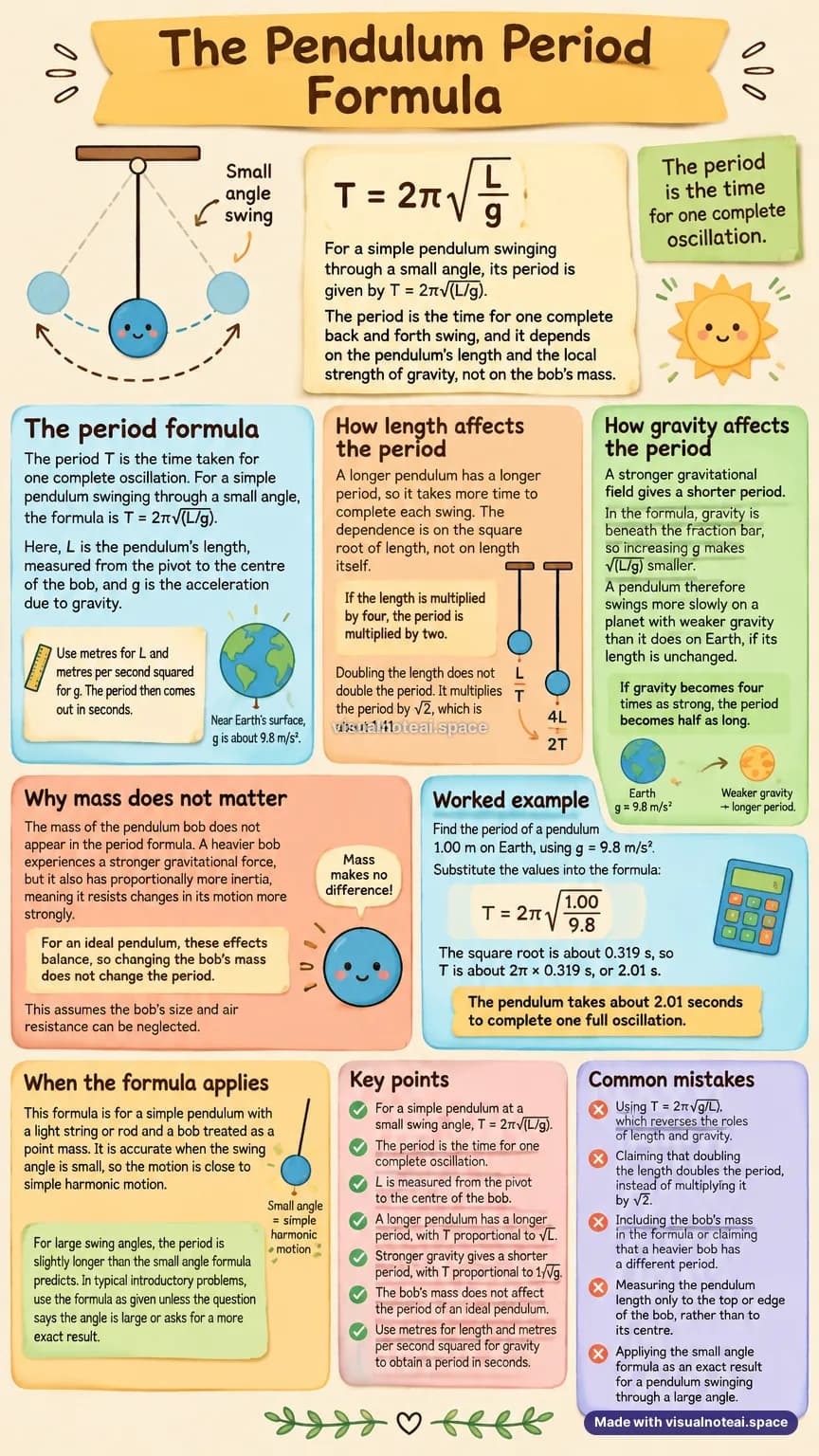
The whole topic on one page. Made with VisualNote.
!Common mistakes
- Using T = 2π√(g/L), which reverses the roles of length and gravity.
- Claiming that doubling the length doubles the period, instead of multiplying it by √2.
- Including the bob’s mass in the formula or claiming that a heavier bob has a different period.
- Measuring the pendulum length only to the top or edge of the bob, rather than to its centre.
- Applying the small angle formula as an exact result for a pendulum swinging through a large angle.
🧠Explore the map32 ideas
The mind map VisualNote made for this topic. Drag to pan, scroll to zoom.
- Simple Pendulum Period
- Period Formula
- T = 2π√(L/g)
- T: time for one complete oscillation
- L: pivot to bob centre
- g: gravitational acceleration
- Use metres and m/s²; T is in seconds
- Length and Gravity Effects
- T ∝ √L: longer pendulum, longer period
- 4× length gives 2× period
- 2× length gives √2× period
- T ∝ 1/√g: stronger gravity, shorter period
- 4× gravity gives half the period
- Bob Mass
- Mass does not appear in the formula
- Gravity and inertia effects balance
- Assumes bob size and air resistance are negligible
- Applicability
- Simple pendulum with light string or rod
- Small swing angle
- Motion approximates simple harmonic motion
- Large angles have slightly longer periods
- Worked Example
- L = 1.00 m; g = 9.8 m/s²
- T = 2π√(1.00/9.8)
- T ≈ 2.01 s
- Common Mistakes
- Reversing L and g in the formula
- Assuming doubled length doubles the period
- Including bob mass in the formula
- Measuring length to the bob's edge, not its centre
- Treating the small-angle formula as exact for large angles
- Period Formula
🃏Flashcards12 cards
- What is the period of a simple pendulum?
- The period is the time taken for one complete oscillation, or back-and-forth swing.
- What is the small-angle pendulum period formula?
- T = 2π√(L/g), where T is the period, L is the pendulum length, and g is gravitational acceleration.
- How is a pendulum’s length measured?
- Measure from the pivot to the centre of the bob.
- What units should be used in the pendulum formula?
- Use metres for L and metres per second squared (m/s²) for g; T will be in seconds.
- How does pendulum length affect the period?
- The period is proportional to √L. A longer pendulum has a longer period.
- What happens to the period if the pendulum’s length is doubled?
- The period is multiplied by √2, approximately 1.41, not by two.
- How does gravity affect the pendulum period?
- The period is proportional to 1/√g, so stronger gravity produces a shorter period.
- What happens to the period if gravity becomes four times as strong?
- The period becomes half as long.
- Does the bob’s mass affect an ideal pendulum’s period?
- No. The bob’s greater gravitational force and greater inertia balance, so mass does not appear in the period formula.
- Under what conditions does the formula apply?
- It applies to a simple pendulum with a light string or rod and a bob treated as a point mass, swinging through a small angle.
- What happens at large swing angles?
- The period is slightly longer than the small-angle formula predicts, so that formula is not exact for large swings.
- What is the period of a 1.00 m pendulum near Earth, where g = 9.8 m/s²?
- T = 2π√(1.00/9.8) ≈ 2.01 s.
✅Test yourself5 questions
Which expression gives the period of a simple pendulum swinging through a small angle?
For a small-angle simple pendulum, the period is T = 2π√(L/g).
If a pendulum’s length is doubled while gravity stays the same, by what factor does its period change?
Because the period is proportional to the square root of length, doubling the length multiplies the period by √2.
If the local gravitational acceleration becomes four times stronger, what happens to the pendulum’s period, assuming its length is unchanged?
The period is proportional to 1/√g, so quadrupling gravity halves the period.
For an ideal pendulum, what effect does increasing the bob’s mass have on its period?
The bob’s mass is absent from the period formula, and its increased weight and inertia balance.
Where should the pendulum’s length be measured from and to?
The length L is measured from the pivot to the centre of the bob.
📝The notes
The period formula
The period T is the time taken for one complete oscillation. For a simple pendulum swinging through a small angle, the formula is T = 2π√(L/g). Here, L is the pendulum’s length, measured from the pivot to the centre of the bob, and g is the acceleration due to gravity.
Use metres for L and metres per second squared for g. The period then comes out in seconds. Near Earth’s surface, g is about 9.8 m/s².
How length affects the period
A longer pendulum has a longer period, so it takes more time to complete each swing. The dependence is on the square root of length, not on length itself. For example, if the length is multiplied by four, the period is multiplied by two.
This means that doubling the length does not double the period. It multiplies the period by √2, which is about 1.41.
How gravity affects the period
A stronger gravitational field gives a shorter period. In the formula, gravity is beneath the fraction bar, so increasing g makes √(L/g) smaller. A pendulum therefore swings more slowly on a planet with weaker gravity than it does on Earth, if its length is unchanged.
The dependence on gravity is also through a square root. If gravity becomes four times as strong, the period becomes half as long.
Why mass does not matter
The mass of the pendulum bob does not appear in the period formula. A heavier bob experiences a stronger gravitational force, but it also has proportionally more inertia, meaning it resists changes in its motion more strongly.
For an ideal pendulum, these effects balance, so changing the bob’s mass does not change the period. This assumes the bob’s size and air resistance can be neglected.
Worked example
Find the period of a pendulum with length 1.00 m on Earth, using g = 9.8 m/s². Substitute the values into the formula: T = 2π√(1.00/9.8).
The square root is about 0.319 s, so T is about 2π × 0.319 s, or 2.01 s. The pendulum takes about 2.01 seconds to complete one full oscillation.
When the formula applies
This formula is for a simple pendulum with a light string or rod and a bob treated as a point mass. It is accurate when the swing angle is small, so the motion is close to simple harmonic motion.
For large swing angles, the period is slightly longer than the small angle formula predicts. In typical introductory problems, use the formula as given unless the question says the angle is large or asks for a more exact result.
Make this for your own notes
Paste a chapter or a PDF and get the sheet, map, cards, quiz and episode back in about a minute. No credit card.