
Diffusion and osmosis are both forms of passive transport, so they do not require the cell to use energy. Diffusion is the net movement of particles down their concentration gradient, while osmosis is the net movement of water across a selectively permeable membrane.
★What to remember
- Diffusion is the net movement of particles from higher concentration to lower concentration.
- Osmosis is the net movement of water across a selectively permeable membrane.
- Both diffusion and osmosis are forms of passive transport and do not require cellular energy.
- In osmosis, water moves overall from a more dilute solution toward a more concentrated solution.
- A hypertonic surrounding solution has a higher solute concentration than the cell, so water moves out of the cell overall.
- A hypotonic surrounding solution has a lower solute concentration than the cell, so water moves into the cell overall.
- An isotonic surrounding solution has the same solute concentration as the cell, so there is no net water movement, even though water continues to cross the membrane.
🎧Listen2:58 · transcript
AnnaLet’s start with the big question. What do diffusion and osmosis have in common?
MarcoThey’re both forms of passive transport. That means the cell doesn’t use energy, such as ATP, to move substances. The particles still move randomly, but a difference in concentration can create net movement in one direction.
AnnaSo what does “down a concentration gradient” mean?
MarcoIt means moving from a region where a substance is more concentrated to a region where it’s less concentrated. Diffusion is the net movement of particles that way. Those particles could be atoms, ions, or molecules.
AnnaDoes diffusion always need a membrane?
MarcoNo. It can happen in gases and liquids without a membrane. But it can also happen across a membrane if the membrane lets those particles pass. Think of food colouring spreading through water: the colouring moves overall away from the concentrated area near the drop.
AnnaThen what makes osmosis different? Is it just diffusion with a special name?
MarcoThe key difference is what moves, and where. In osmosis, the moving particles are water molecules, and their net movement is across a selectively permeable membrane. The membrane lets water through but restricts at least some dissolved substances.
AnnaAnd water moves toward the more concentrated solution, right?
MarcoRight. More precisely, water moves overall from the more dilute solution, with lower solute concentration, toward the more concentrated solution, with higher solute concentration. The solute doesn’t have to cross the membrane. And water molecules still move randomly in both directions; we’re talking about the net movement.
AnnaLet’s test that with a cell. Suppose the cell has five units of solute per hundred units of solution, and outside it there are ten. What happens?
MarcoThe surrounding solution is hypertonic to the cell because its solute concentration is higher. If water can cross but solute can’t, water moves out of the cell overall. An animal cell may shrink. A plant cell may lose water and become flaccid, with its membrane pulling away from the cell wall.
AnnaWhat if we reverse those concentrations? Ten units inside and five outside?
MarcoThen the surrounding solution is hypotonic to the cell. It has a lower solute concentration, so water moves into the cell overall. An animal cell may swell and could burst if enough water enters. A plant cell becomes turgid, and its cell wall helps prevent it from bursting.
AnnaAnd if both sides have five units per hundred, does water stop moving?
MarcoNo, and that’s an important point. The solutions are isotonic, assuming the solutes can’t cross the membrane. Water still crosses in both directions, but at equal rates. So there’s no net movement and the cell has no overall gain or loss of water.
AnnaSo the quick distinction is particles for diffusion, water across a selectively permeable membrane for osmosis. Both are passive, and isotonic doesn’t mean motion stops.
MarcoExactly. And remember, hypertonic and hypotonic describe one solution relative to another, such as the cell contents. They aren’t labels for a solution on its own.
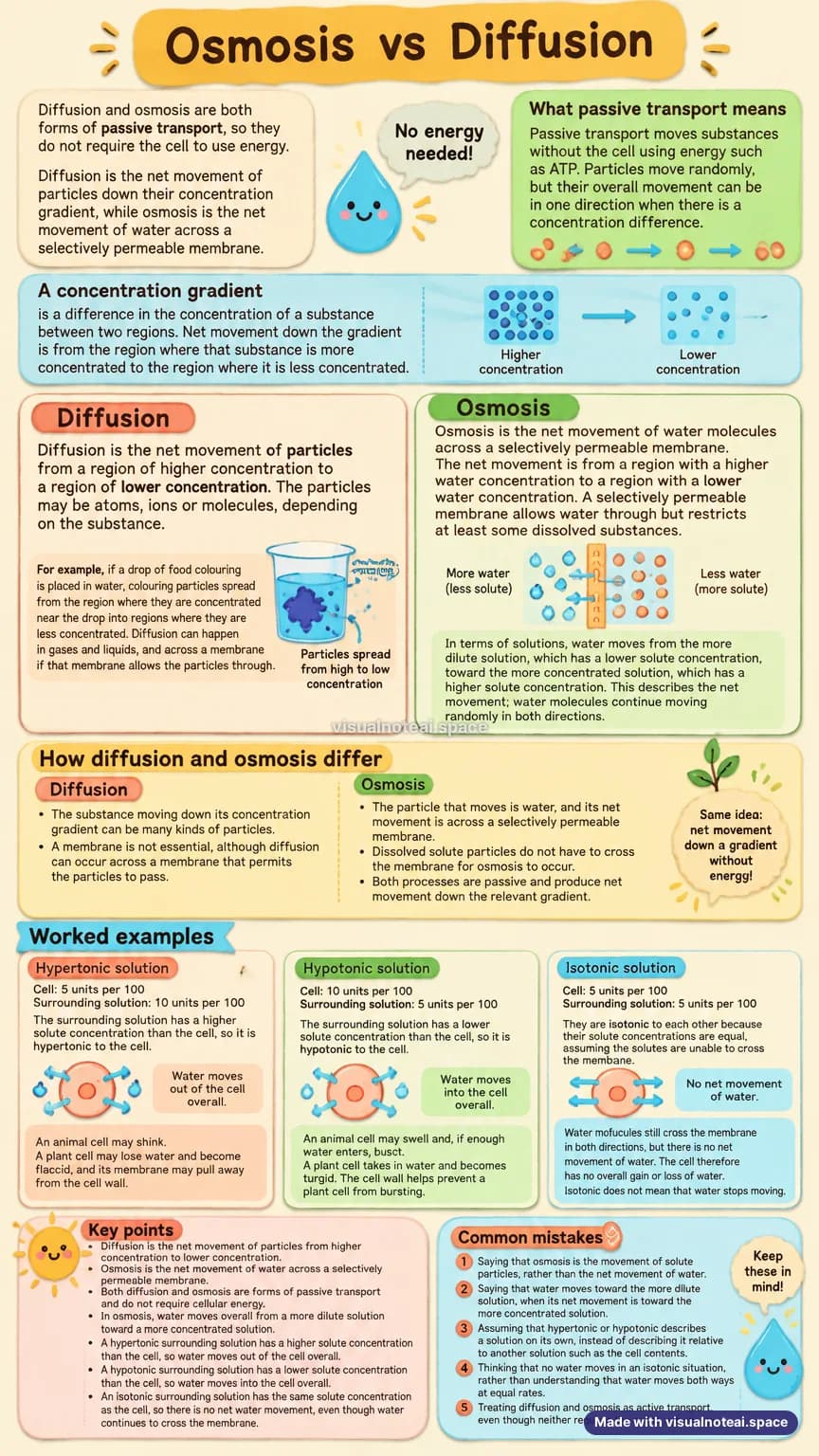
The whole topic on one page. Made with VisualNote.
!Common mistakes
- Saying that osmosis is the movement of solute particles, rather than the net movement of water.
- Saying that water moves toward the more dilute solution, when its net movement is toward the more concentrated solution.
- Assuming that hypertonic or hypotonic describes a solution on its own, instead of describing it relative to another solution such as the cell contents.
- Thinking that no water moves in an isotonic situation, rather than understanding that water moves both ways at equal rates.
- Treating diffusion and osmosis as active transport, even though neither requires the cell to use energy.
🧠Explore the map39 ideas
The mind map VisualNote made for this topic. Drag to pan, scroll to zoom.
- Osmosis vs Diffusion
- Passive Transport
- No cellular energy required
- Random particle motion
- Net movement down a concentration gradient
- Higher concentration to lower concentration
- Diffusion
- Net movement of particles
- Particles may be atoms, ions, or molecules
- May occur in gases, liquids, or across a permeable membrane
- Example: food coloring spreads through water
- Osmosis
- Net movement of water molecules
- Across a selectively permeable membrane
- Water passes; some dissolved substances are restricted
- Water moves from higher to lower water concentration
- More dilute solution to more concentrated solution
- Water moves both ways randomly
- Tonicity and Cell Responses
- Hypertonic surroundings
- Higher solute concentration than the cell
- Water moves out of the cell
- Animal cell may shrink; plant cell may become flaccid
- Hypotonic surroundings
- Lower solute concentration than the cell
- Water moves into the cell
- Animal cell may swell or burst; plant cell becomes turgid
- Isotonic surroundings
- Equal solute concentrations
- Water crosses both ways at equal rates
- No net water movement; cell has no overall water gain or loss
- Hypertonic surroundings
- Key Differences and Misconceptions
- Diffusion: many possible particles; membrane not essential
- Osmosis: water only; selectively permeable membrane required
- Osmosis is not solute movement
- Water moves toward the more concentrated solution
- Tonicity describes one solution relative to another
- Isotonic does not mean water stops moving
- Neither process is active transport
- Passive Transport
🃏Flashcards12 cards
- What is passive transport?
- Movement of substances without the cell using energy such as ATP. Particles move randomly, but a concentration difference can create net movement in one direction.
- What is a concentration gradient?
- A difference in the concentration of a substance between two regions. Net movement down the gradient is from higher concentration to lower concentration.
- What is diffusion?
- The net movement of particles from a region of higher concentration to a region of lower concentration.
- What kinds of particles can diffuse?
- Atoms, ions, or molecules can diffuse. Diffusion can occur in gases and liquids, and across a membrane if it allows those particles through.
- What is osmosis?
- The net movement of water across a selectively permeable membrane, from higher water concentration to lower water concentration.
- What does a selectively permeable membrane do?
- It allows water through while restricting at least some dissolved substances.
- How does osmosis relate to solution concentration?
- Water moves overall from the more dilute solution, with lower solute concentration, toward the more concentrated solution, with higher solute concentration.
- How do diffusion and osmosis differ?
- Diffusion can involve many kinds of particles and does not require a membrane. Osmosis specifically involves water moving across a selectively permeable membrane.
- What happens to a cell in a hypertonic surrounding solution?
- The surroundings have a higher solute concentration than the cell, so water moves out overall. An animal cell may shrink; a plant cell may become flaccid.
- What happens to a cell in a hypotonic surrounding solution?
- The surroundings have a lower solute concentration than the cell, so water moves in overall. An animal cell may swell or burst, while a plant cell becomes turgid.
- What happens in an isotonic situation?
- The cell and surroundings have equal solute concentrations, so water crosses in both directions at equal rates and there is no net movement.
- Does water stop moving in an isotonic situation?
- No. Water continues to cross the membrane in both directions; the rates are equal, so there is no overall gain or loss of water.
✅Test yourself5 questions
Which description best defines osmosis?
Osmosis is the net movement of water across a selectively permeable membrane.
During osmosis, which way does water move overall between solutions of different concentrations?
Water moves overall from the more dilute solution toward the more concentrated solution.
What happens to water in an isotonic situation when the solute cannot cross the membrane?
In an isotonic situation, water continues moving both ways, but equal rates mean there is no net movement.
A surrounding solution has a higher solute concentration than the cell. What is its effect on the cell, assuming only water can cross the membrane?
A solution with higher solute concentration than the cell is hypertonic, causing water to move out overall.
Which statement correctly compares diffusion and osmosis?
Both processes are passive, and osmosis specifically refers to water moving across a selectively permeable membrane.
📝The notes
What passive transport means
Passive transport moves substances without the cell using energy such as ATP. Particles move randomly, but their overall movement can be in one direction when there is a concentration difference.
A concentration gradient is a difference in the concentration of a substance between two regions. Net movement down the gradient is from the region where that substance is more concentrated to the region where it is less concentrated.
Diffusion
Diffusion is the net movement of particles from a region of higher concentration to a region of lower concentration. The particles may be atoms, ions or molecules, depending on the substance.
For example, if a drop of food colouring is placed in water, colouring particles spread from the region where they are concentrated near the drop into regions where they are less concentrated. Diffusion can happen in gases and liquids, and across a membrane if that membrane allows the particles through.
Osmosis
Osmosis is the net movement of water molecules across a selectively permeable membrane. The net movement is from a region with a higher water concentration to a region with a lower water concentration. A selectively permeable membrane allows water through but restricts at least some dissolved substances.
In terms of solutions, water moves from the more dilute solution, which has a lower solute concentration, toward the more concentrated solution, which has a higher solute concentration. This describes the net movement; water molecules continue moving randomly in both directions.
How diffusion and osmosis differ
In diffusion, the substance moving down its concentration gradient can be many kinds of particles. A membrane is not essential, although diffusion can occur across a membrane that permits the particles to pass.
In osmosis, the particle that moves is water, and its net movement is across a selectively permeable membrane. Dissolved solute particles do not have to cross the membrane for osmosis to occur. Both processes are passive and produce net movement down the relevant gradient.
Worked example: hypertonic solution
Suppose a cell contains 5 units of dissolved solute per 100 units of solution, and the surrounding solution contains 10 units per 100. The surrounding solution has a higher solute concentration than the cell, so it is hypertonic to the cell.
If the membrane lets water cross but not the solute, water moves out of the cell overall, from the less concentrated cell solution toward the more concentrated surrounding solution. An animal cell may shrink. A plant cell may lose water and become flaccid, and its membrane may pull away from the cell wall.
Worked example: hypotonic solution
Suppose the cell contains 10 units of dissolved solute per 100 units of solution, while the surrounding solution contains 5 units per 100. The surrounding solution has a lower solute concentration than the cell, so it is hypotonic to the cell.
Water moves into the cell overall. An animal cell may swell and, if enough water enters, burst. A plant cell takes in water and becomes turgid. The cell wall helps prevent a plant cell from bursting.
Worked example: isotonic solution
Suppose the cell and surrounding solution each contain 5 units of dissolved solute per 100 units of solution. They are isotonic to each other because their solute concentrations are equal, assuming the solutes are unable to cross the membrane.
Water molecules still cross the membrane in both directions, but there is no net movement of water because the rates are equal. The cell therefore has no overall gain or loss of water. Isotonic does not mean that water stops moving.
Make this for your own notes
Paste a chapter or a PDF and get the sheet, map, cards, quiz and episode back in about a minute. No credit card.