
Mutations change the DNA sequence, and their effects on a protein depend on where the change occurs and how it alters the genetic code. A change to one base may affect one amino acid or create a stop signal, while adding or removing bases can alter many amino acids if the number changed is not a multiple of three.
★What to remember
- A point mutation changes one nucleotide, commonly through a substitution.
- A substitution can be silent, missense, or nonsense.
- Insertions add bases and deletions remove bases.
- Insertions or deletions in multiples of three preserve the reading frame, but add or remove amino acids.
- Insertions or deletions not in multiples of three usually cause a frameshift.
- A frameshift changes the codons read after the mutation and may create an early stop codon.
- Frameshifts and nonsense mutations are often harmful, but the effect depends on the mutation’s position and the protein’s function.
🎧Listen2:56 · transcript
AnnaWhen people hear the word mutation, they may imagine a protein instantly breaking. Is that really what happens?
MarcoNot necessarily. A mutation changes the DNA sequence, but its effect depends on where the change happens and how it affects the genetic code. Genes are read in groups of three DNA bases, called codons. Each codon specifies an amino acid or a stop signal. The amino acid sequence helps shape a protein and affects what it does.
AnnaSo even a small change can have different outcomes. What happens when just one base changes?
MarcoThat is a point mutation. Often, it is a substitution: one base is replaced by another. The new codon might still specify the same amino acid. That is called a silent substitution, so the protein’s amino acid sequence does not change. Or it might specify a different amino acid, which is a missense change.
AnnaAnd a missense change does not automatically mean the protein stops working, right?
MarcoRight. Its effect can be slight or substantial. It depends on which amino acid changes and where it sits in the protein. There is also a more disruptive possibility: a substitution can turn an amino acid codon into a stop codon. That is a nonsense mutation, and it can end protein production early.
AnnaWhat if bases are added or removed instead of replaced?
MarcoAn insertion adds bases, and a deletion removes them. The key question is how many. If the number added or removed is a multiple of three, the reading frame is preserved. The protein gains or loses amino acids, but codons beyond the change usually stay grouped as before. That can still cause serious harm if an important region is altered or a stop signal appears.
AnnaAnd when the number is not a multiple of three, that is a frameshift?
MarcoExactly. The bases are regrouped into different codons from the mutation onward. That often changes many amino acids and may create an early stop codon, making a shortened protein. A frameshift near the end of a gene may affect fewer amino acids than one near the beginning, though the actual effect depends on the gene and the resulting sequence.
AnnaSo can we simply say frameshifts are worse than substitutions?
MarcoNot as a rule. Frameshifts and nonsense mutations are often more harmful than silent substitutions, but there are no guarantees. A substitution can disrupt an essential amino acid. And an insertion or deletion that preserves the frame can still damage protein function. Some changes have little or no effect, especially if they do not affect a region needed for the protein’s function.
AnnaIf we are reading a mutation description, what should we check first?
MarcoIdentify whether bases were substituted, inserted, or deleted. Then check how many changed, whether the reading frame shifts, and whether a new stop codon appears. Finally, consider where the change occurs and which protein region is affected. The mutation type helps estimate its impact, but it cannot by itself prove how harmful it will be.
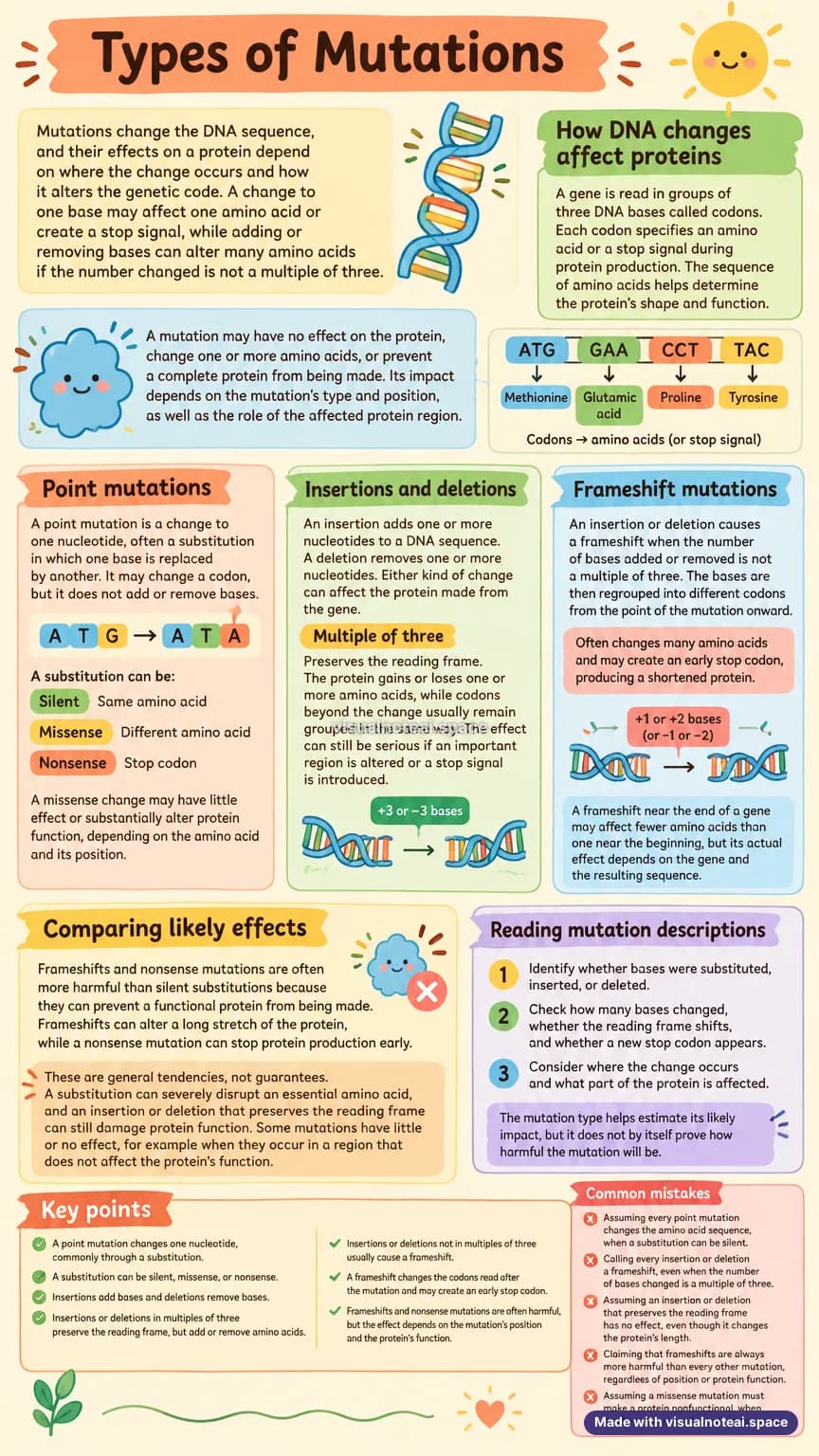
The whole topic on one page. Made with VisualNote.
!Common mistakes
- Assuming every point mutation changes the amino acid sequence, when a substitution can be silent.
- Calling every insertion or deletion a frameshift, even when the number of bases changed is a multiple of three.
- Assuming an insertion or deletion that preserves the reading frame has no effect, even though it changes the protein’s length.
- Claiming that frameshifts are always more harmful than every other mutation, regardless of position or protein function.
- Assuming a missense mutation must make a protein nonfunctional, when its effect can range from slight to severe.
🧠Explore the map30 ideas
The mind map VisualNote made for this topic. Drag to pan, scroll to zoom.
- Types of Mutations
- Genetic Code and Proteins
- Codons: Groups of Three DNA Bases
- Codons Specify Amino Acids or Stop Signals
- Amino Acid Sequence Shapes Protein Function
- Point Mutations
- Change to One Nucleotide
- Substitution: One Base Replaced
- Silent: Same Amino Acid
- Missense: Different Amino Acid
- Nonsense: Stop Codon Created
- Insertions and Deletions
- Insertion Adds Bases
- Deletion Removes Bases
- Multiple of Three: Reading Frame Preserved
- Protein Gains or Loses Amino Acids
- Frame May Be Preserved, but Function Can Still Change
- Frameshift Mutations
- Insertion or Deletion Not in a Multiple of Three
- Codons Regroup After Mutation
- Many Amino Acids May Change
- Possible Early Stop and Shortened Protein
- Effects and Prediction
- Effects Depend on Type, Position, and Protein Region
- Frameshift and Nonsense Mutations Often More Harmful
- Effects Vary; No Mutation Type Guarantees Harm
- Identify Substitution, Insertion, or Deletion
- Check Number of Bases and Reading Frame
- Check for a New Stop Codon
- Consider Mutation Location and Protein Function
- Genetic Code and Proteins
🃏Flashcards12 cards
- What is a mutation?
- A mutation is a change in the DNA sequence. Its effect on a protein depends on where it occurs and how it changes the genetic code.
- What is a codon?
- A codon is a group of three DNA bases read during protein production. It specifies an amino acid or a stop signal.
- What is a point mutation?
- A point mutation changes one nucleotide, most often by replacing one base with another (a substitution). A substitution does not add or remove bases.
- What are the three possible effects of a substitution on a codon?
- A substitution is silent if it specifies the same amino acid, missense if it specifies a different amino acid, or nonsense if it creates a stop codon.
- What determines the effect of a missense mutation?
- Its effect depends on which amino acid changes and where that amino acid is in the protein. It may have little effect or substantially disrupt protein function.
- What are insertions and deletions?
- An insertion adds one or more nucleotides to a DNA sequence; a deletion removes one or more.
- What happens when an insertion or deletion changes a multiple of three bases?
- The reading frame is preserved, but the protein gains or loses amino acids. The change can still harm function or introduce a stop signal.
- What is a frameshift mutation?
- A frameshift occurs when an insertion or deletion changes a number of bases that is not a multiple of three. It changes how codons are grouped from the mutation onward.
- What can a frameshift do to a protein?
- It often changes many amino acids and may create an early stop codon, producing a shortened protein. Its impact depends partly on where it occurs.
- Why are frameshift and nonsense mutations often harmful?
- A frameshift can alter a long stretch of a protein, while a nonsense mutation can stop protein production early. These are tendencies, not guarantees.
- Does every point mutation change a protein’s amino acid sequence?
- No. A substitution can be silent if the new codon specifies the same amino acid.
- How should you estimate the effect of a mutation?
- Identify whether bases were substituted, inserted, or deleted; check the number of bases changed, reading-frame shift, and any new stop codon. Then consider the mutation’s position and the affected protein region.
✅Test yourself5 questions
What can happen when a substitution changes a DNA codon?
A substitution can be silent if the new codon still specifies the same amino acid.
Which insertion or deletion is most likely to cause a frameshift?
A change not divisible by three alters how bases are grouped into codons after the mutation.
What is a likely effect of deleting three bases from a coding sequence?
Deleting three bases removes one codon’s worth of sequence without shifting the reading frame.
What distinguishes a nonsense substitution from a missense substitution?
A nonsense substitution converts an amino-acid codon into a stop codon, potentially ending protein production early.
Which statement best describes how mutation type relates to its harmfulness?
The effect depends not only on mutation type but also on where it occurs and the role of the affected protein region.
📝The notes
How DNA changes affect proteins
A gene is read in groups of three DNA bases called codons. Each codon specifies an amino acid or a stop signal during protein production. The sequence of amino acids helps determine the protein’s shape and function.
A mutation may have no effect on the protein, change one or more amino acids, or prevent a complete protein from being made. Its impact depends on the mutation’s type and position, as well as the role of the affected protein region.
Point mutations
A point mutation is a change to one nucleotide. The most common kind is a substitution, in which one base is replaced by another. A substitution may change a codon, but it does not add or remove bases.
A substitution can be silent if the new codon specifies the same amino acid. It can be missense if it specifies a different amino acid, or nonsense if it changes an amino acid codon into a stop codon. A missense change may have little effect or substantially alter protein function, depending on the amino acid and its position.
Insertions and deletions
An insertion adds one or more nucleotides to a DNA sequence. A deletion removes one or more nucleotides. Either kind of change can affect the protein made from the gene.
If the number of bases inserted or deleted is a multiple of three, the reading frame is preserved. The protein gains or loses one or more amino acids, while codons beyond the change usually remain grouped in the same way. The effect can still be serious if an important region is altered or a stop signal is introduced.
Frameshift mutations
An insertion or deletion causes a frameshift when the number of bases added or removed is not a multiple of three. The bases are then regrouped into different codons from the point of the mutation onward.
This often changes many amino acids and may create an early stop codon, producing a shortened protein. A frameshift near the end of a gene may affect fewer amino acids than one near the beginning, but its actual effect depends on the gene and the resulting sequence.
Comparing likely effects
Frameshifts and nonsense mutations are often more harmful than silent substitutions because they can prevent a functional protein from being made. Frameshifts can alter a long stretch of the protein, while a nonsense mutation can stop protein production early.
These are general tendencies, not guarantees. A substitution can severely disrupt an essential amino acid, and an insertion or deletion that preserves the reading frame can still damage protein function. Some mutations have little or no effect, for example when they occur in a region that does not affect the protein’s function.
Reading mutation descriptions
To predict the effect, first identify whether bases were substituted, inserted, or deleted. Then check how many bases changed, whether the reading frame shifts, and whether a new stop codon appears.
Finally, consider where the change occurs and what part of the protein is affected. The mutation type helps estimate its likely impact, but it does not by itself prove how harmful the mutation will be.
Make this for your own notes
Paste a chapter or a PDF and get the sheet, map, cards, quiz and episode back in about a minute. No credit card.