
Lord of the Flies, William Golding's 1954 novel, follows a group of British schoolboys stranded on an uninhabited island after a plane crash during an unnamed war. Its central themes concern whether civilization is a thin layer over a natural human capacity for violence, and how the desire for power corrupts the innocence the boys bring with them. Tracking how these ideas develop as the boys descend into savagery is the best way to revise them.
★What to remember
- The conch represents order, democracy and civilized rules, and its decline tracks the collapse of the boys' society.
- Simon is the only character who understands that the beast is inside the boys, and his death shows their inability to distinguish a human from a monster.
- Innocence is lost gradually through the first kill, the ritual of the pig's head, the painted faces and the deaths of Simon and Piggy.
- Jack's power rests on fear and the offer of meat and fun, while Ralph's rests on an elected conch that only works while the group agrees to obey it.
- Piggy's glasses represent reason and fire, and their theft signals the triumph of force over intellect.
- The Lord of the Flies, the pig's head, reveals to Simon that the savagery is internal to each boy.
- The naval officer at the end represents an adult world that has not learned from its own violence, which is the novel's final irony.
- Golding presents civilization as a thin, learned layer that can be stripped away when fear, appetite and the absence of authority combine.
🎧Listen2:59 · transcript
AnnaWelcome back. Today we're looking at Lord of the Flies, William Golding's 1954 novel. Marco, where would you start if you were revising it?
MarcoI'd start with the conch. It's the thing that holds the boys together at the beginning, so I'd track what happens to it. Does that sound like a good place to begin?
AnnaIt does. Ralph and Piggy find it on the beach, and Ralph blows it, at Piggy's suggestion, to call everyone together. Why do you think Golding gives the boys a symbol of order so early?
MarcoBecause they bring their rules with them. The conch means only the holder may speak. It stands for the adult world they've left behind, even though they barely understand why it matters.
AnnaExactly, and that's the key point. The boys copy the forms of adult society without really grasping them. So is civilization something natural to them, or something learned?
MarcoLearned, clearly. Golding shows the assemblies and the division of labour as imitation. Piggy is the only one who seems to grasp the reasons behind the rules, and the others mock him from the start.
AnnaLet's talk about Jack. His choir becomes a tribe with face paint, and his authority rests on fear and force instead of election. Is Jack simply the villain here?
MarcoThat's where it gets interesting. Golding doesn't make it that simple. Ralph joins in the mock hunt on Robert and gets caught up in the killing of Simon. So the savagery isn't only in Jack's camp.
AnnaRight, and that connects to Simon's conversation with the Lord of the Flies, the pig's head. What does Simon discover there?
MarcoThat the beast is inside each boy. The danger isn't an external monster. Simon is the only one who understands this, and then the boys kill him in the dark, mistaking him for the beast.
AnnaThat's a disturbing moment. They can't tell a human from a monster. And afterwards they stay silent and don't confess. What does that silence tell you about where their innocence has gone?
MarcoComplicity has replaced innocence. They're not just lost, they're accomplices now. And then Piggy dies, the conch is shattered, and there's no structure left at all.
AnnaSo the rational voice and the symbol of order are both gone. Now think about power. Why do you think the boys choose Jack over Ralph?
MarcoBecause Jack offers meat and fun and protection from the beast, while Ralph offers shelters and signal fires. Ralph's authority only works while the boys agree to obey it, so it's fragile.
AnnaThat's a sobering point, that people often prefer immediate pleasure to long-term discipline. The novel ends with a naval officer arriving. Do you read that as rescue or irony?
MarcoMostly irony. The officer comes from an adult world that's at war and has shown the same violence the boys copied. The adults haven't learned anything from it.
AnnaGood place to stop. If listeners take one thing away, what would it be?
MarcoGolding presents civilization as a thin, learned layer. When fear, appetite and the absence of authority combine, it can be stripped away quite quickly.
AnnaThanks, Marco. Thanks for listening, and we'll see you next time.
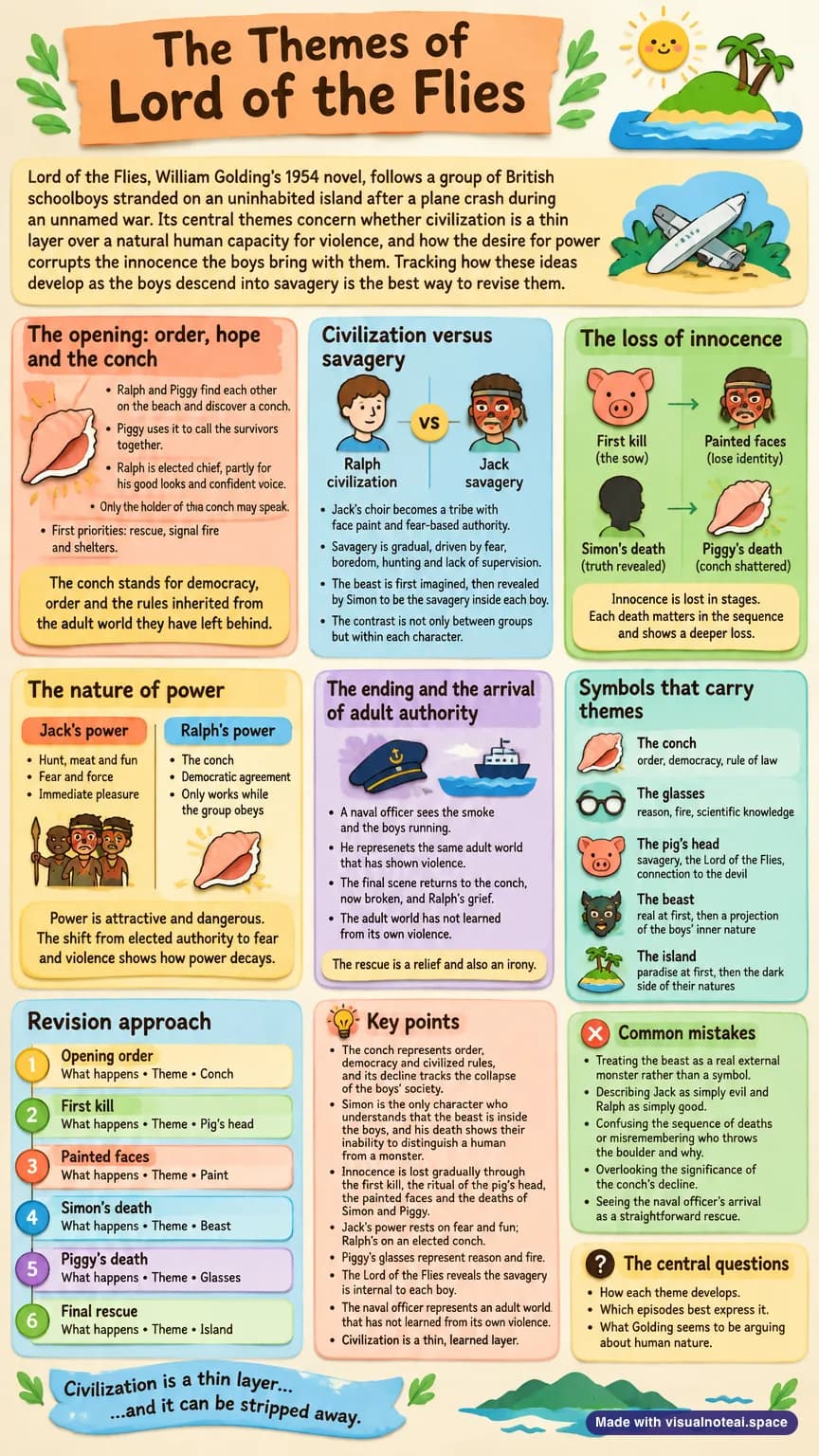
The whole topic on one page. Made with VisualNote.
!Common mistakes
- Treating the beast as a real external monster rather than as a symbol of the savagery within the boys, which misreads Simon's revelation and the novel's main argument.
- Describing Jack as simply evil and Ralph as simply good, when Golding shows Ralph capable of cruelty and the boys' descent as gradual and shared.
- Confusing the sequence of deaths, particularly placing Piggy's death before Simon's, or misremembering which character throws the boulder and why.
- Overlooking the significance of the conch's decline and treating it as a background object rather than as a measure of the group's order.
- Presenting the naval officer's arrival as a straightforward rescue without noticing the irony that the adult world has shown the same savagery as the boys.
🧠Explore the map21 ideas
The mind map VisualNote made for this topic. Drag to pan, scroll to zoom.
- Lord of the Flies: Themes
- Civilization vs savagery
- Ralph: civilization
- Jack: hunting and force
- Descent is gradual
- Savagery is internal
- Loss of innocence
- First pig kill
- Pig's head ritual
- Painted faces hide identity
- Simon's death
- Piggy's death
- Nature of power
- Jack: fear and meat
- Ralph: elected conch
- Roger: pleasure of domination
- Symbols
- Conch: order and democracy
- Piggy's glasses: reason and fire
- Pig's head: Lord of the Flies
- Beast: fear and projection
- Civilization vs savagery
🃏Flashcards14 cards
- What is the central theme of Lord of the Flies?
- Whether civilization is a thin layer over a natural human capacity for violence, and how the desire for power corrupts the innocence of the boys.
- What does the conch represent?
- Order, democracy and the rules inherited from the adult world. Its decline tracks the collapse of the boys' society.
- Who is elected chief at the start of the novel, and why?
- Ralph, partly for his good looks and confident voice.
- What is the main opposition in the novel?
- Ralph, who wants to maintain civilization, versus Jack, who wants hunting, ritual and immediate gratification.
- Who is the only character who understands the beast is inside the boys?
- Simon, who learns this from the Lord of the Flies (the pig's head) and is killed by the boys who mistake him for the beast.
- What does the Lord of the Flies (the pig's head) reveal?
- That the savagery and danger are internal to each boy rather than an external creature.
- What are the key stages of the boys' loss of innocence?
- The first pig kill, the slaughter of the sow with its blood and its head on a stick, the painted faces, Simon's death, and Piggy's death.
- What does Piggy's death accomplish in the novel?
- Roger releases a boulder onto Piggy and the conch is shattered, destroying the rational voice and the symbol of order.
- What is the source of Jack's power?
- Fear, and the offer of meat, fun and protection from the beast, which the boys prefer to Ralph's dull demands.
- What is the source of Ralph's authority, and why is it weak?
- The elected conch and group agreement; it is weak because it depends on the boys' willingness to obey.
- What do Piggy's glasses symbolize?
- Reason, scientific knowledge and fire; their theft signals the triumph of brute force over intellect.
- Who is the naval officer at the end, and what is the irony of his arrival?
- He represents the adult world at war, which has already shown the same capacity for violence the boys imitated, so the adult world is no better, only more distant.
- What does the ending suggest about the rescue?
- It returns the boys to a society that cannot recognise its own savagery, so the rescue is ironic rather than a simple relief.
- What did Golding seem to be arguing about human nature?
- That civilization is a thin, learned layer that can be stripped away when fear, appetite and the absence of authority combine; he came to doubt the belief that human nature is essentially good.
✅Test yourself5 questions
What does the conch primarily symbolize in Lord of the Flies?
The conch is used to call meetings and only its holder may speak, so it represents the democratic order the boys inherit from the adult world.
Why are the boys able to kill Simon without recognizing their mistake?
Simon runs out of the forest at night during the frenzied dance, and in the darkness the boys take him for the beast and kill him.
Why do many boys prefer Jack's leadership to Ralph's?
Jack promises meat, fun and protection, which the boys find more attractive than Ralph's demands for shelters and a signal fire.
Who tells Simon that the beast is the savagery inside each boy?
In the conversation with Simon, the Lord of the Flies, the sow's head on a stick, reveals that the beast is the savagery within each boy.
What does Piggy represent in the novel?
Piggy is intelligent and rational, using scientific reasoning, even though the other boys mock him from the start.
📝The notes
The opening: order, hope and the conch
At the start of the novel Ralph and Piggy find each other on the beach and discover a conch shell, which Ralph blows, at Piggy's suggestion, to call the survivors together. Ralph is elected chief, partly for his good looks and confident voice, and the boys establish a meeting system in which only the holder of the conch may speak. Their first priorities are rescue, a signal fire on the mountain and the building of shelters. The conch therefore stands for democracy, order and the rules inherited from the adult world they have left behind.
The boys initially treat the island as a holiday and try to reproduce school routines, with assemblies and the division of labour. Golding shows that their civilized behaviour is learned rather than natural, since they copy the forms of adult society without fully understanding why they matter. Piggy, who is intelligent but overweight and short-sighted, represents rational thought and scientific reasoning, yet he is mocked by the others from the beginning.
This opening stage sets the baseline against which the descent is measured. Readers should note that the conch's authority depends entirely on the boys agreeing to respect it, which foreshadows its eventual destruction.
Civilization versus savagery
The central opposition in the novel is between Ralph, who wants to maintain civilization, and Jack, who wants hunting, ritual and immediate gratification. Jack's choir, dressed in their black caps, becomes a tribe with face paint and a leader whose authority is based on fear and force rather than election. Jack's transformation from head boy into a painted hunter marks the moment the boys begin to separate into two camps, and it is important to see that the division is caused by appetite as much as by ideas.
Golding's treatment of savagery is complicated. The boys are not simply good or bad, and the descent is gradual, driven by fear of the beast, boredom, the pleasure of hunting and the removal of adult supervision. The beast itself is first imagined as a physical creature and later revealed by Simon, in a conversation with the Lord of the Flies, to be the savagery inside each boy. That revelation, delivered by a rotting pig's head on a stick, is the novel's clearest statement that the danger is internal rather than external.
The contrast is not only between two groups but within each character. Ralph is capable of cruelty, most notably when he joins in the mock hunt in which Robert plays the pig and in the rising frenzy of the killing of Simon, and the novel does not let him stand above the savagery he opposes.
The loss of innocence
Innocence is lost in stages, and each stage can be identified through specific episodes. The first pig kill is followed later by the slaughter of a sow, whose blood is smeared on the hunters and whose head is left on a stick for the beast, which marks the boys' first step towards identifying with violence. Jack's painted face allows the boys to lose their individual identity, and Golding presents this as a step away from shame and accountability. The hunt becomes a theatre in which the boys act out a fantasy in which the usual rules do not apply.
Simon's death is the key moment of lost innocence in the novel. Simon is the only character who understands the truth about the beast, and he goes to tell the others, but in the dark and in the frenzy of the dance they take him for the beast and kill him. The boys cannot recognise the difference between a human and a monster, which is Golding's most disturbing point about human nature. The moment is followed by the boys' silence and their failure to remember or confess, which shows that innocence has been replaced by complicity.
Piggy's death, when Roger releases a boulder onto him and the conch is shattered, completes this process. The rational voice and the symbol of order are both destroyed, and the boys are left with no structure to restrain them. Readers should be able to explain why each death matters in the sequence, not just what happens.
The nature of power
Power in the novel is shown to be attractive and dangerous. Jack's power begins with the simple authority of the hunt, and he discovers that he can command obedience through the offer of meat and the promise of protection from the beast. His tribe grows because the boys prefer his promise of food and fun to Ralph's dull demands for shelters and signal fires. Golding suggests that people often choose the leader who offers immediate pleasure over the one who asks for long-term discipline.
Ralph's leadership is based on the conch and on the democratic agreement of the group, but this authority is weak because it depends on the willingness of the boys to obey. As the group fragments, the conch loses its power, and Ralph is reduced to a fugitive hunted by the tribe he once led. The shift from elected authority to the authority of fear and violence is one of the novel's clearest portraits of how power decays when it is not supported by shared values.
Roger, who throws stones that are deliberately aimed to miss at first and then not, represents the pleasure of domination in its purest form. The novel suggests that power without restraint leads to cruelty, and that those who exercise it often do so because they enjoy the exercise rather than because they believe in any cause.
The ending and the arrival of adult authority
The novel closes with the arrival of a naval officer who sees the smoke from the island and the boys running from the forest, with Ralph crying for Piggy and for the loss of innocence. The officer's presence is ironic, since he represents the same adult world that is at war and that has already shown the capacity for violence that the boys have imitated. Golding leaves the reader to notice that the adult world is no better, only more distant.
The final scene returns to Ralph's grief. His weeping is the first sign that he has understood what has happened to them all. The officer's reaction, which includes an assumption that the boys were playing a game, shows that the adult world has not grasped the lesson of the island, and the novel invites the reader to draw that conclusion.
The ending completes the thematic arc of civilization and savagery, since rescue returns the boys to a society that cannot recognise its own savagery. Students should be able to discuss whether the rescue is a relief or a further irony.
Symbols that carry the themes
The conch, the glasses, the pig's head and the beast are the main symbols, and each carries a specific thematic weight. The conch represents order, democracy and the rule of law, and its gradual loss of power tracks the decline of civilization on the island. Piggy's glasses are a source of fire and of scientific knowledge, so their theft by Jack's tribe signals the triumph of brute force over reason. The pig's head, the Lord of the Flies, is the physical image of the savagery the boys carry inside, and its name connects to the devil.
The beast is the most ambiguous symbol. At first it is a real fear, a creature the younger boys believe lives in the forest, but it becomes a projection of the boys' inner nature. The dead parachutist, who is mistaken for the beast at night, reinforces this idea by showing that fear can make ordinary things seem monstrous. Students should be able to link each symbol to a point in the descent.
The island itself is also symbolic, offering the boys paradise at first and then revealing the dark side of their own natures once they are removed from the constraints of adult society.
Revision approach
When revising, it helps to organise notes around the stages of the descent: the opening order, the first kill, the painted faces, Simon's death, Piggy's death and the final rescue. Under each stage, note what happens, which theme it illustrates and which symbol is most important. This structure allows you to answer both essay questions about specific episodes and questions about the novel as a whole.
It is also useful to prepare a few quotations that you can recall accurately, and to practise explaining how Golding's language, such as the descriptions of the island's beauty alongside the descriptions of violence, creates tension. Pay attention to how the narrator shifts between the boys' perspectives and an omniscient view, since this affects how the reader judges the characters.
Finally, practise connecting the themes to the historical and cultural context of the 1950s and the Second World War, since Golding wrote the novel as a response to the belief that human nature is essentially good, which he had come to doubt.
So the central questions for revision are how each theme develops, which episodes best express it, and what Golding seems to be arguing about human nature.
Make this for your own notes
Paste a chapter or a PDF and get the sheet, map, cards, quiz and episode back in about a minute. No credit card.