
The ideal gas law relates a gas’s pressure, volume, amount and temperature. Use PV = nRT to find any one of these quantities when the other three are known, while keeping units consistent.
★What to remember
- The ideal gas law is PV = nRT.
- P is pressure, V is volume, n is amount in moles, and T is temperature in kelvins.
- R must match the pressure and volume units being used.
- Convert Celsius temperatures to kelvins by adding 273.15.
- Rearrange the equation to make the unknown quantity the subject.
- Check that units cancel correctly and that the answer has the expected unit.
- Use absolute pressure in the ideal gas law.
🎧Listen2:50 · transcript
AnnaToday we’re talking through the ideal gas law. Marco, what does it help us find?
MarcoIt relates a gas’s pressure, volume, amount, and temperature. If we know any three of those quantities, we can use the law to find the fourth.
AnnaAnd the equation is?
MarcoP V equals n R T. P is pressure, V is volume, n is the amount of gas in moles, T is absolute temperature in kelvins, and R is the ideal gas constant.
AnnaWhy do we need to pay special attention to R?
MarcoIts value depends on the units. If pressure is in kilopascals and volume is in litres, use eight point three one four kilopascal litres per mole per kelvin. If pressure is in atmospheres and volume is in litres, use zero point zero eight two zero six litre atmospheres per mole per kelvin.
AnnaSo choosing the equation is only part of the job. What should we check before substituting values?
MarcoMake sure the pressure and volume units match the R value. Temperature must be in kelvins, not degrees Celsius. To convert Celsius to kelvins, add two hundred seventy-three point one five. So twenty-five degrees Celsius is two hundred ninety-eight point one five kelvins.
AnnaAnd pressure needs a particular kind of value, right?
MarcoYes. Use absolute pressure, not gauge pressure. Then rearrange the equation to put the unknown quantity by itself, substitute the known values, and check that the units cancel as expected.
AnnaLet’s try finding pressure. Suppose we have zero point five zero zero moles, ten point zero litres, and a temperature of three hundred kelvins. What do we do?
MarcoRearrange to pressure equals n R T divided by V. Using the kilopascal version of R, the calculation gives one hundred twenty-four point seven kilopascals. The litres and other matching units cancel, leaving pressure.
AnnaWhat if pressure is known and volume is the unknown?
MarcoThen volume equals n R T divided by P. For zero point two five zero moles at two hundred ninety-eight kelvins and one hundred kilopascals, the volume is six point one nine litres.
AnnaCould we also find the amount of gas?
MarcoYes. Amount in moles equals P V divided by R T. With five point zero zero litres, one hundred fifty kilopascals, and three hundred kelvins, we get zero point three zero one moles.
AnnaAnd for temperature, we isolate T?
MarcoExactly. Temperature equals P V divided by n R. For two hundred kilopascals, twelve point zero litres, and zero point eight zero zero moles, the result is three hundred sixty-one kelvins, to three significant figures. Convert to Celsius only if asked.
AnnaWhat mistakes should listeners watch for?
MarcoUsing Celsius directly, choosing an R value that doesn’t match the units, mixing pressure units, or rearranging incorrectly. For pressure, divide n R T by V; don’t multiply by V. And always check that the final unit makes sense.
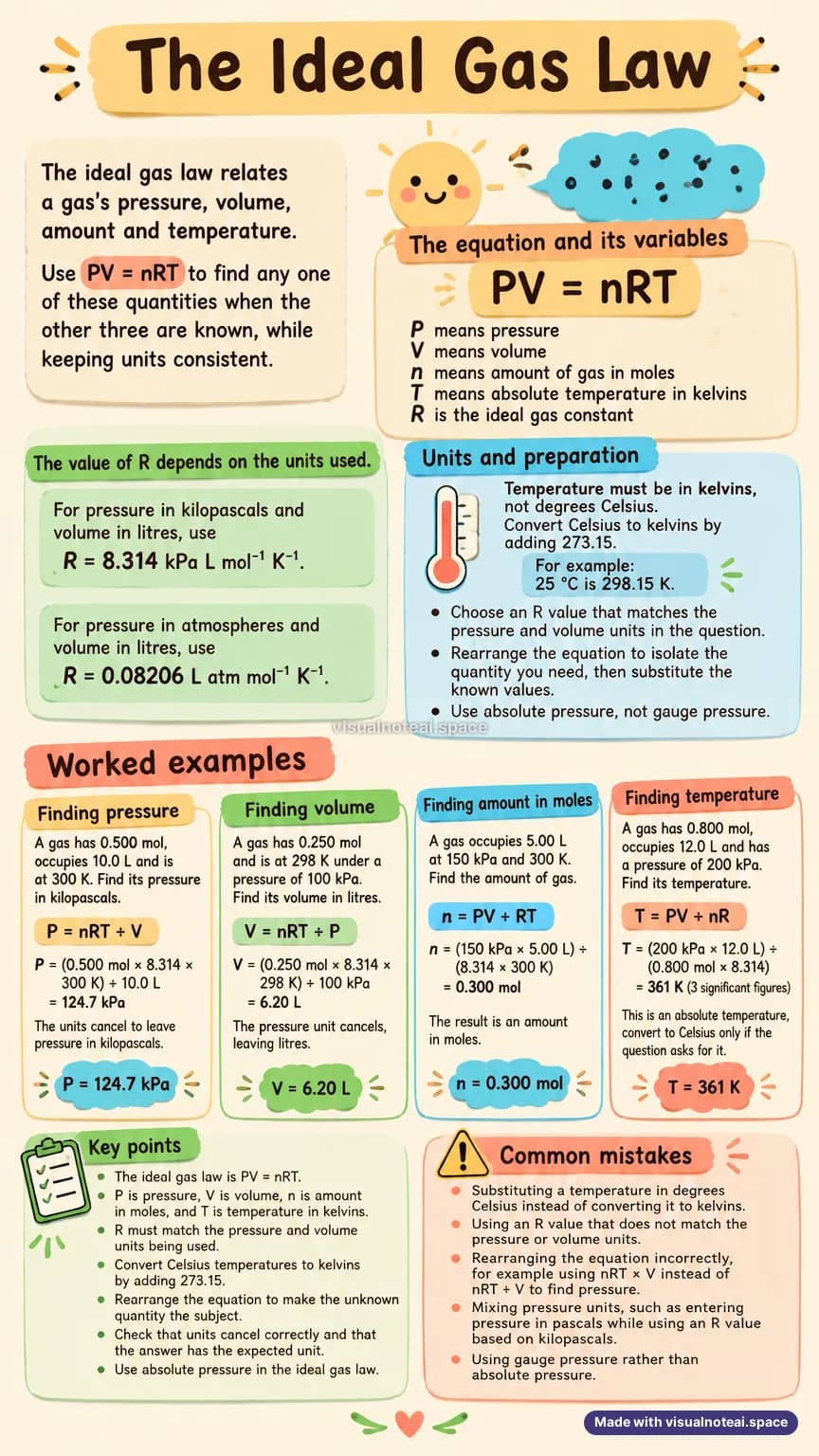
The whole topic on one page. Made with VisualNote.
!Common mistakes
- Substituting a temperature in degrees Celsius instead of converting it to kelvins.
- Using an R value that does not match the pressure or volume units.
- Rearranging the equation incorrectly, for example using nRT × V instead of nRT ÷ V to find pressure.
- Mixing pressure units, such as entering pressure in pascals while using an R value based on kilopascals.
- Using gauge pressure rather than absolute pressure.
🧠Explore the map33 ideas
The mind map VisualNote made for this topic. Drag to pan, scroll to zoom.
- Ideal Gas Law
- Equation and Variables
- PV = nRT
- P: Pressure
- V: Volume
- n: Amount in moles
- T: Absolute temperature in kelvins
- R: Ideal gas constant
- Units and Preparation
- Temperature must be in kelvins
- Celsius to kelvins: add 273.15
- Match R to pressure and volume units
- R = 8.314 kPa·L·mol⁻¹·K⁻¹
- R = 0.08206 L·atm·mol⁻¹·K⁻¹
- Use absolute pressure, not gauge pressure
- Solving for an Unknown
- Pressure: P = nRT ÷ V
- Volume: V = nRT ÷ P
- Amount: n = PV ÷ RT
- Temperature: T = PV ÷ nR
- Substitute known values
- Check unit cancellation and answer units
- Worked Examples
- Pressure: 0.500 mol, 10.0 L, 300 K → 124.7 kPa
- Volume: 0.250 mol, 100 kPa, 298 K → 6.19 L
- Amount: 5.00 L, 150 kPa, 300 K → 0.301 mol
- Temperature: 0.800 mol, 12.0 L, 200 kPa → 361 K
- Common Mistakes
- Using Celsius instead of kelvins
- Choosing an R value that mismatches units
- Mixing pressure units
- Rearranging the equation incorrectly
- Using gauge pressure instead of absolute pressure
- Equation and Variables
🃏Flashcards12 cards
- What does the ideal gas law relate?
- It relates a gas’s pressure, volume, amount, and temperature.
- What is the ideal gas law equation?
- PV = nRT.
- What do P, V, n, and T represent?
- P is pressure, V is volume, n is the amount of gas in moles, and T is absolute temperature in kelvins.
- What does R represent?
- R is the ideal gas constant; choose its value to match the pressure and volume units used.
- Which R value is used with pressure in kPa and volume in litres?
- R = 8.314 kPa·L·mol⁻¹·K⁻¹.
- Which R value is used with pressure in atm and volume in litres?
- R = 0.08206 L·atm·mol⁻¹·K⁻¹.
- How do you convert Celsius to kelvins?
- Add 273.15. For example, 25 °C = 298.15 K.
- What is the rearranged equation for pressure?
- P = nRT ÷ V.
- What is the rearranged equation for volume?
- V = nRT ÷ P.
- What are the rearranged equations for amount and temperature?
- n = PV ÷ RT, and T = PV ÷ nR.
- What kind of pressure should be used in the ideal gas law?
- Use absolute pressure, not gauge pressure.
- What checks should you make when solving an ideal gas law problem?
- Use consistent units and the matching R value, convert temperature to kelvins, rearrange correctly, and check that units cancel to give the expected unit.
✅Test yourself5 questions
A gas is at 25 °C. What temperature should be used in the ideal gas law?
Convert Celsius to kelvins by adding 273.15, so 25 °C is 298.15 K.
Which value of R matches pressure in kilopascals and volume in litres?
For pressure in kilopascals and volume in litres, use R = 8.314 kPa L mol⁻¹ K⁻¹.
Which rearrangement of PV = nRT gives pressure, P?
Dividing both sides of PV = nRT by V gives P = nRT ÷ V.
Which pressure should be used in the ideal gas law?
The ideal gas law requires absolute pressure rather than gauge pressure.
A gas occupies 5.00 L at 150 kPa and 300 K. Using R = 8.314 kPa L mol⁻¹ K⁻¹, what is the amount of gas?
Using n = PV ÷ RT gives (150 × 5.00) ÷ (8.314 × 300) = 0.301 mol.
📝The notes
The equation and its variables
The ideal gas law is PV = nRT. P means pressure, V means volume, n means amount of gas in moles, T means absolute temperature in kelvins, and R is the ideal gas constant.
The value of R depends on the units used. For pressure in kilopascals and volume in litres, use R = 8.314 kPa L mol⁻¹ K⁻¹. For pressure in atmospheres and volume in litres, use R = 0.08206 L atm mol⁻¹ K⁻¹.
Units and preparation
Temperature must be in kelvins, not degrees Celsius. Convert Celsius to kelvins by adding 273.15. For example, 25 °C is 298.15 K.
Choose an R value that matches the pressure and volume units in the question. Rearrange the equation to isolate the quantity you need, then substitute the known values. Pressure should be absolute pressure, not gauge pressure.
Worked example: finding pressure
A gas has 0.500 mol, occupies 10.0 L and is at 300 K. Find its pressure in kilopascals. Rearrange PV = nRT to P = nRT ÷ V.
Substitute the values: P = (0.500 mol × 8.314 kPa L mol⁻¹ K⁻¹ × 300 K) ÷ 10.0 L = 124.7 kPa. The units cancel to leave pressure in kilopascals.
Worked example: finding volume
A gas has 0.250 mol and is at 298 K under a pressure of 100 kPa. Find its volume in litres. Rearrange the equation to V = nRT ÷ P.
Substitute: V = (0.250 mol × 8.314 kPa L mol⁻¹ K⁻¹ × 298 K) ÷ 100 kPa = 6.19 L. The pressure unit cancels, leaving litres.
Worked example: finding amount in moles
A gas occupies 5.00 L at 150 kPa and 300 K. Find the amount of gas. Rearrange the equation to n = PV ÷ RT.
Substitute: n = (150 kPa × 5.00 L) ÷ (8.314 kPa L mol⁻¹ K⁻¹ × 300 K) = 0.301 mol, to three significant figures. The result is an amount in moles.
Worked example: finding temperature
A gas has 0.800 mol, occupies 12.0 L and has a pressure of 200 kPa. Find its temperature. Rearrange the equation to T = PV ÷ nR.
Substitute: T = (200 kPa × 12.0 L) ÷ (0.800 mol × 8.314 kPa L mol⁻¹ K⁻¹) = 361 K to three significant figures. This is an absolute temperature; convert to Celsius only if the question asks for it.
Make this for your own notes
Paste a chapter or a PDF and get the sheet, map, cards, quiz and episode back in about a minute. No credit card.