
Glycolysis is a sequence of ten reactions in the cytosol that converts one glucose molecule into two pyruvate molecules. It first uses ATP to prepare glucose for breakdown, then produces ATP and NADH as the resulting three-carbon molecules are converted to pyruvate.
★What to remember
- Glycolysis takes place in the cytosol and has ten reactions.
- One glucose is converted into two pyruvate molecules.
- The investment phase uses two ATP per glucose.
- The payoff phase produces four ATP per glucose, giving a net gain of two ATP.
- Two NADH are produced per glucose in reaction 6.
- After reaction 5, two glyceraldehyde 3-phosphate molecules continue through the pathway.
- ATP is made by substrate-level phosphorylation in reactions 7 and 10.
🎧Listen3:06 · transcript
AnnaLet’s walk through glycolysis without losing track of the energy. What happens overall?
MarcoOne glucose molecule goes through ten reactions in the cytosol and becomes two pyruvate molecules. The pathway has two phases: an investment phase, then a payoff phase. What do we invest?
AnnaTwo ATP molecules. In the first reaction, hexokinase, or glucokinase in some tissues, transfers a phosphate from ATP to glucose. That makes glucose six-phosphate. Then phosphoglucose isomerase rearranges it into fructose six-phosphate. Why spend another ATP?
MarcoPhosphofructokinase one transfers that second phosphate, forming fructose one, six-bisphosphate. Those are the first three reactions, and together they use two ATP per glucose. Then aldolase splits the six-carbon sugar into two different three-carbon sugars. Do both continue in the same form?
AnnaNot immediately. The split produces glyceraldehyde three-phosphate and dihydroxyacetone phosphate. In reaction five, triose phosphate isomerase converts the dihydroxyacetone phosphate into another glyceraldehyde three-phosphate. So now there are two matching molecules. Why does that matter for counting?
MarcoBecause every remaining reaction happens twice for each glucose. That’s the key to the payoff. In reaction six, glyceraldehyde three-phosphate dehydrogenase oxidizes each molecule and adds inorganic phosphate. NAD plus is reduced to NADH. How much NADH does that make?
AnnaTwo NADH per glucose. And that happens in reaction six, not in the reactions that make ATP. Next, phosphoglycerate kinase transfers a phosphate from one, three-bisphosphoglycerate to ADP, making ATP and three-phosphoglycerate. Since the reaction happens twice, that gives two ATP. What comes after?
MarcoPhosphoglycerate mutase rearranges three-phosphoglycerate into two-phosphoglycerate. Then enolase removes water, producing phosphoenolpyruvate, or PEP. Finally, pyruvate kinase transfers a phosphate from PEP to ADP. That makes ATP and pyruvate. Again, it happens twice, so reaction ten makes two ATP and completes the two pyruvate molecules. How do we get the net ATP total?
AnnaThe payoff phase makes four ATP altogether: two at reaction seven and two at reaction ten. But the investment phase used two, so the net gain is two ATP per glucose, not four. ATP is made by substrate-level phosphorylation in reactions seven and ten. What should we keep in mind about the final yield?
MarcoPer glucose, glycolysis produces two ATP net, two NADH, and two pyruvate. The overall net products also include two water molecules, though the exact equation can vary depending on how acid and ion forms are written. And the main bookkeeping traps are forgetting the pathway doubles after reaction five, or mixing up the three different phosphoglycerate compounds.
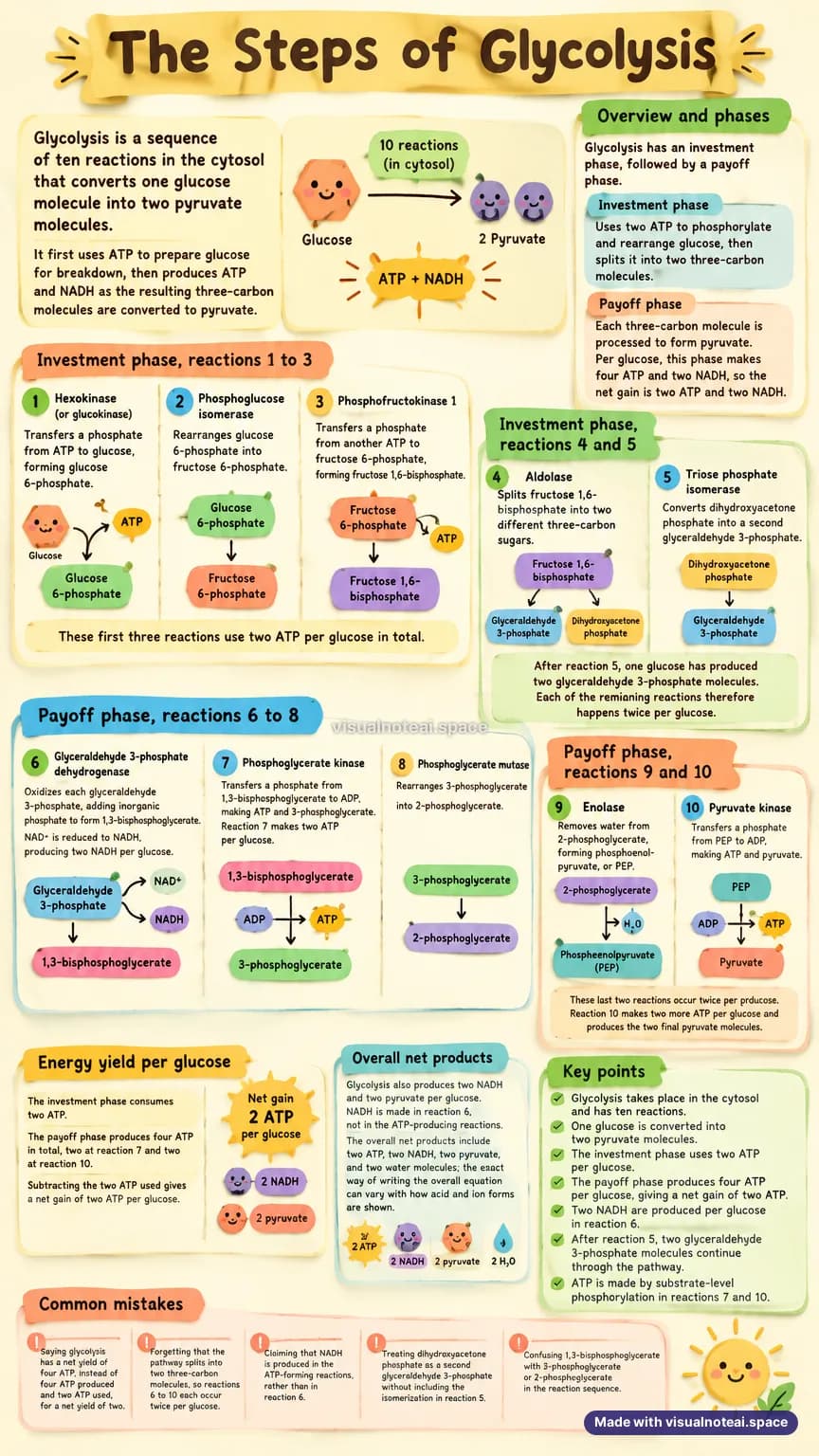
The whole topic on one page. Made with VisualNote.
!Common mistakes
- Saying glycolysis has a net yield of four ATP, instead of four ATP produced and two ATP used, for a net yield of two.
- Forgetting that the pathway splits into two three-carbon molecules, so reactions 6 to 10 each occur twice per glucose.
- Claiming that NADH is produced in the ATP-forming reactions, rather than in reaction 6.
- Treating dihydroxyacetone phosphate as a second glyceraldehyde 3-phosphate without including the isomerization in reaction 5.
- Confusing 1,3-bisphosphoglycerate with 3-phosphoglycerate or 2-phosphoglycerate in the reaction sequence.
🧠Explore the map32 ideas
The mind map VisualNote made for this topic. Drag to pan, scroll to zoom.
- Glycolysis
- Overview
- Ten reactions in the cytosol
- One glucose becomes two pyruvate
- Investment phase
- Reactions 1 to 3 use two ATP
- Hexokinase or glucokinase: glucose → glucose 6-phosphate
- Phosphoglucose isomerase: glucose 6-phosphate → fructose 6-phosphate
- Phosphofructokinase 1: fructose 6-phosphate → fructose 1,6-bisphosphate
- Sugar splitting
- Aldolase splits fructose 1,6-bisphosphate
- Glyceraldehyde 3-phosphate (G3P)
- Dihydroxyacetone phosphate (DHAP)
- Triose phosphate isomerase converts DHAP to G3P
- Two G3P molecules continue
- Aldolase splits fructose 1,6-bisphosphate
- Payoff phase
- Reactions 6 to 10 occur twice per glucose
- Reaction 6: G3P dehydrogenase forms 1,3-bisphosphoglycerate
- Reaction 6 produces two NADH
- Reaction 7: phosphoglycerate kinase forms ATP and 3-phosphoglycerate
- Reaction 8: phosphoglycerate mutase forms 2-phosphoglycerate
- Reaction 9: enolase forms phosphoenolpyruvate (PEP)
- Reaction 10: pyruvate kinase forms ATP and pyruvate
- ATP yield
- Investment: two ATP consumed
- Payoff: four ATP produced
- ATP made by substrate-level phosphorylation in reactions 7 and 10
- Net: two ATP per glucose
- Net products per glucose
- Two NADH
- Two pyruvate
- Two water molecules
- Overview
🃏Flashcards12 cards
- Where does glycolysis take place, and how many reactions does it contain?
- Glycolysis takes place in the cytosol and consists of ten reactions.
- What are the overall carbon products of glycolysis?
- One glucose molecule is converted into two pyruvate molecules.
- What happens during glycolysis’s investment phase?
- Two ATP molecules are used to phosphorylate and prepare glucose for breakdown, which ultimately yields two three-carbon molecules.
- What happens during glycolysis’s payoff phase?
- The two three-carbon molecules are processed to produce four ATP and two NADH per glucose.
- What is glycolysis’s net ATP yield per glucose?
- The pathway produces four ATP and uses two ATP, for a net gain of two ATP.
- What enzyme catalyzes reaction 1, and what does it produce?
- Hexokinase (or glucokinase in some tissues) transfers a phosphate from ATP to glucose, producing glucose 6-phosphate.
- What does phosphofructokinase 1 do in reaction 3?
- It uses ATP to phosphorylate fructose 6-phosphate, forming fructose 1,6-bisphosphate.
- What happens to fructose 1,6-bisphosphate in reactions 4 and 5?
- Aldolase splits it into glyceraldehyde 3-phosphate and dihydroxyacetone phosphate; triose phosphate isomerase converts the latter into a second glyceraldehyde 3-phosphate.
- Why do reactions 6 to 10 occur twice per glucose?
- After reaction 5, one glucose has produced two glyceraldehyde 3-phosphate molecules, and each continues through the remaining reactions.
- In which glycolysis reaction is NADH produced?
- Reaction 6, catalyzed by glyceraldehyde 3-phosphate dehydrogenase, produces two NADH per glucose as glyceraldehyde 3-phosphate is oxidized.
- Which reactions make ATP by substrate-level phosphorylation?
- Reactions 7 and 10 make ATP by transferring a phosphate to ADP. Together they produce four ATP per glucose.
- What are the main net products of glycolysis per glucose?
- Two ATP, two NADH, two pyruvate, and two water molecules.
✅Test yourself5 questions
How many ATP molecules are gained net per glucose molecule during glycolysis?
Glycolysis produces four ATP but uses two ATP, leaving a net gain of two.
What happens to dihydroxyacetone phosphate after aldolase splits fructose 1,6-bisphosphate?
Triose phosphate isomerase converts dihydroxyacetone phosphate into a second glyceraldehyde 3-phosphate.
At which glycolytic reaction is NADH produced?
Reaction 6 oxidizes glyceraldehyde 3-phosphate and reduces NAD+ to NADH.
Why do reactions 6 through 10 each occur twice per glucose molecule?
After reaction 5, two glyceraldehyde 3-phosphate molecules proceed through the remaining reactions.
Which glycolytic reactions produce ATP by transferring phosphate directly to ADP?
Phosphoglycerate kinase in reaction 7 and pyruvate kinase in reaction 10 make ATP by substrate-level phosphorylation.
📝The notes
Overview and phases
Glycolysis has an investment phase, followed by a payoff phase. In the investment phase, two ATP molecules are used to phosphorylate and rearrange glucose, then split it into two three-carbon molecules.
In the payoff phase, each three-carbon molecule is processed through the same reactions to form pyruvate. Per glucose, this phase makes four ATP and two NADH, so the net gain is two ATP and two NADH.
Investment phase, reactions 1 to 3
Reaction 1: Hexokinase, or glucokinase in some tissues, transfers a phosphate from ATP to glucose, forming glucose 6-phosphate. Reaction 2: phosphoglucose isomerase rearranges glucose 6-phosphate into fructose 6-phosphate.
Reaction 3: phosphofructokinase 1 transfers a phosphate from another ATP to fructose 6-phosphate, forming fructose 1,6-bisphosphate. These first three reactions use two ATP per glucose in total.
Investment phase, reactions 4 and 5
Reaction 4: aldolase splits fructose 1,6-bisphosphate into two different three-carbon sugars, glyceraldehyde 3-phosphate and dihydroxyacetone phosphate. Reaction 5: triose phosphate isomerase converts dihydroxyacetone phosphate into a second glyceraldehyde 3-phosphate.
After reaction 5, one glucose has produced two glyceraldehyde 3-phosphate molecules. Each of the remaining reactions therefore happens twice per glucose.
Payoff phase, reactions 6 to 8
Reaction 6: glyceraldehyde 3-phosphate dehydrogenase oxidizes each glyceraldehyde 3-phosphate, adding inorganic phosphate to form 1,3-bisphosphoglycerate. NAD+ is reduced to NADH in this reaction, producing two NADH per glucose.
Reaction 7: phosphoglycerate kinase transfers a phosphate from 1,3-bisphosphoglycerate to ADP, making ATP and 3-phosphoglycerate. Reaction 8: phosphoglycerate mutase rearranges 3-phosphoglycerate into 2-phosphoglycerate. Reaction 7 makes two ATP per glucose.
Payoff phase, reactions 9 and 10
Reaction 9: enolase removes water from 2-phosphoglycerate, forming phosphoenolpyruvate, or PEP. Reaction 10: pyruvate kinase transfers a phosphate from PEP to ADP, making ATP and pyruvate.
These last two reactions occur twice per glucose. Reaction 10 makes two more ATP per glucose and produces the two final pyruvate molecules.
Energy yield per glucose
The investment phase consumes two ATP. The payoff phase produces four ATP in total, two at reaction 7 and two at reaction 10. Subtracting the two ATP used gives a net gain of two ATP per glucose.
Glycolysis also produces two NADH and two pyruvate per glucose. NADH is made in reaction 6, not in the ATP-producing reactions. The overall net products include two ATP, two NADH, two pyruvate, and two water molecules; the exact way of writing the overall equation can vary with how acid and ion forms are shown.
Make this for your own notes
Paste a chapter or a PDF and get the sheet, map, cards, quiz and episode back in about a minute. No credit card.