
Free fall describes motion when gravity is the only force affecting an object. Near Earth’s surface, its acceleration is approximately 9.8 meters per second squared downward, so the free fall equations can be used to find its speed, displacement, or time in motion.
★What to remember
- Free fall means gravity is the only force acting on the object.
- Near Earth’s surface, gravitational acceleration is about 9.8 m/s² downward.
- The free fall equations assume constant acceleration, which is a good approximation over ordinary falling distances.
- A dropped object starts from rest, so its initial velocity is zero.
- The equations are v = u + at, s = ut + ½at², and v² = u² + 2as.
- Choose a positive direction and use consistent signs for displacement, velocity, and acceleration.
- Ignoring air resistance, objects of different masses fall with the same acceleration near Earth.
🎧Listen3:38 · transcript
AnnaWhen people hear “free fall,” they often picture anything dropping. But in physics, it has a more specific meaning, doesn’t it?
MarcoYes. Free fall means gravity is the only force acting on the object. In many school problems, we ignore air resistance. If air resistance matters, another force is affecting the motion, so it is not ideal free fall.
AnnaAnd near Earth’s surface, gravity gives objects an acceleration of about nine point eight meters per second squared downward. That’s acceleration, not speed.
MarcoExactly. It means the downward velocity changes by about nine point eight meters per second every second. So an object released from rest reaches a downward speed of about nine point eight meters per second after one second, if we ignore air resistance.
AnnaDoes that acceleration depend on how heavy the object is?
MarcoNot near Earth, as long as air resistance is negligible. A heavy object and a light one, dropped from the same height at the same time, have the same motion.
AnnaWe treat gravity as constant for ordinary falling problems because the height change is small compared with Earth’s radius. But the value can vary a little with location and altitude.
MarcoRight. And a more precise problem may give you a particular value rather than asking you to use nine point eight.
AnnaLet’s talk equations. The three standard ones are final velocity equals initial velocity plus acceleration times time; displacement equals initial velocity times time plus one half acceleration times time squared; and final velocity squared equals initial velocity squared plus two times acceleration times displacement.
MarcoThe letters matter, too. U is initial velocity, V is final velocity, A is acceleration, T is time, and S is displacement in the direction we choose as positive. How do you keep the signs straight?
AnnaChoose a positive direction first and stick with it. If downward is positive, acceleration is positive nine point eight meters per second squared. If upward is positive, acceleration is negative nine point eight. The displacement and velocities need signs that match the same choice.
MarcoAnd the units should fit: meters for displacement, seconds for time, meters per second for velocity, and meters per second squared for acceleration. A dropped object starts from rest, so its initial velocity is zero. But something thrown downward has a nonzero initial velocity.
AnnaSuppose an object is dropped from twenty meters, starting from rest, with downward positive. To find its falling time, use displacement equals initial velocity times time plus one half acceleration times time squared. Since the initial velocity is zero, twenty equals one half times nine point eight times time squared. That gives about two point zero two seconds.
MarcoThen use final velocity equals initial velocity plus acceleration times time. That gives a speed of about nineteen point eight meters per second just before impact, directed downward. Small differences in the last digit can come from rounding.
AnnaWhat if instead we know the impact speed? If an object starts from rest and reaches twenty-nine point four meters per second downward, that equation gives three seconds of falling.
MarcoAnd then the displacement equation gives forty-four point one meters downward. That’s the displacement from the release point, not necessarily the height above the ground. That distinction is easy to miss.
AnnaSo the practical habits are: identify whether air resistance is being ignored, choose a positive direction, use consistent signs, and select an equation with the quantities you know and the one you need.
MarcoAnd don’t treat nine point eight as a speed, mix sign conventions, assume every object starts from rest, or confuse distance fallen with height remaining. Those checks make the equations much easier to use.
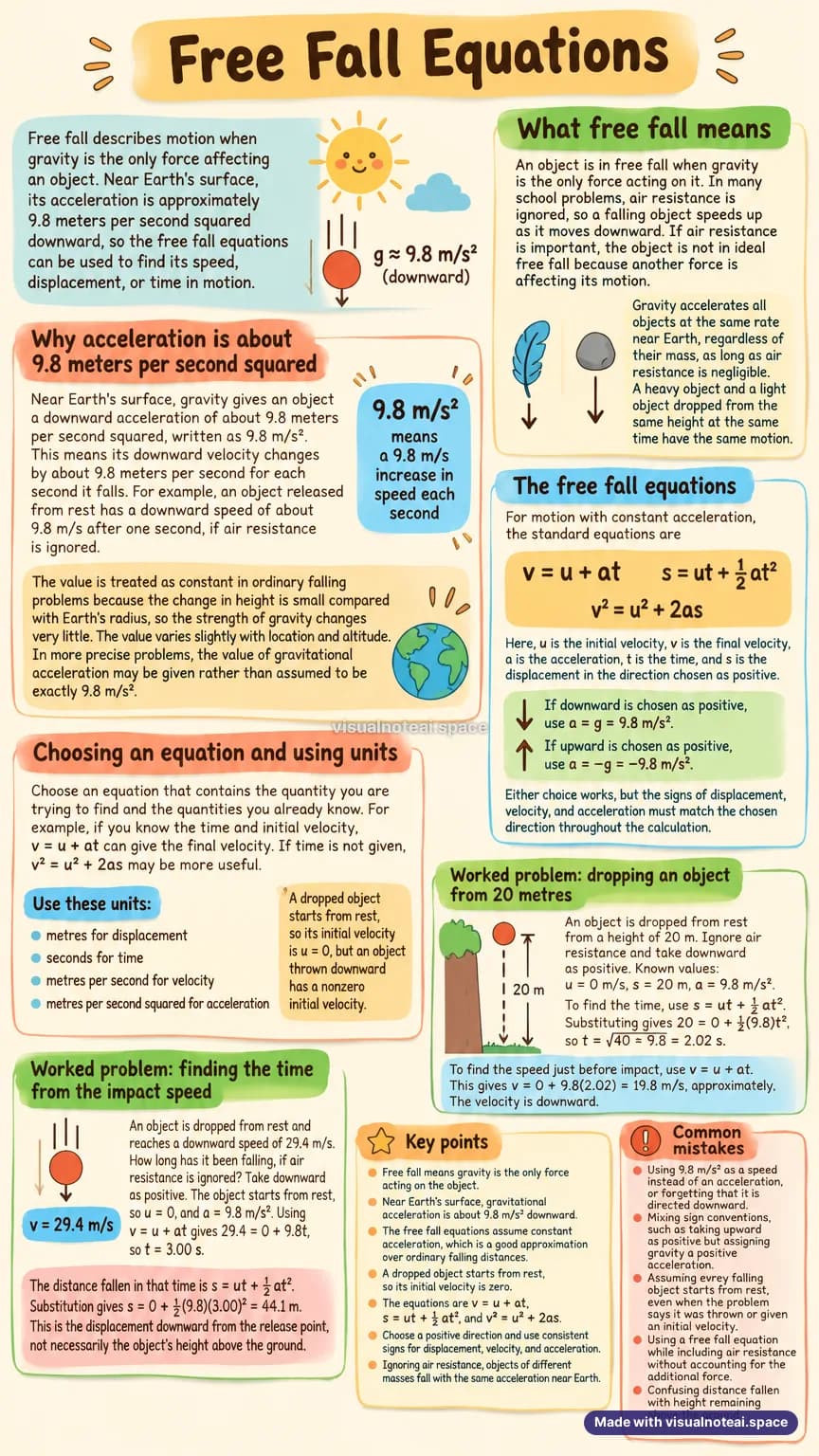
The whole topic on one page. Made with VisualNote.
!Common mistakes
- Using 9.8 m/s² as a speed instead of an acceleration, or forgetting that it is directed downward.
- Mixing sign conventions, such as taking upward as positive but assigning gravity a positive acceleration.
- Assuming every falling object starts from rest, even when the problem says it was thrown or given an initial velocity.
- Using a free fall equation while including air resistance without accounting for the additional force.
- Confusing distance fallen with height remaining above the ground.
🧠Explore the map34 ideas
The mind map VisualNote made for this topic. Drag to pan, scroll to zoom.
- Free Fall Equations
- Meaning of Free Fall
- Gravity as the Only Force
- Air Resistance Negligible
- Equal Acceleration Regardless of Mass
- Gravitational Acceleration
- About 9.8 m/s² Downward
- Approximately Constant Near Earth's Surface
- Varies Slightly with Location and Altitude
- Constant-Acceleration Equations
- v = u + at
- s = ut + ½at²
- v² = u² + 2as
- Variables: u, v, a, t, s
- Sign Conventions and Units
- Choose a Positive Direction
- Downward Positive: a = +g
- Upward Positive: a = −g
- Use Consistent Signs
- SI Units: m, s, m/s, m/s²
- Solving Problems
- Select an Equation Using Known and Unknown Values
- Dropped from Rest: u = 0
- Thrown Object May Have Nonzero Initial Velocity
- 20 m Drop: Time ≈ 2.02 s
- 20 m Drop: Impact Speed ≈ 19.8 m/s Downward
- Impact Speed 29.4 m/s: Time = 3.00 s
- Distance Fallen = 44.1 m
- Common Errors
- Treating 9.8 m/s² as Speed
- Mixing Sign Conventions
- Assuming Every Object Starts from Rest
- Ignoring Air Resistance When It Matters
- Confusing Distance Fallen with Height Remaining
- Meaning of Free Fall
🃏Flashcards14 cards
- What is free fall?
- Motion in which gravity is the only force acting on an object. Ideal free-fall problems typically ignore air resistance.
- What is the acceleration due to gravity near Earth’s surface?
- About 9.8 m/s² downward. It describes how quickly velocity changes, not the object’s speed.
- How does gravity affect objects of different masses in ideal free fall?
- They have the same acceleration near Earth, regardless of mass, when air resistance is negligible.
- Why is gravitational acceleration treated as constant in ordinary falling problems?
- The height change is small compared with Earth’s radius, so gravity changes very little over the motion.
- What are the three constant-acceleration equations used for free fall?
- v = u + at; s = ut + ½at²; v² = u² + 2as.
- What do u, v, a, t, and s represent in the free-fall equations?
- u is initial velocity, v is final velocity, a is acceleration, t is time, and s is displacement in the chosen positive direction.
- How should signs be assigned if downward is chosen as positive?
- For a falling object, use a = +g, approximately +9.8 m/s²; downward velocity and displacement are positive.
- How should signs be assigned if upward is chosen as positive?
- Gravity’s acceleration is a = −g, approximately −9.8 m/s². Keep velocity and displacement signs consistent with this convention.
- What is the initial velocity of an object dropped from rest?
- u = 0. An object thrown downward has a nonzero initial velocity.
- How do you choose which free-fall equation to use?
- Choose an equation that includes the quantity you want to find and the quantities you already know. For example, use v² = u² + 2as when time is unknown.
- An object is dropped from rest from 20 m. Approximately how long does it take to fall, and what is its impact speed?
- Ignoring air resistance, it takes about 2.02 s and reaches about 19.8 m/s downward.
- An object dropped from rest reaches 29.4 m/s downward. How long has it fallen, and how far has it traveled?
- It has fallen for 3.00 s and traveled 44.1 m downward from its release point.
- What is the difference between distance fallen and height remaining?
- Distance fallen is the displacement from the release point; it is not necessarily the object’s height above the ground.
- What common sign and force mistakes should be avoided in free-fall problems?
- Do not treat 9.8 m/s² as a speed, mix sign conventions, assume every falling object starts from rest, or ignore air resistance when it matters.
✅Test yourself5 questions
Which condition must be met for an object to be in ideal free fall?
Ideal free fall occurs when gravity is the only force affecting the object's motion.
Ignoring air resistance, how do objects of different masses fall near Earth's surface?
Near Earth's surface, gravity accelerates objects at the same rate regardless of mass when air resistance is negligible.
If upward is chosen as the positive direction, what acceleration should be used for an object in free fall near Earth?
Gravity acts downward, so it is negative when upward is defined as positive.
An object is thrown downward rather than dropped; how should its initial velocity be treated?
Only an object released from rest has zero initial velocity; a downward throw gives it a nonzero downward initial velocity.
Which equation is most useful for finding final velocity when time is not given, but initial velocity, acceleration, and displacement are known?
The equation v² = u² + 2as relates velocity, acceleration, and displacement without requiring time.
📝The notes
What free fall means
An object is in free fall when gravity is the only force acting on it. In many school problems, air resistance is ignored, so a falling object speeds up as it moves downward. If air resistance is important, the object is not in ideal free fall because another force is affecting its motion.
Gravity accelerates all objects at the same rate near Earth, regardless of their mass, as long as air resistance is negligible. This means that a heavy object and a light object dropped from the same height at the same time have the same motion.
Why acceleration is about 9.8 meters per second squared
Near Earth’s surface, gravity gives an object a downward acceleration of about 9.8 meters per second squared, written as 9.8 m/s². This means its downward velocity changes by about 9.8 meters per second for each second it falls. For example, an object released from rest has a downward speed of about 9.8 m/s after one second, if air resistance is ignored.
The value is treated as constant in ordinary falling problems because the change in height is small compared with Earth’s radius, so the strength of gravity changes very little. The value varies slightly with location and altitude. In more precise problems, the value of gravitational acceleration may be given rather than assumed to be exactly 9.8 m/s².
The free fall equations
For motion with constant acceleration, the standard equations are v = u + at, s = ut + ½at², and v² = u² + 2as. Here, u is the initial velocity, v is the final velocity, a is the acceleration, t is the time, and s is the displacement in the direction chosen as positive.
If downward is chosen as positive, use a = g = 9.8 m/s² for a falling object. If upward is chosen as positive, use a = −g = −9.8 m/s². Either choice works, but the signs of displacement, velocity, and acceleration must match the chosen direction throughout the calculation.
Choosing an equation and using units
Choose an equation that contains the quantity you are trying to find and the quantities you already know. For example, if you know the time and initial velocity, v = u + at can give the final velocity. If time is not given, v² = u² + 2as may be more useful.
Use meters for displacement, seconds for time, and meters per second for velocity. Acceleration must be in meters per second squared. A dropped object starts from rest, so its initial velocity is u = 0, but an object thrown downward has a nonzero initial velocity.
Worked problem: dropping an object from 20 meters
An object is dropped from rest from a height of 20 m. Ignore air resistance and take downward as positive. The known values are u = 0 m/s, s = 20 m, and a = 9.8 m/s². To find the time, use s = ut + ½at². Substituting gives 20 = 0 + ½(9.8)t², so t = √(40 ÷ 9.8) = 2.02 s to three significant figures.
To find the speed just before impact, use v = u + at. This gives v = 0 + 9.8(2.02) = 19.8 m/s, approximately. The velocity is downward. Small differences in the last digit can result from rounding the time during the calculation.
Worked problem: finding the time from the impact speed
An object is dropped from rest and reaches a downward speed of 29.4 m/s. How long has it been falling, if air resistance is ignored? Take downward as positive. The object starts from rest, so u = 0, and a = 9.8 m/s². Using v = u + at gives 29.4 = 0 + 9.8t, so t = 3.00 s.
The distance fallen in that time is s = ut + ½at². Substitution gives s = 0 + ½(9.8)(3.00)² = 44.1 m. This is the displacement downward from the release point, not necessarily the object’s height above the ground.
Make this for your own notes
Paste a chapter or a PDF and get the sheet, map, cards, quiz and episode back in about a minute. No credit card.