
Enthalpy and entropy describe different features of a thermodynamic change. At constant temperature and pressure, their changes combine in the Gibbs free energy equation to help determine whether a process is spontaneous.
★What to remember
- At constant pressure, ΔH equals the heat transferred to or from the system when only pressure-volume work is involved.
- Positive ΔH means the system absorbs heat, and negative ΔH means it releases heat.
- Entropy measures how energy and matter are distributed among accessible arrangements.
- At constant temperature and pressure, ΔG = ΔH − TΔS, with T measured in kelvin.
- A negative ΔG means the forward process is spontaneous under the stated conditions.
- A positive ΔH process can be spontaneous if TΔS is greater than ΔH.
- Spontaneity describes thermodynamic favorability, not how quickly a process occurs.
- A spontaneous process increases the total entropy of the system and its surroundings.
🎧Listen3:18 · transcript
AnnaPeople often hear “enthalpy” and “entropy” together. Are they just two names for energy?
MarcoNo. They describe different things. Enthalpy is a state function related to a system’s energy. At constant pressure, its change equals the heat transferred to or from the system, as long as only pressure-volume work is involved.
AnnaSo if enthalpy goes up, the system has absorbed heat?
MarcoRight. A positive change in enthalpy means heat enters the system, so the change is endothermic. A negative change means heat leaves the system, so it is exothermic. But neither label, on its own, tells us whether the process is spontaneous.
AnnaThen what does entropy add to the picture?
MarcoEntropy describes how energy and matter are distributed among the arrangements available to a system. More accessible arrangements, often called microstates, generally mean higher entropy. Entropy is measured in joules per kelvin.
AnnaCan you give a sense of what might increase it, without reducing it to “disorder”?
MarcoMixing, gas expansion, and some dissolving processes can increase entropy because particles or energy can be distributed in more ways. “Disorder” is an oversimplification. And the system’s entropy change alone does not always settle whether a process is spontaneous.
AnnaSo how do we decide?
MarcoAt constant temperature and pressure, we use Gibbs free energy. Its change equals the enthalpy change minus the temperature times the entropy change. Temperature here means absolute temperature in kelvin, and the energy units must be compatible.
AnnaAnd what does the sign tell us?
MarcoA negative Gibbs free energy change means the forward process is thermodynamically spontaneous under those conditions. A positive one means the forward process is not spontaneous. Zero means equilibrium. But spontaneous does not mean fast; speed depends on kinetics.
AnnaThen an endothermic process can still be spontaneous? That sounds contradictory.
MarcoIt can. If the entropy increase is large enough, the temperature times the entropy change can exceed the enthalpy cost. Then the Gibbs free energy change is negative. Some salts dissolve spontaneously in water even though dissolving absorbs heat. Whether a particular salt does so depends on conditions and on both changes.
AnnaSo temperature can tip the balance?
MarcoYes. If enthalpy and entropy changes are both positive, the process tends to be spontaneous at sufficiently high temperatures. If both are negative, it tends to be spontaneous at sufficiently low temperatures. Those patterns assume the changes do not vary substantially across the temperature range.
AnnaAnd where do the surroundings fit?
MarcoThe Gibbs criterion accounts for entropy changes in both the system and its surroundings. A spontaneous process increases the total entropy of the universe, meaning system plus surroundings. When the system absorbs heat, its surroundings generally lose heat, and their entropy tends to decrease. A large enough increase in the system’s entropy can outweigh that decrease.
AnnaSo the safe takeaway is: don’t mistake heat release for spontaneity, or spontaneity for speed.
MarcoExactly. Consider both enthalpy and entropy, use kelvin in the Gibbs equation, and keep thermodynamic favorability separate from reaction rate.
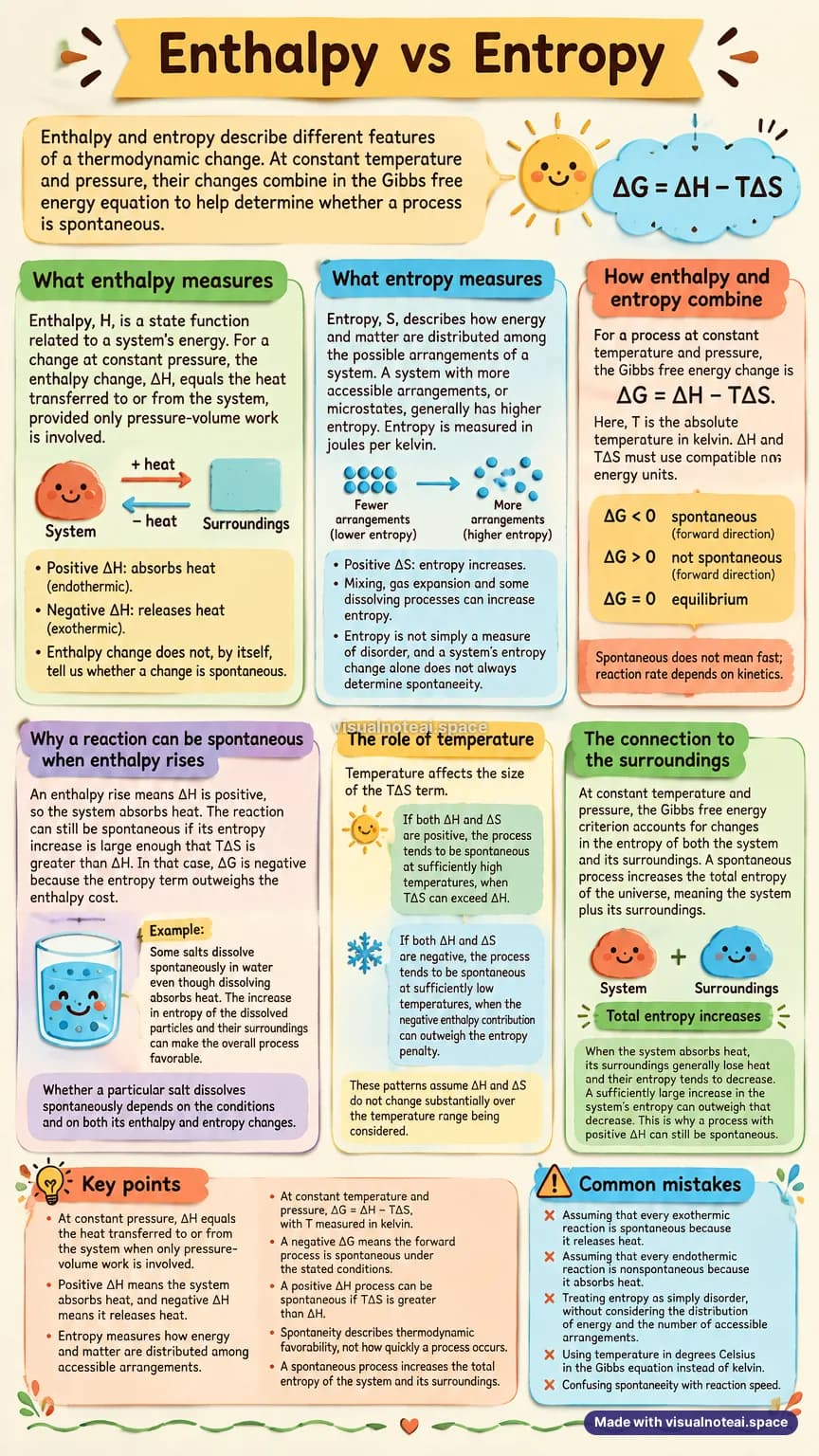
The whole topic on one page. Made with VisualNote.
!Common mistakes
- Assuming that every exothermic reaction is spontaneous because it releases heat.
- Assuming that every endothermic reaction is nonspontaneous because it absorbs heat.
- Treating entropy as simply disorder, without considering the distribution of energy and the number of accessible arrangements.
- Using temperature in degrees Celsius in the Gibbs equation instead of kelvin.
- Confusing spontaneity with reaction speed.
🧠Explore the map39 ideas
The mind map VisualNote made for this topic. Drag to pan, scroll to zoom.
- Enthalpy and Entropy
- Enthalpy (ΔH)
- State function related to system energy
- At constant pressure, ΔH equals heat transfer
- Positive ΔH: absorbs heat; endothermic
- Negative ΔH: releases heat; exothermic
- Enthalpy alone does not determine spontaneity
- Entropy (ΔS)
- Energy and matter distribution among accessible arrangements
- More accessible microstates generally mean higher entropy
- Measured in joules per kelvin
- Mixing, gas expansion, and some dissolving can increase entropy
- Not simply a measure of disorder
- Gibbs Free Energy and Spontaneity
- ΔG = ΔH − TΔS
- Applies at constant temperature and pressure
- T is absolute temperature in kelvin
- ΔH and TΔS require compatible energy units
- ΔG < 0: forward process is spontaneous
- ΔG > 0: forward process is not spontaneous
- ΔG = 0: equilibrium
- Spontaneity means thermodynamic favorability, not speed
- Temperature and Sign Patterns
- Positive ΔH and positive ΔS: tends to favor high temperature
- At high temperature, TΔS may exceed ΔH
- Negative ΔH and negative ΔS: tends to favor low temperature
- Assumes ΔH and ΔS change little with temperature
- System, Surroundings, and Examples
- Spontaneous change increases total entropy of system and surroundings
- Heat absorbed by system generally decreases surroundings' entropy
- Large system entropy increase can outweigh surroundings' entropy decrease
- Positive ΔH can be spontaneous when TΔS > ΔH
- Some salts dissolve spontaneously despite absorbing heat
- Dissolving spontaneity depends on conditions and both ΔH and ΔS
- Common Mistakes
- Assuming every exothermic process is spontaneous
- Assuming every endothermic process is nonspontaneous
- Using Celsius instead of kelvin in the Gibbs equation
- Confusing spontaneity with reaction speed
- Enthalpy (ΔH)
🃏Flashcards12 cards
- What does enthalpy (H) describe?
- Enthalpy is a state function related to a system’s energy. At constant pressure, ΔH equals heat transferred when only pressure-volume work occurs.
- What does the sign of ΔH indicate?
- Positive ΔH means the system absorbs heat (endothermic); negative ΔH means it releases heat (exothermic).
- Does ΔH alone determine spontaneity?
- No. Spontaneity depends on both enthalpy and entropy changes under the stated conditions.
- What does entropy (S) measure?
- Entropy describes how energy and matter are distributed among a system’s accessible arrangements, or microstates. It is measured in joules per kelvin.
- What does positive ΔS mean?
- The system’s entropy increases, often because energy or particles can be distributed among more accessible arrangements.
- What is the Gibbs free energy equation at constant temperature and pressure?
- ΔG = ΔH − TΔS, where T is the absolute temperature in kelvin and the energy units must be compatible.
- What does the sign of ΔG indicate?
- Negative ΔG means the forward process is spontaneous; positive ΔG means it is not spontaneous in the forward direction; ΔG = 0 indicates equilibrium.
- How can a process with positive ΔH still be spontaneous?
- It can be spontaneous if TΔS is greater than ΔH, making ΔG negative.
- How does temperature affect a process with positive ΔH and positive ΔS?
- It tends to be spontaneous at sufficiently high temperatures, when TΔS can exceed ΔH.
- How does temperature affect a process with negative ΔH and negative ΔS?
- It tends to be spontaneous at sufficiently low temperatures, when the favorable enthalpy contribution can outweigh the entropy penalty.
- What does spontaneity mean, and what does it not mean?
- Spontaneity means thermodynamic favorability under specified conditions; it does not mean the process happens quickly. Speed depends on kinetics.
- How is Gibbs free energy connected to the surroundings?
- At constant temperature and pressure, the criterion accounts for entropy changes in both the system and surroundings. A spontaneous process increases the total entropy of the universe.
✅Test yourself5 questions
At constant pressure, when only pressure-volume work occurs, what does ΔH equal?
Under these conditions, the enthalpy change equals the heat transferred to or from the system.
At constant temperature and pressure, which condition indicates that a process is spontaneous in the forward direction?
A negative Gibbs free energy change indicates thermodynamic spontaneity in the forward direction under the stated conditions.
How can a process with positive ΔH still be spontaneous at constant temperature and pressure?
When TΔS exceeds a positive ΔH, ΔG = ΔH − TΔS is negative.
If both ΔH and ΔS are positive, under what conditions does a process tend to become spontaneous?
At higher temperatures, the TΔS contribution can become large enough to exceed ΔH.
Which statement correctly distinguishes thermodynamic spontaneity from reaction kinetics?
Spontaneity describes thermodynamic favorability, while reaction rate depends on kinetics.
📝The notes
What enthalpy measures
Enthalpy, H, is a state function related to a system’s energy. For a change at constant pressure, the enthalpy change, ΔH, equals the heat transferred to or from the system, provided only pressure-volume work is involved.
A positive ΔH means the system absorbs heat from its surroundings, so the change is endothermic. A negative ΔH means the system releases heat, so the change is exothermic. Enthalpy change does not, by itself, tell us whether a change is spontaneous.
What entropy measures
Entropy, S, describes how energy and matter are distributed among the possible arrangements of a system. A system with more accessible arrangements, or microstates, generally has higher entropy. Entropy is measured in joules per kelvin.
A positive ΔS means the system’s entropy increases. Mixing, gas expansion, and some dissolving processes can increase entropy because they allow particles or energy to be distributed in more ways. Entropy is not simply a measure of disorder, and a system’s entropy change alone does not always determine spontaneity.
How enthalpy and entropy combine
For a process at constant temperature and pressure, the Gibbs free energy change is ΔG = ΔH − TΔS. Here, T is the absolute temperature in kelvin. ΔH and TΔS must use compatible energy units.
A negative ΔG indicates a thermodynamically spontaneous change in the forward direction under those conditions. A positive ΔG indicates that the forward change is not spontaneous, while ΔG = 0 indicates equilibrium. Spontaneous does not mean fast; reaction rate depends on kinetics.
Why a reaction can be spontaneous when enthalpy rises
An enthalpy rise means ΔH is positive, so the system absorbs heat. The reaction can still be spontaneous if its entropy increase is large enough that TΔS is greater than ΔH. In that case, ΔG is negative because the entropy term outweighs the enthalpy cost.
For example, some salts dissolve spontaneously in water even though dissolving absorbs heat. The entropy increase of the system as the dissolved particles spread out can outweigh the entropy decrease of the surroundings, which lose heat, making the overall process favorable. Whether a particular salt dissolves spontaneously depends on the conditions and on both its enthalpy and entropy changes.
The role of temperature
Temperature affects the size of the TΔS term. If both ΔH and ΔS are positive, the process tends to be spontaneous at sufficiently high temperatures, when TΔS can exceed ΔH.
If both ΔH and ΔS are negative, the process tends to be spontaneous at sufficiently low temperatures, when the negative enthalpy contribution can outweigh the entropy penalty. These patterns assume ΔH and ΔS do not change substantially over the temperature range being considered.
The connection to the surroundings
At constant temperature and pressure, the Gibbs free energy criterion accounts for changes in the entropy of both the system and its surroundings. A spontaneous process increases the total entropy of the universe, meaning the system plus its surroundings.
When the system absorbs heat, its surroundings generally lose heat and their entropy tends to decrease. A sufficiently large increase in the system’s entropy can outweigh that decrease. This is why a process with positive ΔH can still be spontaneous.
Make this for your own notes
Paste a chapter or a PDF and get the sheet, map, cards, quiz and episode back in about a minute. No credit card.