
An empirical formula gives the simplest whole-number ratio of atoms in a compound. A molecular formula gives the actual number of each type of atom in one molecule, so it is always a whole-number multiple of the empirical formula.
★What to remember
- An empirical formula gives the simplest whole-number ratio of atoms.
- A molecular formula gives the actual number of each type of atom in a molecule.
- Treat percentage values as masses in a 100 g sample when calculating an empirical formula.
- Convert each element's mass to moles by dividing by its relative atomic mass.
- Divide all mole amounts by the smallest amount to find the simplest ratio.
- Multiply fractional ratios by the same number to make whole-number subscripts.
- Divide molar mass by empirical formula mass to find the multiplier for the molecular formula.
- Multiply every empirical formula subscript by that same whole-number multiplier.
🎧Listen3:22 · transcript
AnnaLet’s start with the basic difference. Marco, what does an empirical formula tell us?
MarcoIt gives the simplest whole-number ratio of atoms in a compound. So C H two O tells us there is one carbon atom for every two hydrogen atoms and one oxygen atom in the ratio. But it does not tell us how many atoms are in a particular molecule.
AnnaAnd a molecular formula does tell us the actual number in one molecule, right?
MarcoExactly. Glucose has the molecular formula C six H twelve O six. Those subscripts simplify to one, two, and one, so its empirical formula is C H two O. The molecular formula is a whole-number multiple of the empirical one.
AnnaSuppose we’re given a compound’s percentage composition. What’s the first move?
MarcoTreat the percentages as masses in a one hundred gram sample. For example, forty point zero percent carbon becomes forty point zero grams of carbon. Six point seven percent hydrogen becomes six point seven grams, and fifty-three point three percent oxygen becomes fifty-three point three grams. If actual masses are given, use those directly. The sample size won’t change the final ratio.
AnnaThen we convert those masses to moles. Why do we need that step?
MarcoBecause atom ratios come from comparing amounts of atoms, and moles let us compare those amounts. Divide each element’s mass by its relative atomic mass. Here, carbon is forty point zero divided by twelve point zero, or about three point three three moles. Hydrogen is six point seven divided by one point zero, or six point seven moles. Oxygen is fifty-three point three divided by sixteen point zero, or about three point three three moles.
AnnaSo now we divide by the smallest amount, not just any amount?
MarcoRight. Divide every mole amount by three point three three. That gives approximately one, two, and one. Write those as subscripts, and we get C H two O. Keep enough digits while working, because rounding too early can distort the ratio.
AnnaWhat if one of the ratios isn’t a whole number? Say it’s near one point five.
MarcoDon’t round one point five to two. Multiply every ratio by the same number. In that case, multiplying by two gives two to three. Ratios near thirds or quarters may need to be multiplied by three or four.
AnnaHow do we use the empirical formula to find the molecular one?
MarcoFirst find the empirical formula mass. For C H two O, that’s twelve point zero plus two times one point zero plus sixteen point zero, which equals thirty point zero. Divide the compound’s molar mass by thirty point zero. If the molar mass is one hundred eighty, the multiplier is six. Multiply every subscript by six, giving C six H twelve O six.
AnnaAnd what checks that result?
MarcoThe multiplier should be a whole number, and every subscript must use that same multiplier. Also, six to twelve to six simplifies back to one to two to one. If the division isn’t close to a whole number, check the arithmetic, units, and given molar mass. Rounded percentages can cause small differences, but don’t ignore a clearly non-integer result.
AnnaSo the main traps are using percentages as subscripts, dividing by something other than the smallest mole amount, or scaling just one subscript.
MarcoExactly. Convert to moles, find the simplest ratio, then scale every subscript together.
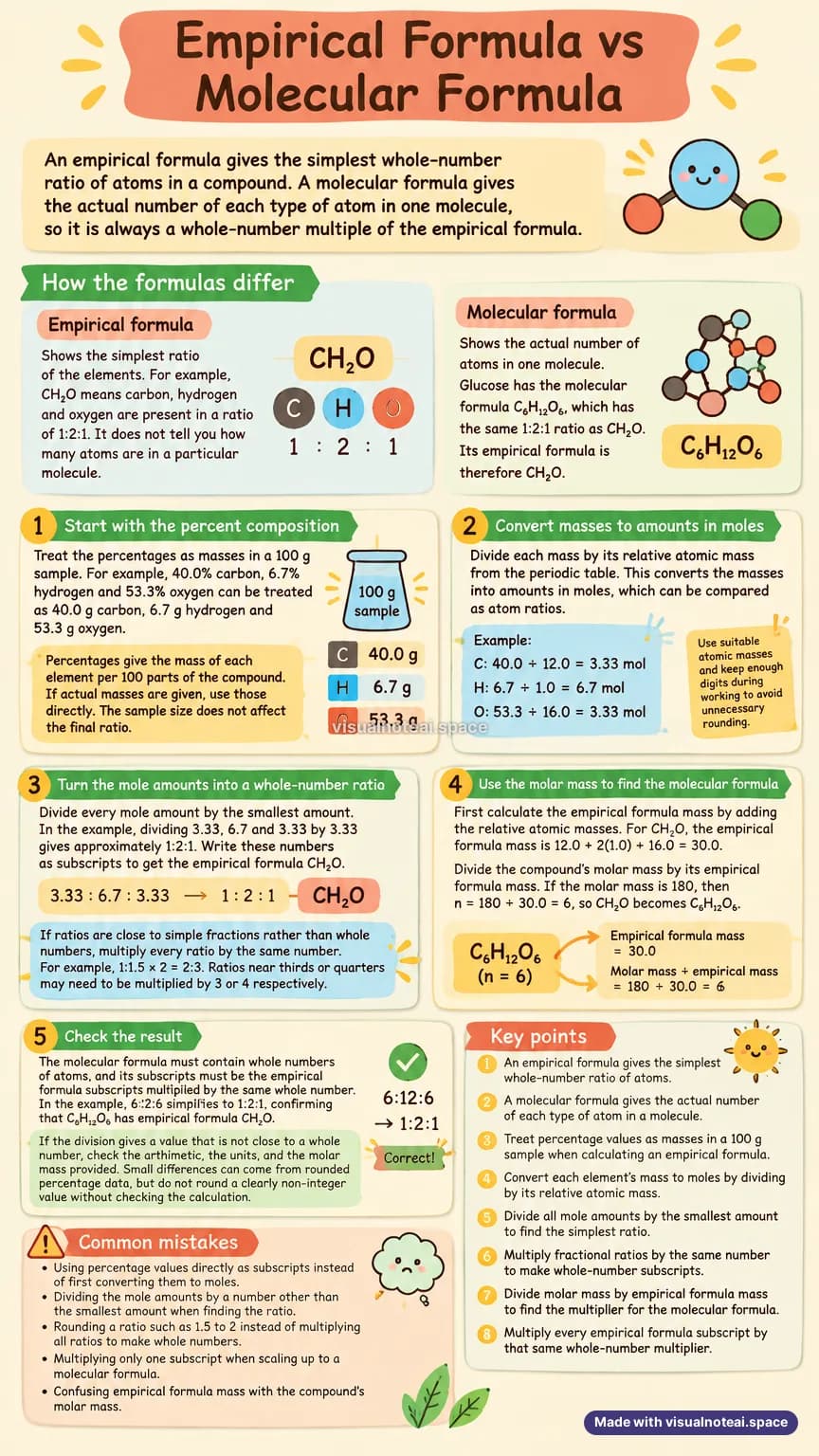
The whole topic on one page. Made with VisualNote.
!Common mistakes
- Using percentage values directly as subscripts instead of first converting them to moles.
- Dividing the mole amounts by a number other than the smallest amount when finding the ratio.
- Rounding a ratio such as 1.5 to 2 instead of multiplying all ratios to make whole numbers.
- Multiplying only one subscript when scaling up to a molecular formula.
- Confusing empirical formula mass with the compound's molar mass.
🧠Explore the map33 ideas
The mind map VisualNote made for this topic. Drag to pan, scroll to zoom.
- Empirical and Molecular Formulas
- Formula Types
- Empirical formula: simplest whole-number atom ratio
- Molecular formula: actual atoms in one molecule
- Molecular formula is a whole-number multiple of empirical formula
- Example: CH₂O and C₆H₁₂O₆ share a 1:2:1 ratio
- Find the Empirical Formula
- Treat percentages as masses in a 100 g sample
- Use actual masses directly when provided
- Convert each element's mass to moles
- Moles = mass ÷ relative atomic mass
- Divide all mole amounts by the smallest
- Multiply every ratio equally to clear fractions
- Write the whole-number ratio as subscripts
- Example: 40.0 g C, 6.7 g H, 53.3 g O
- Mole ratio ≈ 1:2:1; empirical formula CH₂O
- Find the Molecular Formula
- Calculate empirical formula mass
- Divide compound molar mass by empirical formula mass
- Use the whole-number quotient as multiplier n
- Multiply every empirical subscript by n
- Example: 180 ÷ 30.0 = 6; CH₂O becomes C₆H₁₂O₆
- Check Results
- Molecular subscripts must be whole numbers
- All subscripts must use the same multiplier
- Simplify molecular ratio to confirm empirical formula
- If quotient is not near an integer, check arithmetic, units, and molar mass
- Common Mistakes
- Using percentages directly as subscripts
- Dividing moles by a value other than the smallest
- Rounding fractional ratios instead of scaling all ratios
- Scaling only one subscript
- Confusing empirical formula mass with compound molar mass
- Formula Types
🃏Flashcards12 cards
- What does an empirical formula show?
- It shows the simplest whole-number ratio of the atoms of each element in a compound.
- What does a molecular formula show?
- It gives the actual number of each type of atom in one molecule.
- How are empirical and molecular formulas related?
- A molecular formula is a whole-number multiple of the empirical formula.
- What are the empirical and molecular formulas of glucose?
- Glucose has molecular formula C₆H₁₂O₆ and empirical formula CH₂O; both express a 1:2:1 ratio of carbon, hydrogen, and oxygen.
- How should percentages be treated when finding an empirical formula?
- Treat each percentage as the corresponding mass in a 100 g sample. If actual masses are given, use them directly.
- How do you convert an element’s mass to moles?
- Divide its mass by its relative atomic mass.
- How do you find the simplest mole ratio?
- Divide each element’s mole amount by the smallest mole amount.
- What should you do if the mole ratio includes simple fractions?
- Multiply every ratio by the same number to make all values whole numbers. For example, multiply 1:1.5 by 2 to get 2:3.
- How do you turn a whole-number ratio into an empirical formula?
- Use the ratio values as the formula’s subscripts.
- How do you calculate empirical formula mass?
- Add the relative atomic masses of all atoms represented in the empirical formula, including their subscripts.
- How do you find the molecular formula from the empirical formula and molar mass?
- Divide the compound’s molar mass by the empirical formula mass to find the whole-number multiplier, then multiply every empirical-formula subscript by it.
- What checks should you make when finding a molecular formula?
- Confirm that the multiplier is close to a whole number and that all subscripts are scaled by that same number. If not, check arithmetic, units, and the given molar mass.
✅Test yourself5 questions
What does an empirical formula tell you about a compound?
An empirical formula represents the simplest whole-number ratio of the elements, not the actual atom count in a molecule.
When calculating an empirical formula from percentage composition, how should the percentages be treated?
Percentages can be treated as grams in a 100 g sample, after which each mass is converted to moles.
After converting each element's mass to moles, what should you do to find the simplest ratio?
Dividing every mole amount by the smallest one sets the smallest ratio to 1 and gives the relative proportions.
A mole ratio is approximately 1:1.5; how should it be converted to whole-number subscripts?
Multiplying all parts of the ratio by 2 preserves the proportions and converts 1:1.5 into the whole-number ratio 2:3.
A compound has an empirical formula of CH2O and a molar mass of 180; its empirical formula mass is 30. What is its molecular formula?
The molar-mass multiplier is 180 ÷ 30 = 6, so every empirical-formula subscript is multiplied by 6.
📝The notes
How the formulas differ
An empirical formula shows the simplest ratio of the elements. For example, CH2O means that carbon, hydrogen, and oxygen are present in a ratio of 1:2:1. It does not tell you how many atoms are in a particular molecule.
A molecular formula shows the actual number of atoms in one molecule. Glucose has the molecular formula C6H12O6, which has the same 1:2:1 ratio as CH2O. Its empirical formula is therefore CH2O.
Start with the percent composition
To find an empirical formula from percentages, treat the percentages as masses in a 100 g sample. For example, a composition of 40.0% carbon, 6.7% hydrogen, and 53.3% oxygen can be treated as 40.0 g carbon, 6.7 g hydrogen, and 53.3 g oxygen.
This works because percentages give the mass of each element per 100 parts of the compound. If the question gives actual masses instead, use those masses directly. The sample size does not affect the final ratio.
Convert masses to amounts in moles
For each element, divide its mass by its relative atomic mass from the periodic table. This converts the masses into amounts in moles, which can be compared as atom ratios.
For the example, carbon gives 40.0 ÷ 12.0 = 3.33 mol, hydrogen gives 6.7 ÷ 1.0 = 6.7 mol, and oxygen gives 53.3 ÷ 16.0 = 3.33 mol. Use suitable atomic masses and keep enough digits during working to avoid unnecessary rounding.
Turn the mole amounts into a whole-number ratio
Divide every mole amount by the smallest amount. In the example, dividing 3.33, 6.7, and 3.33 by 3.33 gives approximately 1:2:1. Write these numbers as subscripts to get the empirical formula CH2O.
If the ratios are close to simple fractions rather than whole numbers, multiply every ratio by the same number to make whole numbers. For example, a ratio near 1:1.5 can be multiplied by 2 to give 2:3. Ratios near thirds or quarters may need to be multiplied by 3 or 4 respectively.
Use the molar mass to find the molecular formula
First calculate the empirical formula mass by adding the relative atomic masses in the empirical formula. For CH2O, the empirical formula mass is 12.0 + 2(1.0) + 16.0 = 30.0.
Divide the compound's molar mass by its empirical formula mass. The result should be a whole number, n. Multiply every subscript in the empirical formula by n to obtain the molecular formula. If the molar mass is 180, then n = 180 ÷ 30.0 = 6, so CH2O becomes C6H12O6.
Check the result
The molecular formula must contain whole numbers of atoms, and its subscripts must be the empirical formula subscripts multiplied by the same whole number. In the example, 6:12:6 simplifies to 1:2:1, confirming that C6H12O6 has empirical formula CH2O.
If the division gives a value that is not close to a whole number, check the arithmetic, the units, and the molar mass provided. Small differences can come from rounded percentage data, but do not round a clearly non-integer value without checking the calculation.
Make this for your own notes
Paste a chapter or a PDF and get the sheet, map, cards, quiz and episode back in about a minute. No credit card.