
The electric field describes the force that a charge would experience at a point, per unit positive charge. For a point charge, its strength depends on the charge and the distance from it.
★What to remember
- Electric field is force per unit positive test charge, E = F/q.
- The field magnitude around a point charge is E = k|Q|/r^2.
- Use charge in coulombs and distance in metres.
- The SI unit of electric field is N/C.
- A positive source charge has a field directed radially outward.
- A negative source charge has a field directed radially inward.
- Doubling the distance from a point charge reduces the field magnitude to one quarter.
🎧Listen2:49 · transcript
AnnaLet’s start with the basic idea. What does an electric field tell us?
MarcoIt describes the force a charge would experience at a particular point, per unit positive charge. More precisely, electric field strength is the electric force on a test charge divided by the test charge. So, E equals F over q.
AnnaAnd because the test charge is positive in that definition, the field has a direction as well as a size, right?
MarcoExactly. The electric field is a vector. Its SI unit is newtons per coulomb. The direction is defined as the direction of the force on a small positive test charge.
AnnaHow do we find the field around a point charge?
MarcoFor a source charge Q, at a distance r, the magnitude is E equals k times the absolute value of Q, divided by r squared. Coulomb’s constant, k, is approximately eight point nine nine times ten to the ninth newton metre squared per coulomb squared.
AnnaWhy do we use the absolute value of Q there?
MarcoThat formula gives the magnitude, which can’t be negative. The sign of the source charge tells us the direction separately. A positive charge points radially outward. A negative charge points radially inward.
AnnaSo a negative test charge doesn’t reverse the field itself?
MarcoRight. It feels a force opposite to the field direction, but the field’s direction convention stays the same. That’s why it’s important not to say the field points in the direction of force on a negative test charge.
AnnaLet’s walk through the calculation. What should we check before using the formula?
MarcoIdentify the source charge and the distance from that charge to the field point. Convert the charge to coulombs and the distance to metres. Then square the distance in the denominator. The distance is measured from the source charge, not from some arbitrary origin.
AnnaCan we use the example from the source? A positive two point zero microcoulomb charge, with the field point zero point three zero metres away.
MarcoFirst, two point zero microcoulombs is two point zero times ten to the minus six coulombs. The distance squared is zero point three zero squared, or zero point zero nine zero. Substituting into the formula gives a field magnitude of about two point zero times ten to the fifth newtons per coulomb.
AnnaAnd because the source charge is positive, the direction is radially outward from it.
MarcoYes. State the magnitude and direction separately. Also, doubling the distance makes the field one quarter as strong, because distance is squared in the formula.
AnnaDoes the point-charge formula work if there are several charges?
MarcoFor one point charge, yes. It also applies outside a spherically symmetric charge distribution. With several charges, find each field at the point, then add them as vectors, keeping their directions in account. The common slips are forgetting to square the distance, failing to convert units, or giving a magnitude without its direction.
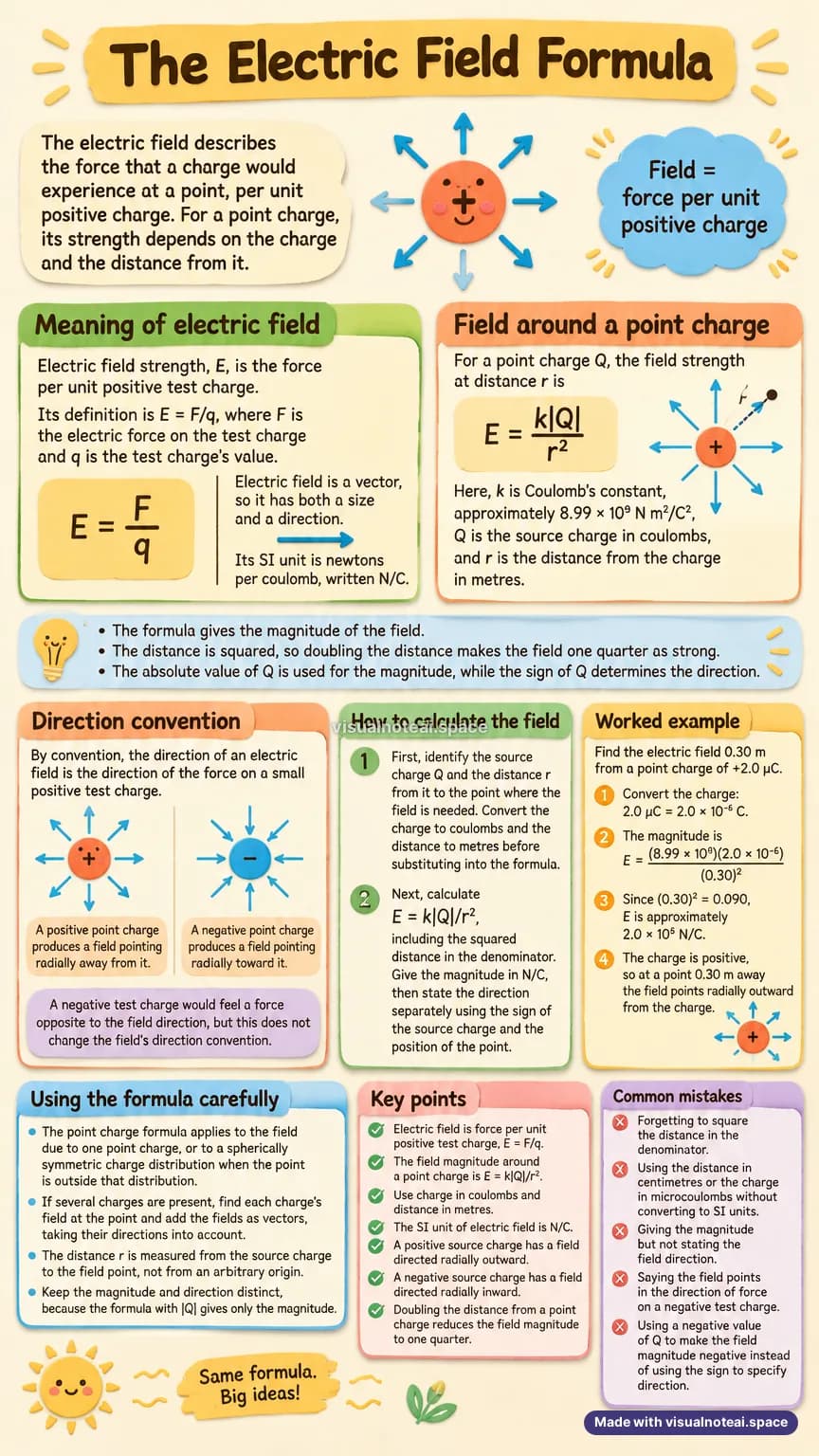
The whole topic on one page. Made with VisualNote.
!Common mistakes
- Forgetting to square the distance in the denominator.
- Using the distance in centimetres or the charge in microcoulombs without converting to SI units.
- Giving the magnitude but not stating the field direction.
- Saying the field points in the direction of force on a negative test charge.
- Using a negative value of Q to make the field magnitude negative instead of using the sign to specify direction.
🧠Explore the map35 ideas
The mind map VisualNote made for this topic. Drag to pan, scroll to zoom.
- Electric Field Formula
- Meaning and Units
- Force per positive test charge: E = F/q
- Vector: magnitude and direction
- SI unit: newtons per coulomb (N/C)
- Point Charge Field
- Magnitude: E = k|Q|/r²
- Coulomb constant: k ≈ 8.99 × 10⁹ N·m²/C²
- Q: source charge; r: distance to field point
- Inverse-square relationship
- Doubling r reduces E to one quarter
- Direction Convention
- Direction of force on a positive test charge
- Positive source: radially outward
- Negative source: radially inward
- Negative test charge feels force opposite to field
- Calculation Steps
- Identify Q and distance r from source to field point
- Convert charge to coulombs and distance to metres
- Substitute into E = k|Q|/r²
- Report magnitude in N/C and state direction separately
- Example: +2.0 μC at 0.30 m
- Convert charge: 2.0 × 10⁻⁶ C
- Field magnitude: approximately 2.0 × 10⁵ N/C
- Direction: radially outward
- Scope and Multiple Charges
- Applies to a point charge
- Also applies outside a spherically symmetric distribution
- Multiple charges: add fields as vectors
- Common Mistakes
- Forgetting to square distance
- Failing to convert to SI units
- Omitting field direction
- Using negative Q to make magnitude negative
- Confusing field direction with force on a negative test charge
- Meaning and Units
🃏Flashcards12 cards
- What is the electric field strength?
- It is the force per unit positive test charge: E = F/q.
- What kind of quantity is the electric field, and what is its SI unit?
- The electric field is a vector with magnitude and direction. Its SI unit is newtons per coulomb (N/C).
- What is the electric field magnitude due to a point charge?
- E = k|Q|/r², where Q is the source charge and r is the distance to the field point.
- What is Coulomb’s constant?
- k is approximately 8.99 × 10⁹ N·m²/C².
- How does distance affect the field from a point charge?
- The field magnitude varies as 1/r². Doubling the distance reduces the field to one quarter.
- Why does the point-charge formula use |Q|?
- The absolute value gives the field magnitude. The sign of Q determines the field direction.
- What is the direction of the field around a positive point charge?
- It points radially outward from the charge.
- What is the direction of the field around a negative point charge?
- It points radially inward, toward the charge.
- How is electric-field direction defined in relation to a test charge?
- It is the direction of the force on a small positive test charge. A negative test charge feels a force opposite to the field.
- What units should be used when calculating electric field?
- Convert charge to coulombs and distance to metres before using E = k|Q|/r².
- How do you find the net field from several charges?
- Find each charge’s field at the point, then add the fields as vectors, accounting for their directions.
- What is the field 0.30 m from a +2.0 μC point charge?
- Its magnitude is approximately 2.0 × 10⁵ N/C, directed radially outward from the positive charge.
✅Test yourself5 questions
How is electric field strength defined in terms of the force on a test charge?
Electric field strength is the force per unit positive test charge, so E = F/q.
If the distance from a point charge is doubled, how does the field magnitude change?
Because distance is squared in the denominator, doubling it reduces the field to one quarter.
What is the electric field direction around a negative point charge?
A negative source charge attracts a positive test charge, so its field points radially inward.
Before using E = k|Q|/r², how should a charge given in microcoulombs and a distance in centimetres be handled?
The formula requires charge in coulombs and distance in metres to produce the field in N/C.
How should the electric field from several charges be found at one point?
Electric fields obey superposition, so each field must be calculated and combined with its direction taken into account.
📝The notes
Meaning of electric field
Electric field strength, E, is the force per unit positive test charge. Its definition is E = F/q, where F is the electric force on the test charge and q is the test charge's value.
Electric field is a vector, so it has both a size and a direction. Its SI unit is newtons per coulomb, written N/C.
Field around a point charge
For a point charge Q, the field strength at distance r is E = k|Q|/r^2. Here, k is Coulomb's constant, approximately 8.99 × 10^9 N m^2/C^2, Q is the source charge in coulombs, and r is the distance from the charge in metres.
The formula gives the magnitude of the field. The distance is squared, so doubling the distance makes the field one quarter as strong. The absolute value of Q is used for the magnitude, while the sign of Q determines the direction.
Direction convention
By convention, the direction of an electric field is the direction of the force on a small positive test charge. A positive point charge produces a field pointing radially away from it.
A negative point charge produces a field pointing radially toward it. A negative test charge would feel a force opposite to the field direction, but this does not change the field's direction convention.
How to calculate the field
First, identify the source charge Q and the distance r from it to the point where the field is needed. Convert the charge to coulombs and the distance to metres before substituting into the formula.
Next, calculate E = k|Q|/r^2, including the squared distance in the denominator. Give the magnitude in N/C, then state the direction separately using the sign of the source charge and the position of the point.
Worked example
Find the electric field 0.30 m from a point charge of +2.0 μC. Convert the charge: 2.0 μC = 2.0 × 10^-6 C. The magnitude is E = (8.99 × 10^9)(2.0 × 10^-6)/(0.30)^2.
Since (0.30)^2 = 0.090, E is approximately 2.0 × 10^5 N/C. The charge is positive, so at a point 0.30 m away the field points radially outward from the charge.
Using the formula carefully
The point charge formula applies to the field due to one point charge, or to a spherically symmetric charge distribution when the point is outside that distribution. If several charges are present, find each charge's field at the point and add the fields as vectors, taking their directions into account.
The distance r is measured from the source charge to the field point, not from an arbitrary origin. Keep the magnitude and direction distinct, because the formula with |Q| gives only the magnitude.
Make this for your own notes
Paste a chapter or a PDF and get the sheet, map, cards, quiz and episode back in about a minute. No credit card.