
The Doppler effect is a change in the frequency a listener measures when the source of a wave and the listener move relative to each other. It explains why a passing siren sounds higher in pitch as it approaches and lower in pitch as it moves away.
★What to remember
- The Doppler effect is a change in observed frequency caused by relative motion between a wave source and an observer.
- A source moving toward an observer makes the wave crests in front closer together.
- An observer moving toward incoming crests encounters them more frequently.
- Approaching motion raises the observed frequency, while receding motion lowers it.
- The wave speed in a medium is measured relative to that medium and is not changed simply by the source's motion.
- For sound in a stationary medium, f_obs = f (v + v_o) / (v - v_s) applies when source and observer move toward each other.
- A passing siren sounds higher as it approaches and lower as it recedes.
🎧Listen3:05 · transcript
AnnaA passing siren seems to change pitch. It sounds higher as it comes toward you, then lower as it moves away. Is the siren changing the note it makes?
MarcoNot necessarily. That’s the Doppler effect: relative motion between a wave’s source and a listener changes the frequency the listener measures. The source can keep emitting the same frequency throughout.
AnnaSo what changes, if the siren’s emitted frequency stays the same?
MarcoThe spacing between the wave crests in the air. Frequency means how many wave cycles pass a point each second. A moving source emits each new crest from a different position. As it moves forward, each crest is emitted closer to the one before it in front of the siren. Behind it, the crests are farther apart.
AnnaAnd closer crests mean a higher pitch?
MarcoRight. Wave speed equals frequency multiplied by wavelength. If the wave speed stays the same, a shorter wavelength corresponds to a higher frequency. A longer wavelength corresponds to a lower one. So a listener in front hears a higher pitch, and one behind hears a lower pitch.
AnnaYou said the wave speed stays the same. Even while the siren is moving?
MarcoYes. For sound in still air, sound travels at the same speed relative to the air. The source and listener can move through that air, but the source’s motion doesn’t simply change the sound speed in the medium.
AnnaWhat if the source stays still, but the listener moves? Does that change the wave spacing?
MarcoNo. The spacing in the medium stays unchanged. Instead, the listener meets incoming crests at a different rate. Moving toward them means meeting them more often, so the measured frequency rises. Moving away means meeting them less often, so it falls.
AnnaCan we put those two kinds of motion into the sound formula?
MarcoFor source and observer moving toward each other, the observed frequency equals the source frequency multiplied by the speed of sound plus the observer’s speed, divided by the speed of sound minus the source’s speed. In symbols, that’s f sub obs equals f times open parenthesis v plus v sub o close parenthesis over open parenthesis v minus v sub s close parenthesis.
AnnaAnd if they’re moving apart?
MarcoThen it’s f sub obs equals f times open parenthesis v minus v sub o close parenthesis over open parenthesis v plus v sub s close parenthesis. Here v sub o and v sub s are the speeds away from each other, both taken as positive. The signs change because the motion makes crests arrive less often. If both are stationary, the observed frequency equals the source frequency.
AnnaDoes this idea apply beyond sound?
MarcoYes. Astronomers use shifts in light from stars and galaxies to infer motion along the line of sight. But the sound formula assumes a medium, such as air. Light doesn’t need a medium, so its Doppler shift is treated using special relativity.
AnnaSo the key is to ask what’s moving, and what the listener actually encounters.
MarcoExactly. Approaching motion raises observed frequency; receding motion lowers it. And a changing pitch doesn’t mean the source itself changed what it emitted.
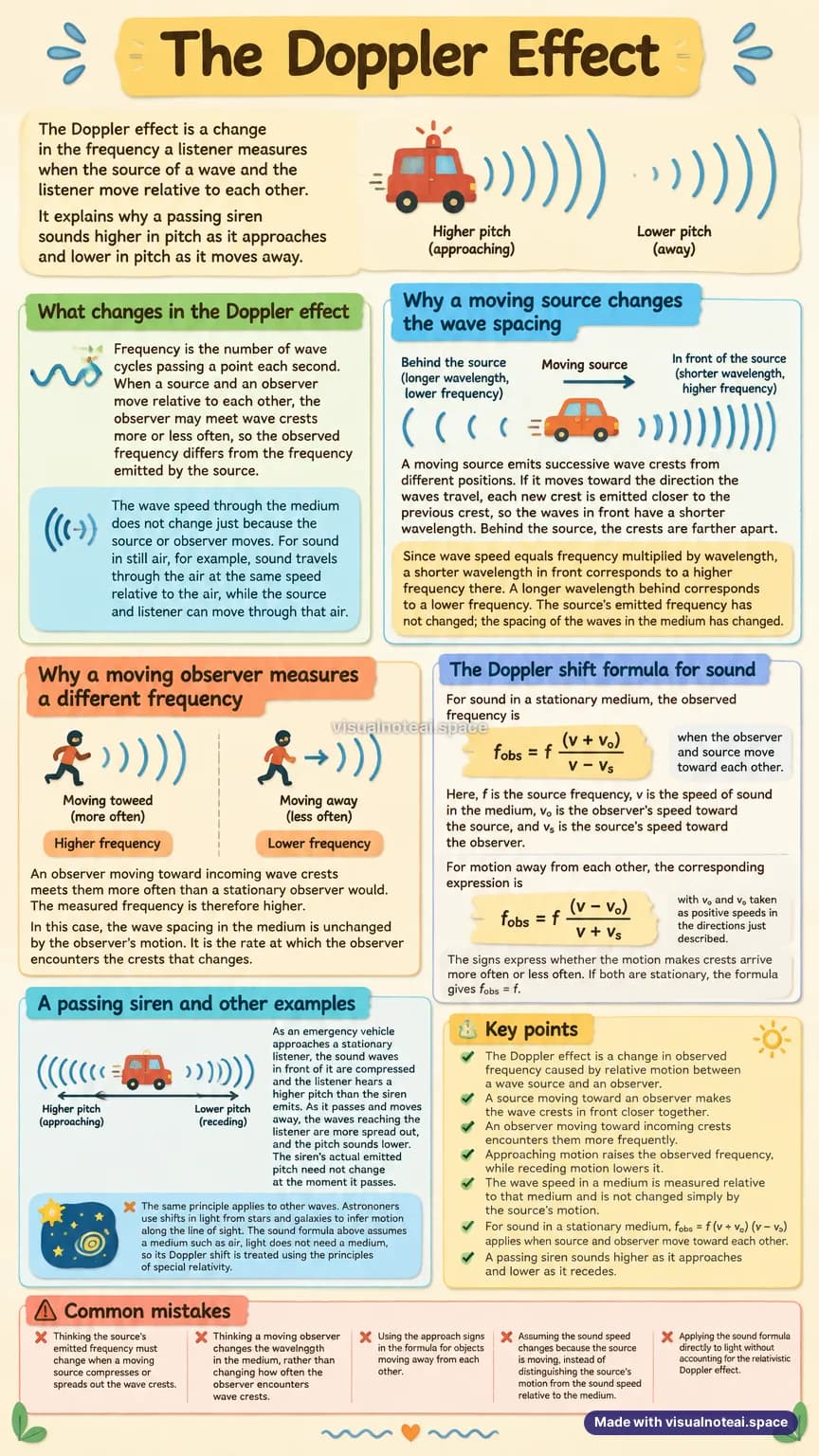
The whole topic on one page. Made with VisualNote.
!Common mistakes
- Thinking the source's emitted frequency must change when a moving source compresses or spreads out the wave crests.
- Thinking a moving observer changes the wavelength in the medium, rather than changing how often the observer encounters wave crests.
- Using the approach signs in the formula for objects moving away from each other.
- Assuming the sound speed changes because the source is moving, instead of distinguishing the source's motion from the sound speed relative to the medium.
- Applying the sound formula directly to light without accounting for the relativistic Doppler effect.
🧠Explore the map32 ideas
The mind map VisualNote made for this topic. Drag to pan, scroll to zoom.
- Doppler Effect
- Core Concept
- Observed frequency changes with relative motion
- Frequency: wave cycles passing per second
- Approach raises frequency; recession lowers it
- Wave speed in a medium
- Speed remains fixed relative to the medium
- Source motion does not change emitted frequency
- Moving source changes wave spacing
- Approaching source compresses crests ahead
- Shorter wavelength ahead; higher frequency
- Longer wavelength behind; lower frequency
- Moving observer changes crest encounter rate
- Moving toward crests: encounters more often
- Moving away from crests: encounters less often
- Observer motion does not change wavelength in the medium
- Sound Doppler Formula
- Toward each other: f_obs = f(v + v_o)/(v - v_s)
- Away from each other: f_obs = f(v - v_o)/(v + v_s)
- f: source frequency; v: sound speed in medium
- v_o: observer speed; v_s: source speed
- Both stationary: f_obs = f
- Examples and Applications
- Passing siren: higher pitch approaching, lower receding
- Astronomy: light shifts reveal line-of-sight motion
- Light Doppler shift requires special relativity
- Common Misconceptions
- Moving source does not change its emitted frequency
- Moving observer changes encounter rate, not wavelength
- Use signs matching approach or recession
- Sound speed is relative to the medium
- Do not apply sound formula directly to light
- Core Concept
🃏Flashcards12 cards
- What is the Doppler effect?
- A change in the frequency an observer measures due to relative motion between a wave source and the observer.
- What is frequency?
- The number of wave cycles that pass a point each second.
- What happens to observed frequency as a source and observer approach each other?
- The observed frequency increases because wave crests reach the observer more often.
- What happens to observed frequency as a source and observer move apart?
- The observed frequency decreases because wave crests reach the observer less often.
- How does a moving source affect wave spacing in front of it?
- As it moves toward the direction its waves travel, successive crests are emitted closer together, producing a shorter wavelength in front.
- How does a moving source affect wave spacing behind it?
- Successive crests are farther apart behind the source, producing a longer wavelength.
- Does a moving source necessarily change the frequency it emits?
- No. The source's emitted frequency can remain unchanged; its motion changes the spacing of the waves in the medium.
- How does a moving observer change the measured frequency?
- Moving toward incoming crests makes the observer encounter them more often; moving away makes the observer encounter them less often. The wave spacing in the medium remains unchanged.
- What is the relationship between wave speed, frequency, and wavelength?
- Wave speed equals frequency multiplied by wavelength: v = fλ.
- What is the sound Doppler formula when source and observer move toward each other?
- For a stationary medium, f_obs = f (v + v_o) / (v − v_s), where v is sound speed, v_o is observer speed toward the source, and v_s is source speed toward the observer.
- What is the sound Doppler formula when source and observer move away from each other?
- f_obs = f (v − v_o) / (v + v_s), where v_o and v_s are the positive speeds of observer and source away from each other. If both are stationary, f_obs = f.
- Why does a passing siren change pitch, and how does the Doppler effect apply to light?
- The siren sounds higher as it approaches and lower as it recedes, even if its emitted pitch does not change. Astronomers use Doppler shifts in light to infer motion, but light's shift must be treated using special relativity rather than the sound formula.
✅Test yourself5 questions
A source moves toward an observer, compressing the wave crests in front of it. What happens to the source's emitted frequency?
The source keeps emitting at the same frequency, while its motion changes the spacing of the crests in the medium.
A stationary source sends sound through still air toward an observer moving toward it. Which quantity changes because of the observer's motion?
A moving observer meets incoming crests more often, while the wave spacing in the medium remains unchanged.
A sound source moves through still air. How does this motion affect the speed of sound in the air?
Sound speed is measured relative to the medium and is not changed simply because the source moves.
For source and observer moving away from each other, which expression gives the observed frequency, with v_o and v_s as the positive speeds away from each other?
Receding motion makes crests arrive less often, so the observer-speed term is subtracted in the numerator and the source-speed term added in the denominator.
Why should the sound Doppler formula for a stationary medium not be applied directly to light from a moving galaxy?
The sound formula is based on wave propagation through a medium, whereas light's Doppler shift is treated using special relativity.
📝The notes
What changes in the Doppler effect
Frequency is the number of wave cycles passing a point each second. When a source and an observer move relative to each other, the observer may meet wave crests more or less often, so the observed frequency differs from the frequency emitted by the source.
The wave speed through the medium does not change just because the source or observer moves. For sound in still air, for example, sound travels through the air at the same speed relative to the air, while the source and listener can move through that air.
Why a moving source changes the wave spacing
A moving source emits successive wave crests from different positions. If it moves toward the direction the waves travel, each new crest is emitted closer to the previous crest, so the waves in front have a shorter wavelength. Behind the source, the crests are farther apart.
Since wave speed equals frequency multiplied by wavelength, a shorter wavelength in front corresponds to a higher frequency there. A longer wavelength behind corresponds to a lower frequency. The source's emitted frequency has not changed; the spacing of the waves in the medium has changed.
Why a moving observer measures a different frequency
An observer moving toward incoming wave crests meets them more often than a stationary observer would. The measured frequency is therefore higher. An observer moving away meets the crests less often, so the measured frequency is lower.
In this case, the wave spacing in the medium is unchanged by the observer's motion. It is the rate at which the observer encounters the crests that changes.
The Doppler shift formula for sound
For sound in a stationary medium, the observed frequency is f_obs = f (v + v_o) / (v - v_s) when the observer and source move toward each other. Here, f is the source frequency, v is the speed of sound in the medium, v_o is the observer's speed toward the source, and v_s is the source's speed toward the observer.
For motion away from each other, the corresponding expression is f_obs = f (v - v_o) / (v + v_s), where v_o is now the observer's speed away from the source and v_s the source's speed away from the observer, both taken as positive. The signs express whether the motion makes crests arrive more often or less often. If both are stationary, the formula gives f_obs = f.
A passing siren and other examples
As an emergency vehicle approaches a stationary listener, the sound waves in front of it are compressed and the listener hears a higher pitch than the siren emits. As it passes and moves away, the waves reaching the listener are more spread out, and the pitch sounds lower. The siren's actual emitted pitch need not change at the moment it passes.
The same principle applies to other waves. Astronomers use shifts in light from stars and galaxies to infer motion along the line of sight. The sound formula above assumes a medium such as air; light does not need a medium, so its Doppler shift is treated using the principles of special relativity.
Make this for your own notes
Paste a chapter or a PDF and get the sheet, map, cards, quiz and episode back in about a minute. No credit card.