
Momentum is the product of an object's mass and velocity, so its direction matters as well as its size. In a closed system with no resultant external force, the total momentum before an interaction equals the total momentum after it.
★What to remember
- Momentum equals mass multiplied by velocity, p = mv.
- Momentum has direction, so choose a positive direction and use signed velocities.
- Total momentum is conserved when the resultant external force on the system is zero.
- For a one-dimensional collision, total momentum before equals total momentum after.
- An elastic collision conserves both total momentum and total kinetic energy.
- An inelastic collision conserves momentum in an isolated system but does not conserve total kinetic energy.
- In a perfectly inelastic collision, the objects stick together and have the same final velocity.
🎧Listen3:22 · transcript
AnnaWhen two objects collide, people often focus on how fast they move. But what else matters?
MarcoWhich way they’re moving. Momentum is mass multiplied by velocity, and velocity has direction. So momentum has direction too. We calculate it as mass times velocity, and its unit is kilogram metre per second.
AnnaSo if we’re working in one dimension, how do we keep track of direction?
MarcoChoose a positive direction first. Velocities in that direction are positive, and velocities the other way are negative. Then use those signed velocities when you add momentum. You can’t just treat every velocity as positive.
AnnaAnd when can we say the total momentum stays the same?
MarcoWhen no resultant external force acts on the system during the interaction. The objects can exert forces on each other, but those internal forces are equal and opposite, so their effects on the system’s total momentum cancel. A collision is often treated as isolated if outside forces, like friction, have a negligible effect during its short duration.
AnnaBut if there is a resultant external force?
MarcoThen total momentum can change. How much it changes depends on the force and how long it acts. And conservation means the system’s total momentum stays constant, not that each object keeps its own momentum.
AnnaLet’s set up the basic equation. Say there are two objects moving along one line. What do we write?
MarcoCall their masses m one and m two. Use u one and u two for their velocities before, and v one and v two after. Then the momentum before, m one u one plus m two u two, equals the momentum after, m one v one plus m two v two. Keep the signs on the velocities.
AnnaAnd if we’re solving for an unknown velocity?
MarcoWrite down the known masses and signed velocities, substitute them, and solve. Check the units, and make sure both objects appear before and after. In two or three dimensions, conserve momentum separately in each direction.
AnnaWhat extra condition makes a collision elastic?
MarcoIt conserves total kinetic energy as well as momentum. Kinetic energy is one half times mass times velocity squared. Here’s the example: a two kilogram object at three metres per second hits a one kilogram object at rest. Afterward, they move at one and four metres per second. Momentum starts at six kilogram metres per second, and ends at six too.
AnnaDoes the energy check agree?
MarcoYes. Initially, kinetic energy is nine joules. Afterward, it’s one joule for the first object and eight for the second, again nine. If both final velocities are unknown, momentum alone isn’t enough. Use the kinetic energy equation too.
AnnaAnd if the objects stick together?
MarcoThat’s perfectly inelastic. Momentum is still conserved if there’s no resultant external force, but kinetic energy isn’t. With a two kilogram object moving at three metres per second hitting a stationary one kilogram object, the shared speed is two metres per second. The combined mass is three kilograms. Kinetic energy falls from nine joules to six; the difference goes into other forms, such as heat, sound, or deformation.
AnnaSo the quick check is: track direction, conserve total momentum only under the right conditions, and don’t assume every collision conserves kinetic energy.
MarcoExactly. And when objects stick, combine their masses to find their shared final velocity.
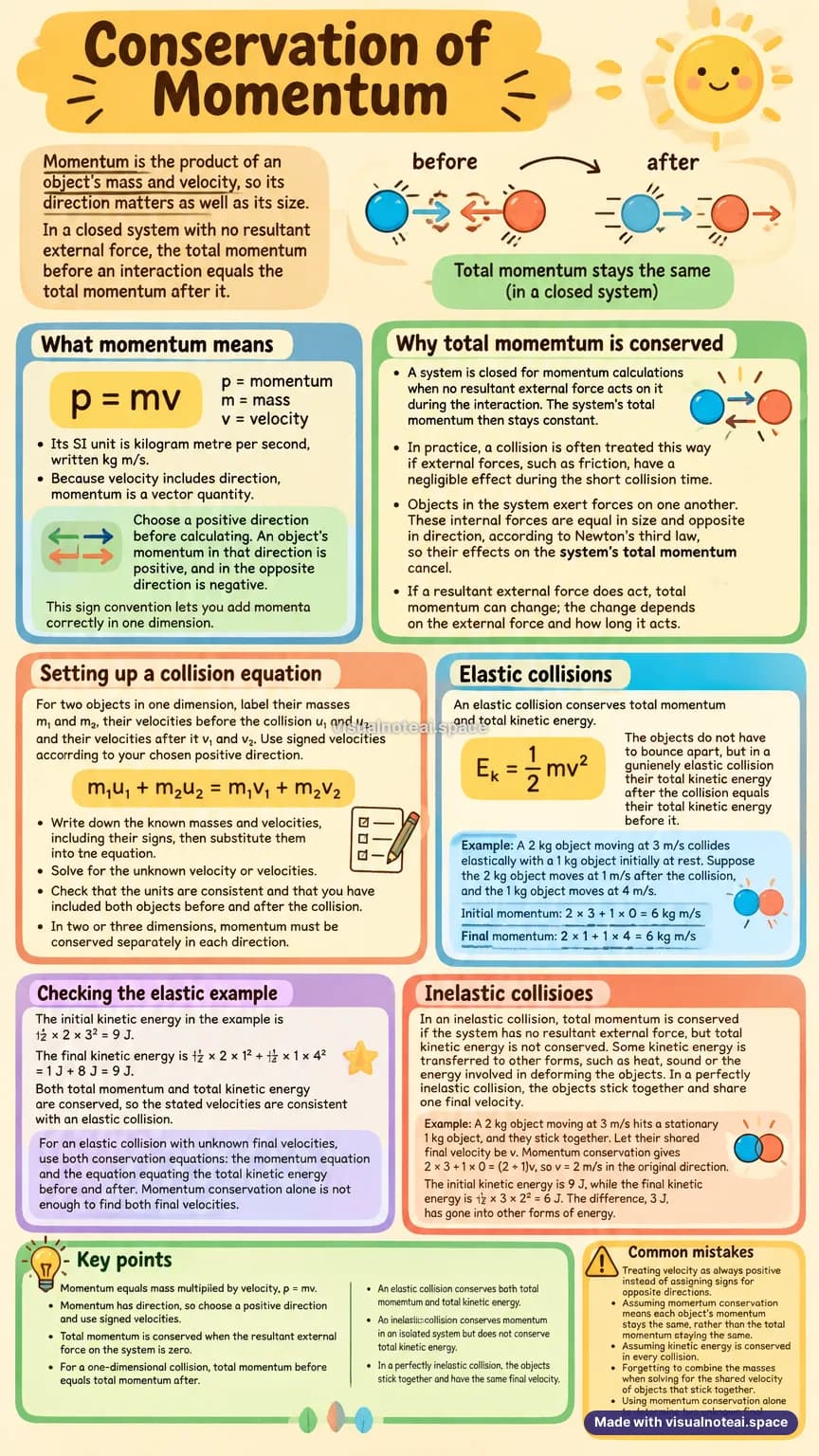
The whole topic on one page. Made with VisualNote.
!Common mistakes
- Treating velocity as always positive instead of assigning signs for opposite directions.
- Assuming momentum conservation means each object's momentum stays the same, rather than the total momentum staying the same.
- Assuming kinetic energy is conserved in every collision.
- Forgetting to combine the masses when solving for the shared velocity of objects that stick together.
- Using momentum conservation alone to determine two unknown final velocities in an elastic collision.
🧠Explore the map34 ideas
The mind map VisualNote made for this topic. Drag to pan, scroll to zoom.
- Conservation of Momentum
- Momentum Basics
- Momentum formula: p = mv
- SI unit: kg m/s
- Vector quantity; direction matters
- Choose a positive direction
- Assign signed velocities and momenta
- Conditions for Conservation
- Closed system: zero resultant external force
- Total momentum before equals total momentum after
- Internal forces cancel (Newton's third law)
- Negligible external effects during short collisions
- External force can change total momentum
- Collision Equations
- Two objects in one dimension
- m₁u₁ + m₂u₂ = m₁v₁ + m₂v₂
- Use signed velocities
- Substitute known values and solve
- Check units and include both objects
- Conserve momentum separately in each direction
- Two objects in one dimension
- Elastic Collisions
- Conserve momentum and kinetic energy
- Kinetic energy: Eₖ = ½mv²
- Use both conservation equations for two unknown final velocities
- Inelastic Collisions
- Momentum conserved in an isolated system
- Kinetic energy transfers to heat, sound, or deformation
- Perfectly inelastic: objects stick together
- Shared final velocity; combine masses
- Common Mistakes
- Treating all velocities as positive
- Confusing total momentum conservation with individual momentum
- Assuming kinetic energy is conserved in every collision
- Using momentum alone for two unknown elastic final velocities
- Momentum Basics
🃏Flashcards12 cards
- How is momentum calculated?
- Momentum is mass multiplied by velocity: p = mv. Its SI unit is kg m/s.
- Why is momentum a vector quantity?
- Momentum has direction because velocity has direction.
- How should direction be handled in one-dimensional momentum calculations?
- Choose a positive direction and assign positive or negative signs to velocities and momenta accordingly.
- When is total momentum conserved?
- When the resultant external force on a system is zero during the interaction. External forces with negligible effects during a short collision are often ignored.
- Why do internal forces not change a system’s total momentum?
- The forces between objects in the system are equal and opposite, so their effects on total momentum cancel.
- What is the one-dimensional momentum equation for two colliding objects?
- m₁u₁ + m₂u₂ = m₁v₁ + m₂v₂, using signed velocities.
- How is momentum conserved in two or three dimensions?
- Apply conservation of momentum separately along each direction.
- What quantities are conserved in an elastic collision?
- Both total momentum and total kinetic energy are conserved. Kinetic energy is Eₖ = ½mv².
- What equations can determine two unknown final velocities in an elastic collision?
- Use both the momentum-conservation equation and the equation equating total kinetic energy before and after.
- What is conserved in an inelastic collision?
- Total momentum is conserved if the system has no resultant external force, but total kinetic energy is not.
- What happens in a perfectly inelastic collision?
- The objects stick together and move with a shared final velocity. Find it using the combined mass.
- In the example where a 2 kg object at 3 m/s sticks to a stationary 1 kg object, what is the final velocity and kinetic-energy loss?
- The shared final velocity is 2 m/s in the original direction. Kinetic energy falls from 9 J to 6 J, so 3 J is transferred to other forms.
✅Test yourself5 questions
An object moves left while right is chosen as the positive direction. How should its momentum be represented?
Momentum is a vector, so its sign follows the direction of velocity relative to the chosen positive direction.
During a short collision, friction has a negligible effect and the system has no resultant external force. What is conserved?
With no resultant external force, internal forces cancel in their effects on the system, so its total momentum remains constant.
Which statement correctly describes an inelastic collision in an isolated system?
An isolated system conserves total momentum, while an inelastic collision transfers some kinetic energy into other forms.
A 2 kg object moving at 3 m/s hits a stationary 1 kg object, and they stick together. What is their shared final velocity?
Momentum conservation gives 2 × 3 = (2 + 1)v, so the combined objects move at 2 m/s in the original direction.
For an elastic collision with two unknown final velocities, what information is generally needed to determine both velocities?
The two conservation equations provide the necessary independent constraints for finding both unknown final velocities.
📝The notes
What momentum means
Momentum is calculated using p = mv, where p is momentum, m is mass and v is velocity. Its SI unit is kilogram metre per second, written kg m/s. Because velocity includes direction, momentum is a vector quantity.
Choose a positive direction before calculating. An object's momentum in that direction is positive, and momentum in the opposite direction is negative. This sign convention lets you add momenta correctly in one dimension.
Why total momentum is conserved
A system is closed for momentum calculations when no resultant external force acts on it during the interaction. The system's total momentum then stays constant. In practice, a collision is often treated this way if external forces, such as friction, have a negligible effect during the short collision time.
Objects in the system exert forces on one another. These internal forces are equal in size and opposite in direction, according to Newton's third law, so their effects on the system's total momentum cancel. If a resultant external force does act, total momentum can change; the change depends on the external force and how long it acts.
Setting up a collision equation
For two objects in one dimension, label their masses m1 and m2, their velocities before the collision u1 and u2, and their velocities after it v1 and v2. Use signed velocities according to your chosen positive direction. Conservation of momentum gives m1u1 + m2u2 = m1v1 + m2v2.
Write down the known masses and velocities, including their signs, then substitute them into the equation. Solve for the unknown velocity or velocities. Check that the units are consistent and that you have included both objects before and after the collision. In two or three dimensions, momentum must be conserved separately in each direction.
Elastic collisions
An elastic collision conserves total momentum and total kinetic energy. Kinetic energy is calculated using E_k = 1/2 mv². The objects do not have to bounce apart, but in a genuinely elastic collision their total kinetic energy after the collision equals their total kinetic energy before it.
For example, a 2 kg object moving at 3 m/s collides elastically with a 1 kg object initially at rest. Suppose the 2 kg object moves at 1 m/s after the collision, and the 1 kg object moves at 4 m/s. The initial momentum is 2 × 3 + 1 × 0 = 6 kg m/s. The final momentum is 2 × 1 + 1 × 4 = 6 kg m/s.
Checking the elastic example
The initial kinetic energy in the example is 1/2 × 2 × 3² = 9 J. The final kinetic energy is 1/2 × 2 × 1² + 1/2 × 1 × 4² = 1 J + 8 J = 9 J. Both total momentum and total kinetic energy are conserved, so the stated velocities are consistent with an elastic collision.
For an elastic collision with unknown final velocities, use both conservation equations: the momentum equation and the equation equating the total kinetic energy before and after. Momentum conservation alone is not enough to find both final velocities.
Inelastic collisions
In an inelastic collision, total momentum is conserved if the system has no resultant external force, but total kinetic energy is not conserved. Some kinetic energy is transferred to other forms, such as heat, sound or the energy involved in deforming the objects. In a perfectly inelastic collision, the objects stick together and share one final velocity.
For example, a 2 kg object moving at 3 m/s hits a stationary 1 kg object, and they stick together. Let their shared final velocity be v. Momentum conservation gives 2 × 3 + 1 × 0 = (2 + 1)v, so v = 2 m/s in the original direction. The initial kinetic energy is 9 J, while the final kinetic energy is 1/2 × 3 × 2² = 6 J. The difference, 3 J, has gone into other forms of energy.
Make this for your own notes
Paste a chapter or a PDF and get the sheet, map, cards, quiz and episode back in about a minute. No credit card.