
Centripetal force is the name for the net force directed toward the centre of a circular path. It continually changes an object’s direction of motion, allowing the object to follow that path.
★What to remember
- Circular motion requires acceleration because the direction of velocity changes.
- The net force for circular motion points toward the centre of the circle.
- For uniform circular motion, F = mv²/r and a = v²/r.
- Centripetal force is the role of the net inward force, not a separate type of force.
- Friction can provide the centripetal force for a car rounding a level curve.
- Gravity provides the centripetal force for a satellite in a circular orbit.
- Without the inward force, an object moves along a straight line tangent to its path.
🎧Listen2:54 · transcript
AnnaLet’s start with the name. What does centripetal force actually mean?
MarcoIt means the net force directed toward the centre of a circular path. That inward force keeps changing an object’s direction, so it can follow the curve.
AnnaEven if the object’s speed stays the same, its velocity changes, right? Because velocity includes direction.
MarcoExactly. A change in velocity is acceleration. In circular motion, that acceleration points toward the centre. Newton’s second law tells us the net force points in the same direction, so it points inward too.
AnnaAnd for an object moving at constant speed in a circle, we can calculate that force with a formula.
MarcoYes. The force equals mass times speed squared, divided by the circle’s radius. The force is measured in newtons. Mass is in kilograms, speed in metres per second, and radius in metres. The matching acceleration is speed squared divided by radius.
AnnaThe speed squared part is easy to miss. If speed doubles, what happens?
MarcoIf mass and radius stay the same, the inward force must be four times as large. And if the radius increases, the required force decreases for the same mass and speed.
AnnaSo is centripetal force a special extra force, on top of things like friction or gravity?
MarcoNo. It describes the role of the net inward force. The actual force can come from tension, friction, gravity, or a combination. For uniform circular motion, its magnitude stays constant, but its direction keeps changing as the object travels around the circle.
AnnaWhat changes if the object’s speed changes as well?
MarcoThen there must also be a force component along or against the object’s motion, as well as the inward component.
AnnaLet’s take a car on a level curve. What supplies the inward force there?
MarcoFriction between the tyres and the road can provide it. The force points toward the curve’s centre, while the car’s velocity points along the road. If there isn’t enough friction, the car may skid. A faster car needs more inward force to follow the same curve, because force depends on speed squared.
AnnaAnd a satellite? People sometimes imagine there must be an outward force holding it in orbit.
MarcoBut gravity supplies the inward force. The satellite is continually falling toward Earth, while its sideways speed keeps it moving around Earth instead of reaching the ground. It doesn’t need a separate outward force.
AnnaThen what happens if the inward force stops acting?
MarcoThe object stops following a circular path and moves in a straight line in the direction of its velocity at that instant. That line is tangent to the circle. It doesn’t fly outward because of a real outward force; the force that would turn it is simply absent.
AnnaSo the key idea is that the force points toward the centre, not along the motion. And without it, the object carries on straight.
MarcoRight. Circular motion needs inward acceleration, even at constant speed. Centripetal force is the name for the inward role of the net force, not an extra kind of force.
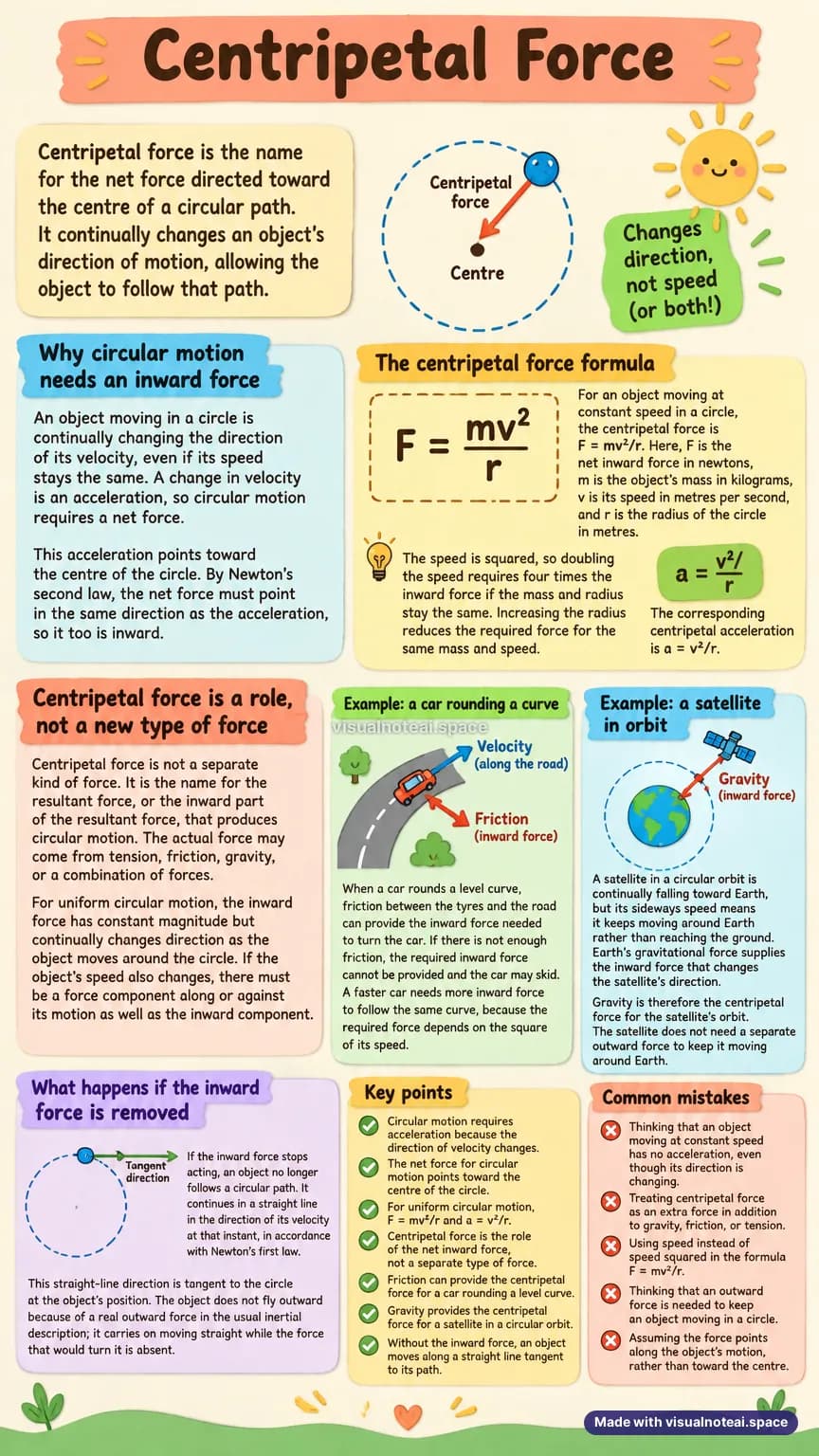
The whole topic on one page. Made with VisualNote.
!Common mistakes
- Thinking that an object moving at constant speed has no acceleration, even though its direction is changing.
- Treating centripetal force as an extra force in addition to gravity, friction, or tension.
- Using speed instead of speed squared in the formula F = mv²/r.
- Thinking that an outward force is needed to keep an object moving in a circle.
- Assuming the force points along the object’s motion, rather than toward the centre.
🧠Explore the map36 ideas
The mind map VisualNote made for this topic. Drag to pan, scroll to zoom.
- Centripetal Force
- Circular Motion and Inward Force
- Changing velocity direction means acceleration
- Acceleration points toward the centre
- Net force points with acceleration
- Formula and Relationships
- Centripetal force: F = mv²/r
- Centripetal acceleration: a = v²/r
- Doubling speed requires four times the force
- Greater radius requires less force
- Mass, speed, and radius
- Force Role and Components
- Not a separate type of force
- May come from tension, friction, gravity, or combined forces
- Uniform circular motion: constant force magnitude, changing direction
- Changing speed also requires a tangential force component
- Examples of Centripetal Force
- Car on a level curve
- Tyre-road friction supplies inward force
- Insufficient friction can cause skidding
- Higher speed requires more inward force
- Satellite in circular orbit
- Gravity supplies inward force
- Sideways speed keeps satellite moving around Earth
- No separate outward force is needed
- Car on a level curve
- Removing the Inward Force
- Object moves in a straight line
- Direction is tangent to the circle
- Newton's first law: motion continues without the turning force
- No real outward force in an inertial frame
- Common Misconceptions
- Constant speed does not mean zero acceleration
- Centripetal force is not an extra force
- Use speed squared in the force formula
- Force points toward the centre, not along motion
- No outward force is needed to maintain circular motion
- Circular Motion and Inward Force
🃏Flashcards12 cards
- What is centripetal force?
- It is the net force, or inward component of the net force, directed toward the centre of a circular path.
- Why does circular motion require acceleration?
- An object’s velocity continually changes direction as it moves in a circle, even if its speed remains constant. Any change in velocity is acceleration.
- In which direction do centripetal acceleration and force point?
- Both point toward the centre of the circle, since the net force points in the direction of the acceleration.
- What is the formula for centripetal force?
- For an object moving at constant speed in a circle, F = mv²/r, where m is mass, v is speed, and r is the circle’s radius.
- What is the formula for centripetal acceleration?
- a = v²/r.
- How does doubling speed affect the required centripetal force?
- If mass and radius stay the same, doubling speed requires four times the force because force depends on speed squared.
- How does increasing the radius affect centripetal force?
- For the same mass and speed, a larger radius means a smaller required centripetal force.
- Is centripetal force a separate type of force?
- No. It describes the role of the inward net force that produces circular motion; the force may come from tension, friction, gravity, or a combination.
- What provides centripetal force for a car rounding a level curve?
- Friction between the tyres and the road can provide the inward force. If there is not enough friction, the car may skid.
- What provides centripetal force for a satellite in a circular orbit?
- Earth’s gravitational force provides the inward force that continually changes the satellite’s direction.
- What happens when the inward force on a circularly moving object is removed?
- The object moves in a straight line in the direction of its velocity at that instant, tangent to the circle.
- Does an object need an outward force to keep moving in a circle?
- No. In an inertial description, no real outward force is needed; the inward force turns the object from its straight-line path.
✅Test yourself5 questions
Why does an object moving at constant speed in a circle still accelerate?
Acceleration is a change in velocity, and velocity changes when its direction changes even if speed remains constant.
If an object's speed doubles while its mass and circular-path radius stay unchanged, how does the required centripetal force change?
Since centripetal force is proportional to the square of speed, doubling speed multiplies the force by four.
What does “centripetal force” describe?
Centripetal force names the inward role of the resultant force, which may be supplied by tension, friction, gravity, or other forces.
What provides the centripetal force for a satellite in a circular orbit around Earth?
Earth's gravity pulls the satellite inward and continually changes the direction of its velocity.
If the inward force on an object moving in a circle suddenly disappears, what path will it follow immediately afterward?
Without the inward force to turn it, the object continues in a straight line in the direction of its instantaneous velocity, tangent to the circle.
📝The notes
Why circular motion needs an inward force
An object moving in a circle is continually changing the direction of its velocity, even if its speed stays the same. A change in velocity is an acceleration, so circular motion requires a net force.
This acceleration points toward the centre of the circle. By Newton’s second law, the net force must point in the same direction as the acceleration, so it too is inward.
The centripetal force formula
For an object moving at constant speed in a circle, the centripetal force is F = mv²/r. Here, F is the net inward force in newtons, m is the object’s mass in kilograms, v is its speed in metres per second, and r is the radius of the circle in metres.
The speed is squared, so doubling the speed requires four times the inward force if the mass and radius stay the same. Increasing the radius reduces the required force for the same mass and speed. The corresponding centripetal acceleration is a = v²/r.
Centripetal force is a role, not a new type of force
Centripetal force is not a separate kind of force. It is the name for the resultant force, or the inward part of the resultant force, that produces circular motion. The actual force may come from tension, friction, gravity, or a combination of forces.
For uniform circular motion, the inward force has constant magnitude but continually changes direction as the object moves around the circle. If the object’s speed also changes, there must be a force component along or against its motion as well as the inward component.
Example: a car rounding a curve
When a car rounds a level curve, friction between the tyres and the road can provide the inward force needed to turn the car. The force acts toward the centre of the curve, while the car’s velocity is directed along the road.
If there is not enough friction, the required inward force cannot be provided and the car may skid. A faster car needs more inward force to follow the same curve, because the required force depends on the square of its speed.
Example: a satellite in orbit
A satellite in a circular orbit is continually falling toward Earth, but its sideways speed means it keeps moving around Earth rather than reaching the ground. Earth’s gravitational force supplies the inward force that changes the satellite’s direction.
Gravity is therefore the centripetal force for the satellite’s orbit. The satellite does not need a separate outward force to keep it moving around Earth.
What happens if the inward force is removed
If the inward force stops acting, an object no longer follows a circular path. It continues in a straight line in the direction of its velocity at that instant, in accordance with Newton’s first law.
This straight-line direction is tangent to the circle at the object’s position. The object does not fly outward because of a real outward force in the usual inertial description; it carries on moving straight while the force that would turn it is absent.
Make this for your own notes
Paste a chapter or a PDF and get the sheet, map, cards, quiz and episode back in about a minute. No credit card.