
Angular momentum describes the rotational motion of an object and depends on how its mass is distributed as well as how fast it rotates. When the net external torque on a system is zero, its total angular momentum stays constant, which explains why a spinning skater rotates faster when drawing in their arms.
★What to remember
- For a particle, angular momentum about a point is L = r × p.
- For rotation about a fixed principal axis, a rigid object's angular momentum is L = Iω.
- The moment of inertia depends on the mass distribution relative to the rotation axis.
- Net external torque equals the rate of change of total angular momentum.
- With zero net external torque, a system's total angular momentum is conserved.
- A spinning skater speeds up by pulling their arms inward because their moment of inertia decreases.
- A skater's rotational kinetic energy can change even when angular momentum is conserved.
🎧Listen3:05 · transcript
AnnaWhen people hear “angular momentum,” they often think of a skater spinning faster with their arms tucked in. But what does the idea actually describe?
MarcoIt describes rotational motion. It depends on how an object’s mass is arranged and how fast it rotates. For a particle, angular momentum about a chosen point is its position vector crossed with its momentum. Its direction follows the right-hand rule.
AnnaSo the chosen point matters?
MarcoYes. For an extended object, you add up the angular momentum of all its parts, and the total depends on the reference point. That’s why you need to say what point or axis you’re measuring about.
AnnaAnd for a rigid object spinning around one fixed principal axis, there’s a simpler formula: angular momentum equals moment of inertia times angular velocity. What does the moment of inertia tell us?
MarcoIt reflects how much mass there is and how far that mass lies from the axis. Mass farther from the axis gives a larger moment of inertia. But we shouldn’t use that simple formula for every three-dimensional rotation. In general, angular momentum may not point in the same direction as angular velocity; the relationship uses the inertia tensor.
AnnaWhat determines whether angular momentum changes?
MarcoThe net external torque. In vector form, external torque equals the rate of change of total angular momentum, measured about the same reference point. A force produces torque when its line of action doesn’t pass through that point or axis. With zero net external torque, total angular momentum stays constant.
AnnaDoes that mean there can’t be any forces inside the system?
MarcoNo. Parts of the system can exert internal forces and torques on one another. Those interactions can transfer angular momentum between parts, but their torques cancel in pairs, so they don’t change the system’s total. The conservation claim is about the whole system, and it requires zero net external torque about the chosen point.
AnnaLet’s return to the skater. Why does drawing in their arms make them spin faster?
MarcoPulling the arms inward brings mass closer to the rotation axis, reducing the moment of inertia. If external torque is negligible, angular momentum stays approximately constant. So, when the moment of inertia gets smaller, angular speed must increase to keep their product unchanged.
AnnaAnd extending the arms does the reverse?
MarcoRight. The moment of inertia increases, and angular speed decreases. But conservation of angular momentum doesn’t mean rotational kinetic energy stays constant. Pulling the arms inward requires work, and that work can increase rotational kinetic energy.
AnnaSo it’s not that tucking in creates extra angular momentum.
MarcoExactly. It changes the mass distribution and the spin rate; it doesn’t create extra angular momentum. In real life, friction with the ice and air resistance can exert external torques, so conservation is an approximation when those torques are small. For the same axis before and after, we can compare moment of inertia times angular speed in each posture.
AnnaThat’s the key: track the axis, the mass distribution, and the external torque, not just how fast something looks like it’s spinning.
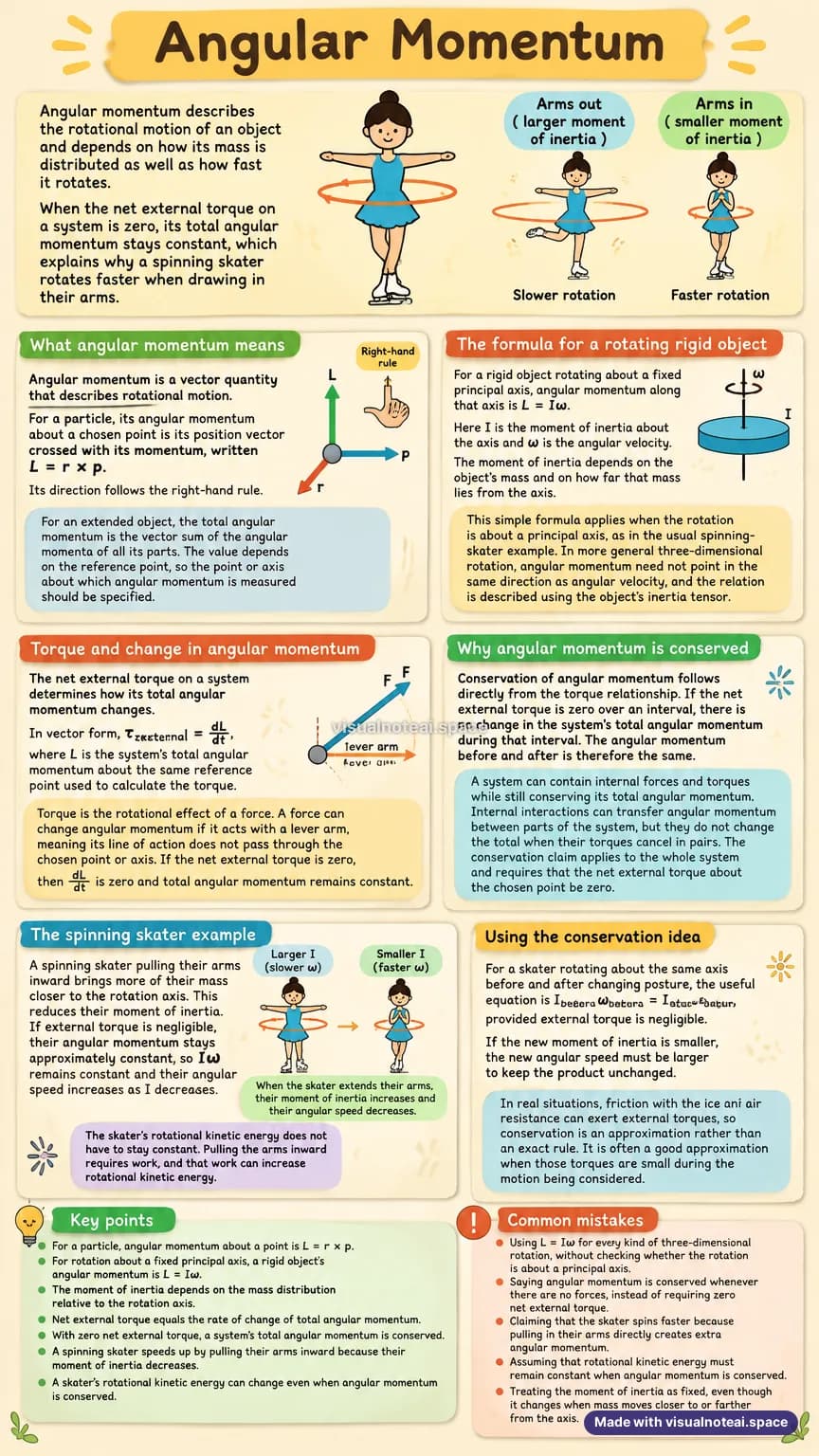
The whole topic on one page. Made with VisualNote.
!Common mistakes
- Using L = Iω for every kind of three-dimensional rotation, without checking whether the rotation is about a principal axis.
- Saying angular momentum is conserved whenever there are no forces, instead of requiring zero net external torque.
- Claiming that the skater spins faster because pulling in their arms directly creates extra angular momentum.
- Assuming that rotational kinetic energy must remain constant when angular momentum is conserved.
- Treating the moment of inertia as fixed, even though it changes when mass moves closer to or farther from the axis.
🧠Explore the map30 ideas
The mind map VisualNote made for this topic. Drag to pan, scroll to zoom.
- Angular Momentum
- Meaning and Measurement
- Vector quantity describing rotational motion
- Particle: L = r × p
- Direction follows the right-hand rule
- Depends on the chosen reference point
- Rigid-Body Rotation
- Fixed principal axis: L = Iω
- Moment of inertia depends on mass distribution
- General 3D rotation uses the inertia tensor
- Torque and Conservation
- External torque: τ = dL/dt
- Zero net external torque means constant total L
- Internal torques can transfer L between parts
- Torque requires a force with a lever arm
- Spinning Skater
- Arms inward: moment of inertia decreases
- With negligible external torque, angular speed increases
- Arms outward: moment of inertia increases and angular speed decreases
- Rotational kinetic energy can change
- Applying Conservation
- Ibefore ωbefore = Iafter ωafter
- Valid when external torque is negligible about the same axis
- Friction and air resistance make conservation approximate
- Common Misconceptions
- L = Iω is not universal for 3D rotation
- Conservation requires zero net external torque, not zero force
- Pulling in arms does not create angular momentum
- Conserved angular momentum does not require constant kinetic energy
- Moment of inertia can change with mass distribution
- Meaning and Measurement
🃏Flashcards12 cards
- What does angular momentum describe?
- Angular momentum is a vector quantity describing rotational motion. It depends on an object's mass distribution and motion.
- What is a particle’s angular momentum about a point?
- It is L = r × p, where r is the position vector from the chosen point and p is momentum.
- How is the direction of angular momentum determined?
- For L = r × p, its direction follows the right-hand rule.
- Why must the reference point for angular momentum be specified?
- An object's angular momentum depends on the point about which it is measured.
- When does L = Iω apply to a rigid object?
- It applies to rotation about a fixed principal axis, with I the moment of inertia about that axis and ω the angular velocity.
- What determines an object's moment of inertia?
- Its mass and how that mass is distributed relative to the rotation axis; mass farther from the axis contributes more.
- What is the relationship between external torque and angular momentum?
- The net external torque equals the rate of change of total angular momentum: τ_external = dL/dt, about the same reference point.
- What condition is required for total angular momentum to be conserved?
- The net external torque about the chosen point must be zero. Internal interactions may transfer angular momentum between parts without changing the system total.
- Why does a spinning skater speed up by pulling in their arms?
- Pulling the arms inward reduces the skater's moment of inertia. With negligible external torque, angular momentum stays approximately constant, so angular speed increases.
- How can a skater's angular speed change when extending their arms?
- Extending the arms increases moment of inertia, so angular speed decreases if angular momentum is approximately conserved.
- Does conservation of angular momentum require rotational kinetic energy to stay constant?
- No. A skater's rotational kinetic energy can change; pulling in the arms requires work and can increase that energy.
- What equation compares a skater's rotation before and after changing posture?
- If external torque is negligible and the skater rotates about the same axis, I_beforeω_before = I_afterω_after.
✅Test yourself5 questions
How is a particle’s angular momentum about a chosen point defined?
A particle’s angular momentum about a point is defined by L = r × p.
When does the formula L = Iω directly describe angular momentum along the rotation axis?
The simple scalar relation L = Iω applies to rotation about a fixed principal axis.
Which condition is required for a system’s total angular momentum to remain constant?
Total angular momentum is conserved when the net external torque about the reference point is zero.
A skater pulls their arms inward while external torque is negligible. What happens to their angular speed?
With angular momentum conserved, a decrease in moment of inertia requires an increase in angular speed.
What can happen to a skater’s rotational kinetic energy while angular momentum is conserved?
Conservation of angular momentum does not require rotational kinetic energy to stay constant, since the skater can do work while changing posture.
📝The notes
What angular momentum means
Angular momentum is a vector quantity that describes rotational motion. For a particle, its angular momentum about a chosen point is its position vector crossed with its momentum, written L = r × p. Its direction follows the right-hand rule.
For an extended object, the total angular momentum is the vector sum of the angular momenta of all its parts. The value depends on the reference point, so the point or axis about which angular momentum is measured should be specified.
The formula for a rotating rigid object
For a rigid object rotating about a fixed principal axis, angular momentum along that axis is L = Iω. Here I is the moment of inertia about the axis and ω is the angular velocity. The moment of inertia depends on the object's mass and on how far that mass lies from the axis.
This simple formula applies when the rotation is about a principal axis, as in the usual spinning-skater example. In more general three-dimensional rotation, angular momentum need not point in the same direction as angular velocity, and the relation is described using the object's inertia tensor.
Torque and change in angular momentum
The net external torque on a system determines how its total angular momentum changes. In vector form, τ external = dL/dt, where L is the system's total angular momentum about the same reference point used to calculate the torque.
Torque is the rotational effect of a force. A force can change angular momentum if it acts with a lever arm, meaning its line of action does not pass through the chosen point or axis. If the net external torque is zero, then dL/dt is zero and total angular momentum remains constant.
Why angular momentum is conserved
Conservation of angular momentum follows directly from the torque relationship. If the net external torque is zero over an interval, there is no change in the system's total angular momentum during that interval. The angular momentum before and after is therefore the same.
A system can contain internal forces and torques while still conserving its total angular momentum. Internal interactions can transfer angular momentum between parts of the system, but they do not change the total when their torques cancel in pairs. The conservation claim applies to the whole system and requires that the net external torque about the chosen point be zero.
The spinning skater example
A spinning skater pulling their arms inward brings more of their mass closer to the rotation axis. This reduces their moment of inertia. If external torque is negligible, their angular momentum stays approximately constant, so Iω remains constant and their angular speed increases as I decreases.
When the skater extends their arms, their moment of inertia increases and their angular speed decreases. The skater's rotational kinetic energy does not have to stay constant during these movements. Pulling the arms inward requires work, and that work can increase rotational kinetic energy.
Using the conservation idea
For a skater rotating about the same axis before and after changing posture, the useful equation is I before times ω before = I after times ω after, provided external torque is negligible. If the new moment of inertia is smaller, the new angular speed must be larger to keep the product unchanged.
In real situations, friction with the ice and air resistance can exert external torques, so conservation is an approximation rather than an exact rule. It is often a good approximation when those torques are small during the motion being considered.
Make this for your own notes
Paste a chapter or a PDF and get the sheet, map, cards, quiz and episode back in about a minute. No credit card.