
VSEPR theory predicts a molecule’s shape by treating regions of electron density around a central atom as repelling one another. These regions arrange themselves as far apart as possible, and the shape named for the molecule describes the positions of its atoms, not its lone pairs.
★What to remember
- VSEPR predicts shapes by arranging electron domains as far apart as possible.
- Each bond to the central atom counts as one domain, including a double or triple bond.
- Each lone pair on the central atom counts as one domain.
- Two domains give a linear arrangement with a 180 degree angle.
- Three domains give a trigonal planar electron-domain geometry, with angles near 120 degrees.
- Four domains give a tetrahedral electron-domain geometry, with angles near 109.5 degrees when all are bonding pairs.
- Molecular shape describes the positions of atoms, so lone pairs affect the shape but are not included in its name.
🎧Listen2:54 · transcript
AnnaWhen people hear VSEPR, they may think it is just a list of molecule shapes. What is the idea behind it?
MarcoIt starts with electron density around a central atom. Bonding electrons and lone pairs occupy regions, also called electron domains. Those regions repel one another, so they arrange themselves as far apart as possible. VSEPR stands for valence shell electron pair repulsion.
AnnaSo to use it, we first need to count those domains. What do we count as one?
MarcoStart with the Lewis structure and identify the central atom. Each atom bonded to it counts as one bonding domain. That stays true for a single, double, or triple bond. Each lone pair on the central atom counts as one more domain. Don’t include lone pairs on the surrounding atoms.
AnnaThat double-bond rule can be easy to miss. A double bond still counts as one domain, though it can repel a little more strongly than a single bond. What happens with two domains?
MarcoThey arrange in a line. That is a linear geometry, with a bond angle of one hundred eighty degrees. Carbon dioxide is an example. Its central carbon has two domains, one for each double bond.
AnnaAnd with three domains, we get trigonal planar geometry, with angles around one hundred twenty degrees. If all three domains are bonds, the molecular shape is trigonal planar, as in boron trifluoride. Is that where we need to distinguish geometry from shape?
MarcoExactly. Electron-domain geometry counts both bonds and lone pairs. Molecular shape describes only where the atoms are. So lone pairs affect the shape, but they are not included in its name.
AnnaCan you walk through what that distinction does with four domains?
MarcoFour domains have a tetrahedral electron-domain geometry. When all four are bonding pairs, the shape is tetrahedral, as in methane, and the angles are about one hundred nine point five degrees. But with three bonds and one lone pair, the molecular shape is trigonal pyramidal, as in ammonia. With two bonds and two lone pairs, it is bent, as in water.
AnnaAnd there’s also a bent shape with three domains, right?
MarcoRight. Two bonds and one lone pair give a bent shape, as in sulfur dioxide. So bent does not tell you the number of domains by itself. Lone pairs usually repel more strongly than bonding pairs, which tends to compress the angles between bonds. That is why we shouldn’t assume the ideal angles stay unchanged when lone pairs are present.
AnnaLet me check the method. Identify the central atom, count its bonds and lone pairs, find the electron-domain geometry, then name the arrangement of the bonded atoms only. Did I leave out a common trap?
MarcoThat’s the sequence. The main traps are counting a multiple bond as more than one domain, counting lone pairs on surrounding atoms, and calling the electron-domain geometry the molecular shape when there are lone pairs. Keep those distinctions clear, and VSEPR gives you a reliable way to predict the shape.
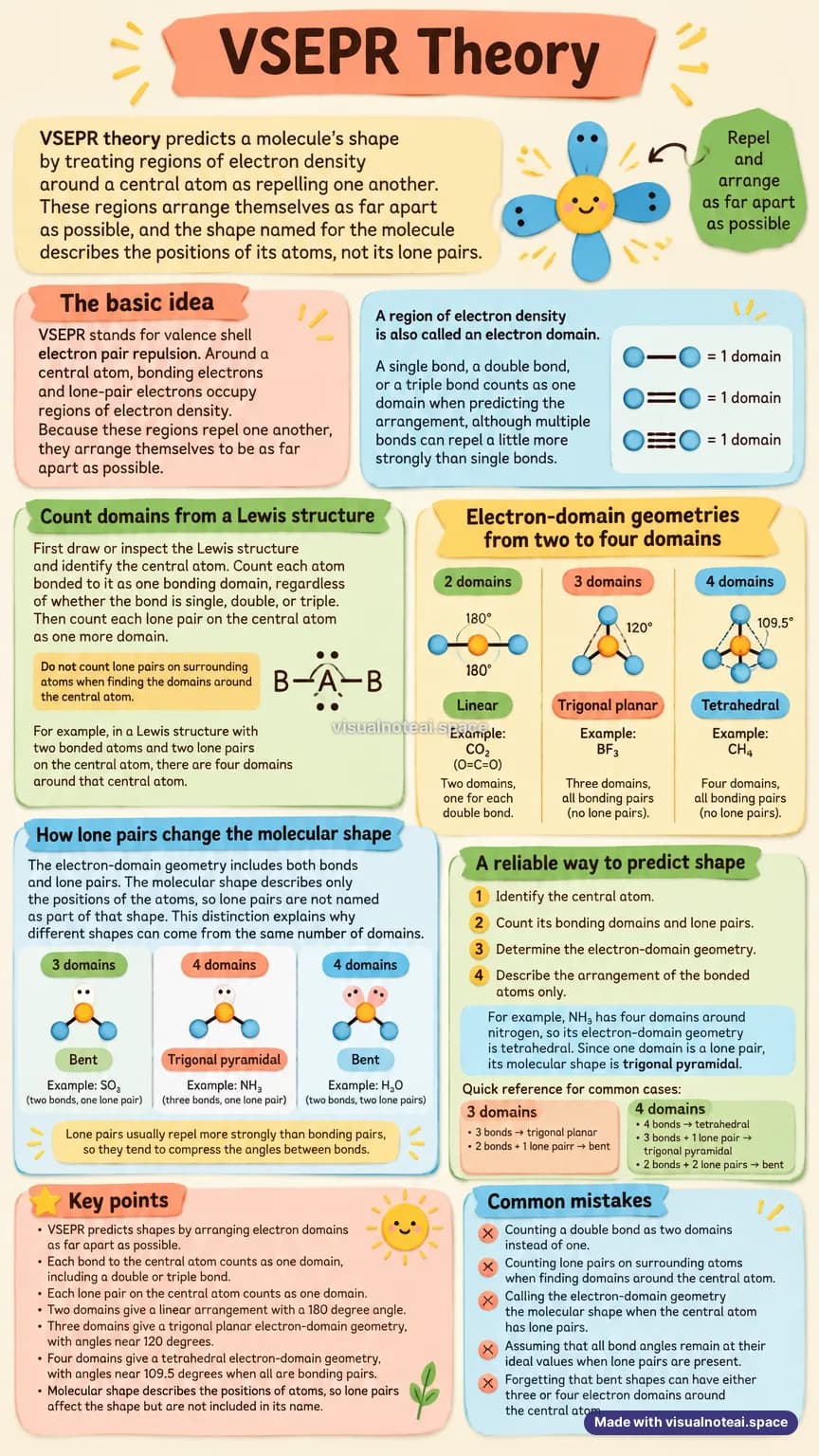
The whole topic on one page. Made with VisualNote.
!Common mistakes
- Counting a double bond as two domains instead of one.
- Counting lone pairs on surrounding atoms when finding domains around the central atom.
- Calling the electron-domain geometry the molecular shape when the central atom has lone pairs.
- Assuming that all bond angles remain at their ideal values when lone pairs are present.
- Forgetting that bent shapes can have either three or four electron domains around the central atom.
🧠Explore the map38 ideas
The mind map VisualNote made for this topic. Drag to pan, scroll to zoom.
- VSEPR Theory
- Core Principle
- Valence shell electron pair repulsion
- Electron domains repel
- Domains arrange as far apart as possible
- Counting Electron Domains
- Start from the Lewis structure
- Each bond to the central atom counts as one domain
- Double and triple bonds each count as one domain
- Each central-atom lone pair counts as one domain
- Ignore lone pairs on surrounding atoms
- Electron-Domain Geometries
- Two domains: linear, 180°
- Example: CO₂
- Three domains: trigonal planar, about 120°
- Example: BF₃
- Four domains: tetrahedral, about 109.5°
- Example: CH₄
- Two domains: linear, 180°
- Molecular Shape and Lone Pairs
- Electron-domain geometry includes bonds and lone pairs
- Molecular shape describes atom positions only
- Lone pairs are not named in molecular shape
- Lone pairs repel more strongly and compress bond angles
- Three domains: two bonds, one lone pair → bent
- Example: SO₂
- Four domains: three bonds, one lone pair → trigonal pyramidal
- Example: NH₃
- Four domains: two bonds, two lone pairs → bent
- Example: H₂O
- Prediction Steps and Pitfalls
- Identify the central atom
- Count bonding domains and lone pairs
- Determine electron-domain geometry
- Name the arrangement of bonded atoms
- Do not count multiple bonds as multiple domains
- Do not confuse electron-domain geometry with molecular shape
- Do not assume ideal bond angles with lone pairs
- Bent shapes can have three or four domains
- Core Principle
🃏Flashcards12 cards
- What does VSEPR stand for?
- Valence shell electron pair repulsion.
- What is the basic idea of VSEPR theory?
- Electron-density regions around a central atom repel one another and arrange themselves as far apart as possible.
- What is an electron domain?
- A region of electron density around the central atom, such as a bond or a lone pair.
- How does a single, double, or triple bond count in domain counting?
- Each bond to the central atom counts as one domain, regardless of bond order.
- Which lone pairs are counted when finding domains around a central atom?
- Count lone pairs on the central atom, but not lone pairs on surrounding atoms.
- What is the electron-domain geometry for two domains?
- Linear, with an angle of 180°; carbon dioxide is an example.
- What is the electron-domain geometry for three domains?
- Trigonal planar, with angles near 120°.
- What is the electron-domain geometry for four domains?
- Tetrahedral; with four bonding pairs, the angles are about 109.5°.
- What is the difference between electron-domain geometry and molecular shape?
- Electron-domain geometry includes bonds and lone pairs. Molecular shape describes only the positions of the atoms.
- What shape results from three domains with two bonds and one lone pair?
- Bent, as in SO₂.
- What shapes result from four domains with one or two lone pairs?
- Three bonds and one lone pair give trigonal pyramidal, as in NH₃; two bonds and two lone pairs give bent, as in H₂O.
- How do lone pairs generally affect bond angles?
- They usually repel more strongly than bonding pairs and compress the angles between bonds.
✅Test yourself5 questions
When counting electron domains around a central atom, how should a double bond be counted?
A single, double, or triple bond to the central atom counts as one electron domain.
A central atom is bonded to two atoms and has two lone pairs; how many electron domains surround it?
Each bond to the central atom and each lone pair on it counts as one domain, giving four total.
What is the electron-domain geometry around nitrogen in NH₃?
Nitrogen in NH₃ has four domains (three bonding domains and one lone pair), which form a tetrahedral electron-domain geometry.
Why is the molecular shape of NH₃ called trigonal pyramidal rather than tetrahedral?
Molecular shape names describe the positions of atoms, so the lone pair is not included in the shape name.
What usually happens to bond angles when lone pairs are present on the central atom?
Lone pairs usually repel more strongly than bonding pairs and tend to compress the angles between bonds.
📝The notes
The basic idea
VSEPR stands for valence shell electron pair repulsion. Around a central atom, bonding electrons and lone-pair electrons occupy regions of electron density. Because these regions repel one another, they arrange themselves to be as far apart as possible.
A region of electron density is also called an electron domain. A single bond, a double bond, or a triple bond counts as one domain when predicting the arrangement, although multiple bonds can repel a little more strongly than single bonds.
Count domains from a Lewis structure
First draw or inspect the Lewis structure and identify the central atom. Count each atom bonded to it as one bonding domain, regardless of whether the bond is single, double, or triple. Then count each lone pair on the central atom as one more domain.
Do not count lone pairs on surrounding atoms when finding the domains around the central atom. For example, in a Lewis structure with two bonded atoms and two lone pairs on the central atom, there are four domains around that central atom.
Electron-domain geometries from two to four domains
Two domains arrange themselves in a line, giving a linear geometry with a bond angle of 180 degrees. An example is carbon dioxide, O=C=O. Its central carbon has two domains, one for each double bond.
Three domains arrange themselves in a trigonal planar geometry, with angles of about 120 degrees. With three bonded atoms and no lone pairs, the molecular shape is trigonal planar, as in boron trifluoride, BF3. Four domains arrange themselves in a tetrahedral geometry, with angles of about 109.5 degrees when all four domains are bonding pairs, as in methane, CH4.
How lone pairs change the molecular shape
The electron-domain geometry includes both bonds and lone pairs. The molecular shape describes only the positions of the atoms, so lone pairs are not named as part of that shape. This distinction explains why different shapes can come from the same number of domains.
With three domains, two bonds and one lone pair give a bent shape, as in SO2. With four domains, three bonds and one lone pair give a trigonal pyramidal shape, as in NH3. Four domains with two bonds and two lone pairs give a bent shape, as in H2O. Lone pairs usually repel more strongly than bonding pairs, so they tend to compress the angles between bonds.
A reliable way to predict shape
Use this sequence: identify the central atom, count its bonding domains and lone pairs, determine the electron-domain geometry, and then describe the arrangement of the bonded atoms only. For example, NH3 has four domains around nitrogen, so its electron-domain geometry is tetrahedral. Since one domain is a lone pair, its molecular shape is trigonal pyramidal.
For a structure with three domains, three bonds give a trigonal planar shape, while two bonds and one lone pair give a bent shape. For four domains, four bonds give tetrahedral, three bonds and one lone pair give trigonal pyramidal, and two bonds and two lone pairs give bent.
Make this for your own notes
Paste a chapter or a PDF and get the sheet, map, cards, quiz and episode back in about a minute. No credit card.