
Solubility rules are guidelines for deciding whether an ionic compound dissolves in water or remains as a solid. To predict a precipitate, identify the products of a reaction in solution, then use the rules to see whether any product is insoluble.
★What to remember
- Group 1 and ammonium compounds are generally soluble.
- All nitrates and most acetates are soluble.
- Most chlorides, bromides, and iodides are soluble, with important exceptions including silver and lead(II).
- Most sulfates are soluble, but barium sulfate, lead(II) sulfate, and strontium sulfate are common exceptions.
- Most carbonates, phosphates, sulfides, and hydroxides are insoluble unless an important exception applies.
- To predict a precipitate, write the possible products of the reaction and apply the solubility rules to each one.
- An insoluble product is written as a solid, while a soluble product is written as aqueous.
🎧Listen3:14 · transcript
AnnaWhen people hear “solubility rules,” they may think every compound either dissolves completely or not at all. Is that really how it works?
MarcoNot quite. These rules are guidelines for predicting whether an ionic compound dissolves in water or remains as a solid. A soluble compound dissolves enough to form ions in solution. An insoluble one dissolves so little that we usually treat it as a solid. And some compounds are only slightly soluble, so tables can classify them differently.
AnnaSo the table we use matters, especially for borderline cases. What are the rules that are easiest to start with?
MarcoCompounds containing a Group One metal, like sodium or potassium, are generally soluble. Ammonium compounds are, too, whatever the other ion is. All nitrates are soluble, and acetates are generally treated as soluble. Some tables include other soluble ions, like perchlorate.
AnnaThen there are the halides: chlorides, bromides, and iodides. Most are soluble, but the exceptions are important, right?
MarcoRight. Compounds with silver or lead two are generally insoluble or only slightly soluble. Mercury one is also an exception in many school tables. Its ion is a paired ion, so it’s important not to confuse mercury one with mercury two.
AnnaAnd sulfates follow a similar pattern: mostly soluble, with some familiar exceptions?
MarcoYes. Barium sulfate and lead two sulfate are insoluble, and strontium sulfate is usually treated as insoluble. Calcium sulfate is only slightly soluble, so tables may differ. Silver sulfate also isn’t as soluble as most sulfates. For those cases, follow the conventions in your course.
AnnaWhat about the ions that usually make insoluble compounds?
MarcoMost carbonates, phosphates, and sulfides are insoluble. But pair them with a Group One ion or ammonium, and the compound is generally soluble. Most hydroxides are insoluble, too. Group One hydroxides and ammonium hydroxide are treated as soluble in standard school rules. Calcium, strontium, and barium hydroxides are more soluble than most, and tables may call them slightly soluble or soluble. Sulfide exceptions can vary by table as well.
AnnaHow do we use all that to predict a precipitate in a reaction?
MarcoStart with the ions in the two aqueous compounds. For a double replacement reaction, exchange the positive ions between the negative ions. Then balance the ion charges to get the correct product formulas. Check each product against the solubility rules. An insoluble product is the precipitate, written as a solid. A soluble one stays aqueous.
AnnaCan you walk through the silver nitrate and sodium chloride example?
MarcoExchange the ions, and the products are silver chloride and sodium nitrate. Silver chloride is an insoluble exception among chlorides, so it forms a solid. Sodium nitrate is soluble, so it remains aqueous. Then balance the complete equation. If asked for the net ionic equation, remove spectator ions: ions that stay unchanged and dissolved on both sides.
AnnaSo the key is not to call every product a precipitate, or assume every polyatomic ion makes a soluble compound.
MarcoExactly. Check the rules, watch the exceptions, balance charges, and use the solubility table your course provides for slightly soluble compounds.
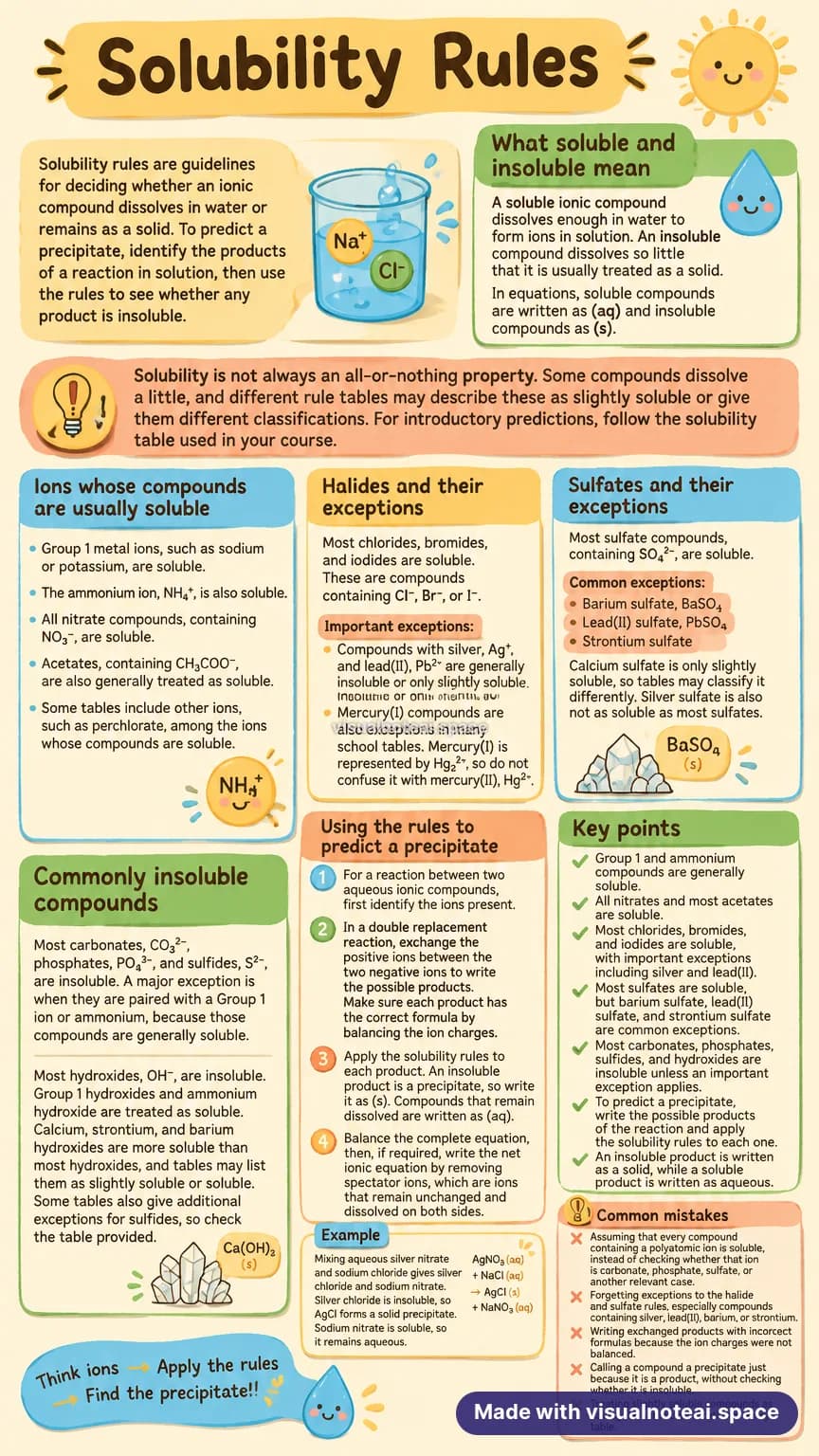
The whole topic on one page. Made with VisualNote.
!Common mistakes
- Assuming that every compound containing a polyatomic ion is soluble, instead of checking whether that ion is carbonate, phosphate, sulfate, or another relevant case.
- Forgetting exceptions to the halide and sulfate rules, especially compounds containing silver, lead(II), barium, or strontium.
- Writing exchanged products with incorrect formulas because the ion charges were not balanced.
- Calling a compound a precipitate just because it is a product, without checking whether it is insoluble.
- Treating slightly soluble compounds as having the same classification in every solubility table.
🧠Explore the map38 ideas
The mind map VisualNote made for this topic. Drag to pan, scroll to zoom.
- Solubility Rules
- Soluble and Insoluble
- Soluble compounds form ions in water
- Insoluble compounds are treated as solids
- Aqueous notation: (aq)
- Solid notation: (s)
- Generally Soluble Ions and Compounds
- Group 1 metal compounds
- Ammonium compounds (NH₄⁺)
- Nitrates (NO₃⁻)
- Acetates (CH₃COO⁻)
- Halides and Sulfates
- Most chlorides, bromides, and iodides are soluble
- Halide exceptions: Ag⁺, Pb²⁺, and often Hg₂²⁺
- Most sulfates (SO₄²⁻) are soluble
- Sulfate exceptions: BaSO₄, PbSO₄, SrSO₄
- Borderline cases: CaSO₄ and Ag₂SO₄
- Commonly Insoluble Compounds
- Most carbonates (CO₃²⁻)
- Most phosphates (PO₄³⁻)
- Most sulfides (S²⁻)
- Most hydroxides (OH⁻)
- Group 1 and ammonium exceptions
- Ca, Sr, and Ba hydroxides: more soluble
- Precipitate Prediction
- Identify ions in aqueous reactants
- Exchange ions to write possible products
- Balance ion charges in each formula
- Apply solubility rules to each product
- Insoluble product forms a precipitate: (s)
- Soluble product remains aqueous: (aq)
- Balance equation; remove spectator ions if needed
- Borderline Cases and Common Errors
- Slight solubility classifications vary by table
- Check polyatomic-ion rules instead of assuming solubility
- Check halide and sulfate exceptions
- Do not call every product a precipitate
- Use correct formulas by balancing ion charges
- Soluble and Insoluble
🃏Flashcards14 cards
- What do solubility rules help predict?
- They help determine whether an ionic compound dissolves in water or remains solid, including whether a reaction forms a precipitate.
- What do (aq) and (s) mean in a chemical equation?
- (aq) means the compound is dissolved in water; (s) means it is present as a solid.
- Which compounds are generally soluble regardless of their other ion?
- Compounds containing Group 1 metal ions or ammonium (NH₄⁺) are generally soluble.
- How soluble are nitrates and acetates?
- All nitrate compounds are soluble, and acetates are generally treated as soluble.
- What is the general solubility rule for chlorides, bromides, and iodides?
- Most are soluble, but compounds with silver (Ag⁺) or lead(II) (Pb²⁺) are common exceptions and are generally insoluble or slightly soluble.
- What is mercury(I), and why is its notation important?
- Mercury(I) is commonly represented as the paired ion Hg₂²⁺. It is a halide exception in many school tables and should not be confused with mercury(II), Hg²⁺.
- What is the general rule for sulfates, and what are common exceptions?
- Most sulfates are soluble. Barium sulfate, lead(II) sulfate, and strontium sulfate are common insoluble exceptions.
- Which compounds are generally insoluble?
- Most carbonates, phosphates, and sulfides are insoluble, except when paired with a Group 1 ion or ammonium.
- What are the solubility rules for hydroxides?
- Most hydroxides are insoluble, while Group 1 hydroxides and ammonium hydroxide are treated as soluble. Calcium, strontium, and barium hydroxides are more soluble than most.
- How do you find possible products in a double replacement reaction?
- Exchange the positive ions between the negative ions, then balance each product formula so its total ionic charge is zero.
- How do you identify a precipitate from reaction products?
- Apply the solubility rules to each product. An insoluble product is a precipitate and is written as (s); a soluble product is written as (aq).
- What is a spectator ion?
- A spectator ion remains unchanged and dissolved on both sides of the equation. Remove spectator ions when writing the net ionic equation.
- What precipitate forms when aqueous silver nitrate reacts with aqueous sodium chloride?
- Silver chloride, AgCl, forms as an insoluble solid precipitate; sodium nitrate remains aqueous.
- How should slightly soluble compounds be classified?
- Their classifications can vary between solubility tables. Follow the conventions or table specified for the course.
✅Test yourself5 questions
How is an insoluble ionic compound usually represented in a chemical equation?
An insoluble compound dissolves so little that it is usually treated as a solid and written (s).
Which compound is generally soluble under the standard solubility rules?
Compounds containing Group 1 ions such as potassium are generally soluble, including carbonates.
Which sulfate is commonly treated as insoluble?
Barium sulfate is a common exception to the rule that most sulfates are soluble.
When predicting products in a double replacement reaction, what must be done after exchanging the ions?
The exchanged products must have formulas that balance the charges of their constituent ions.
A reaction produces AgCl and NaNO3 in aqueous solution. Which product forms a precipitate?
Silver chloride is an important exception to the usual solubility of chlorides, so it forms a solid precipitate.
📝The notes
What soluble and insoluble mean
A soluble ionic compound dissolves enough in water to form ions in solution. An insoluble compound dissolves so little that it is usually treated as a solid. In equations, soluble compounds are written as aqueous, or (aq), and insoluble compounds as solid, or (s).
Solubility is not always an all-or-nothing property. Some compounds dissolve a little, and different rule tables may describe these as slightly soluble or give them different classifications. For introductory predictions, follow the solubility table used in your course.
Ions whose compounds are usually soluble
Compounds containing a Group 1 metal ion, such as sodium or potassium, are soluble. Compounds containing the ammonium ion, NH4+, are also soluble. These rules apply to the compound as a whole, whatever its other ion is.
All nitrate compounds, containing NO3−, are soluble. Acetates, containing CH3COO−, are also generally treated as soluble. Some tables include other ions, such as perchlorate, among the ions whose compounds are soluble.
Halides and their exceptions
Most chlorides, bromides, and iodides are soluble. These are compounds containing Cl−, Br−, or I−.
Important exceptions include compounds of these ions with silver, Ag+, and lead(II), Pb2+, which are generally insoluble or only slightly soluble. Mercury(I) compounds are also exceptions in many school tables. Mercury(I) is commonly represented by the paired ion Hg2^2+, so do not confuse it with mercury(II), Hg2+.
Sulfates and their exceptions
Most sulfate compounds, containing SO4^2−, are soluble. Common exceptions include barium sulfate, BaSO4, and lead(II) sulfate, PbSO4, which are insoluble. Strontium sulfate is also usually treated as insoluble.
Calcium sulfate is only slightly soluble, so tables may classify it differently. Silver sulfate is also not as soluble as most sulfates. Use the classification and conventions in your course when a question involves one of these borderline cases.
Commonly insoluble compounds
Most carbonates, CO3^2−, phosphates, PO4^3−, and sulfides, S^2−, are insoluble. A major exception is when they are paired with a Group 1 ion or ammonium, because those compounds are generally soluble.
Most hydroxides, OH−, are insoluble. Group 1 hydroxides and ammonium hydroxide are treated as soluble in standard school rules. Calcium, strontium, and barium hydroxides are more soluble than most hydroxides, and tables may list them as slightly soluble or soluble. Some tables also give additional exceptions for sulfides, so check the table provided.
Using the rules to predict a precipitate
For a reaction between two aqueous ionic compounds, first identify the ions present. In a double replacement reaction, exchange the positive ions between the two negative ions to write the possible products. Make sure each product has the correct formula by balancing the ion charges.
Apply the solubility rules to each product. A product classified as insoluble is a precipitate, so write it as (s). Compounds that remain dissolved are written as (aq). Balance the complete equation, then, if required, write the net ionic equation by removing spectator ions, which are ions that remain unchanged and dissolved on both sides.
For example, mixing aqueous silver nitrate and sodium chloride gives silver chloride and sodium nitrate. Silver chloride is an insoluble chloride exception, so AgCl forms a solid precipitate. Sodium nitrate is soluble, so it remains aqueous.
Make this for your own notes
Paste a chapter or a PDF and get the sheet, map, cards, quiz and episode back in about a minute. No credit card.