
Across a period, atomic radius generally decreases, while ionization energy and electronegativity generally increase. Down a group, atomic radius generally increases, while ionization energy and electronegativity generally decrease, mainly because the outer electrons are farther from the nucleus and more shielded.
★What to remember
- Atomic radius generally decreases from left to right across a period because effective nuclear attraction increases while shielding changes little.
- Atomic radius generally increases down a group because new electron shells are added and inner electrons provide more shielding.
- First ionization energy generally increases across a period because outer electrons are held more strongly.
- First ionization energy generally decreases down a group because outer electrons are farther from the nucleus and more shielded.
- Electronegativity generally increases across a period as attraction for shared bonding electrons becomes stronger.
- Electronegativity generally decreases down a group as bonding electrons become farther from the nucleus and more shielded.
- Ionization energy and electronegativity trends have exceptions, so their patterns are general rather than perfectly smooth.
🎧Listen3:01 · transcript
AnnaWhen people look at the periodic table, they often hear that properties change in predictable directions. But what is actually causing those trends?
MarcoThe key is attraction. A positively charged nucleus attracts electrons, while inner electrons partly shield outer electrons from that pull. So an outer electron’s experience depends on nuclear charge, shielding, and its distance from the nucleus.
AnnaSo across a period, the nucleus gains protons. But the added electrons usually go into the same main energy level. Does that mean shielding changes only a little?
MarcoExactly. With only a small change in shielding, the effective attraction on the outer electrons tends to grow. That helps explain why atomic radius generally decreases from left to right. The electron cloud is pulled closer to the nucleus.
AnnaAnd down a group, the pattern reverses for radius. Each step adds an occupied energy level, putting the outer electrons farther away. There are also more inner electrons to shield them, right?
MarcoRight. Nuclear charge increases too, but the greater distance and shielding generally outweigh that effect for the outermost electrons. So atomic radius generally increases down a group. And radius is not a sharply defined edge, since an electron cloud has no fixed boundary. Measurements can vary, but the overall trend is useful.
AnnaHow does that connect to first ionization energy?
MarcoFirst ionization energy is the energy needed to remove one electron from each atom in a mole of gaseous atoms, making a mole of gaseous singly charged positive ions. It generally rises across a period because the outer electrons are held more strongly. Down a group, it generally falls because the outer electron is farther away and more shielded, so it is easier to remove.
AnnaBut it does not rise in a perfectly smooth line across a period. What causes those small dips?
MarcoSometimes an electron in a higher energy subshell is easier to remove than one in a lower subshell. Also, two electrons paired in the same orbital repel each other, which can make one easier to remove. Those effects create exceptions to the overall pattern.
AnnaThen electronegativity is related, but it is not the same thing as ionization energy. What does it describe?
MarcoIt describes how strongly an atom attracts shared electrons in a chemical bond. It generally increases across a period as attraction for bonding electrons strengthens and atomic size usually decreases. Down a group, it generally decreases because the shared electrons are farther from the nucleus and more shielded.
AnnaSo the shared idea is attraction, but the definitions matter. Ionization energy concerns removing an electron from a gaseous atom; electronegativity concerns shared electrons in a bond.
MarcoYes. Electronegativity is a relative scale, not a directly measured energy. In basic comparisons, noble gases usually are not assigned values, because they rarely form the bonds those scales are based on. The safest approach is to use the overall trend, then check for exceptions and definitions.
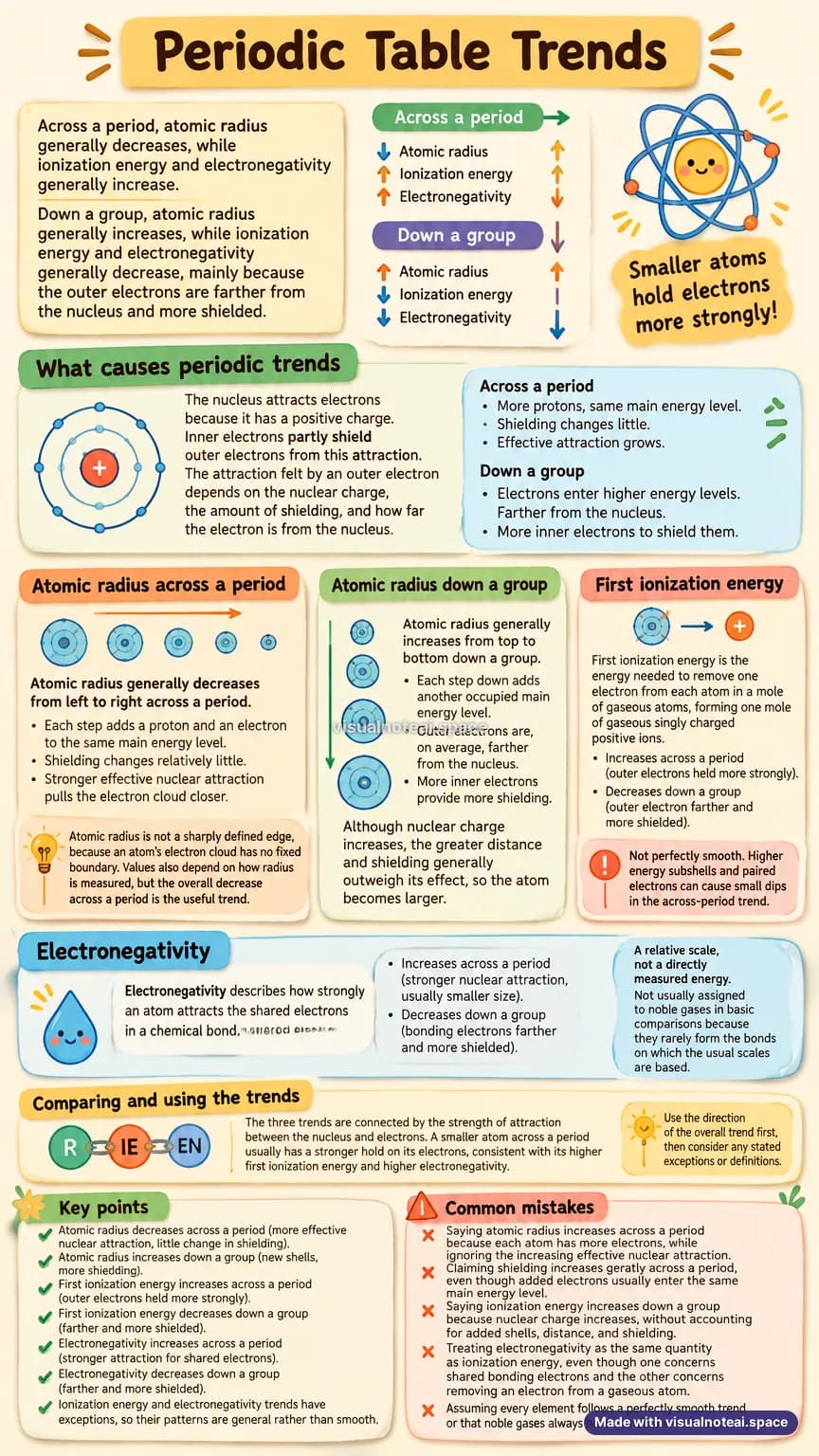
The whole topic on one page. Made with VisualNote.
!Common mistakes
- Saying atomic radius increases across a period because each atom has more electrons, while ignoring the increasing effective nuclear attraction.
- Claiming shielding increases greatly across a period, even though added electrons usually enter the same main energy level.
- Saying ionization energy increases down a group because nuclear charge increases, without accounting for added shells, distance, and shielding.
- Treating electronegativity as the same quantity as ionization energy, even though one concerns attraction for shared bonding electrons and the other concerns removing an electron from a gaseous atom.
- Assuming every element follows a perfectly smooth trend or that noble gases always have standard electronegativity values.
🧠Explore the map37 ideas
The mind map VisualNote made for this topic. Drag to pan, scroll to zoom.
- Periodic Table Trends
- Causes of Periodic Trends
- Positive nucleus attracts electrons
- Inner electrons shield outer electrons
- Effective attraction depends on nuclear charge, shielding, and distance
- Across a period: proton count rises; shielding changes little
- Down a group: added shells increase distance and shielding
- Atomic Radius
- Decreases across a period
- Stronger effective attraction pulls electron cloud closer
- Increases down a group
- Added energy levels and shielding enlarge the atom
- Electron cloud has no sharp boundary
- Decreases across a period
- First Ionization Energy
- Energy to remove one electron from a gaseous atom
- Generally increases across a period
- Outer electrons are held more strongly
- Generally decreases down a group
- Greater distance and shielding ease electron removal
- Small dips from subshell energy and electron pairing
- Electronegativity
- Attraction for shared bonding electrons
- Generally increases across a period
- Smaller atoms attract bonding electrons more strongly
- Generally decreases down a group
- Bonding electrons are farther away and more shielded
- Relative scale; noble gas values often omitted
- Comparing and Using Trends
- Smaller atoms usually have higher ionization energy and electronegativity
- Trends are general, not perfectly smooth
- Use overall direction, then consider exceptions and definitions
- Common Misconceptions
- More electrons do not mean radius increases across a period
- Shielding does not rise greatly across a period
- Nuclear charge alone does not determine down-group trends
- Electronegativity differs from ionization energy
- Do not assume smooth trends or standard noble gas values
- Causes of Periodic Trends
🃏Flashcards13 cards
- What is the general atomic-radius trend across a period?
- Atomic radius generally decreases from left to right because effective nuclear attraction increases while shielding changes little.
- What is the general atomic-radius trend down a group?
- Atomic radius generally increases because new occupied energy levels place outer electrons farther from the nucleus, with more shielding.
- What causes periodic trends in electron attraction?
- The attraction on outer electrons depends on nuclear charge, shielding by inner electrons, and distance from the nucleus.
- Why does effective nuclear attraction usually increase across a period?
- Proton number increases while added electrons usually enter the same main energy level, so shielding changes relatively little.
- What is first ionization energy?
- The energy needed to remove one electron from each atom in a mole of gaseous atoms, forming a mole of gaseous singly charged positive ions.
- How does first ionization energy generally change across a period, and why?
- It generally increases because stronger effective nuclear attraction holds outer electrons more tightly.
- How does first ionization energy generally change down a group, and why?
- It generally decreases because outer electrons are farther from the nucleus and more shielded, making them easier to remove.
- Why is the ionization-energy trend across a period not perfectly smooth?
- Subshell energy differences and repulsion between paired electrons can make certain electrons easier to remove, causing small dips.
- What does electronegativity describe?
- It describes how strongly an atom attracts shared electrons in a chemical bond.
- How does electronegativity generally change across a period?
- It generally increases as attraction for bonding electrons strengthens and atomic size tends to decrease.
- How does electronegativity generally change down a group?
- It generally decreases because bonding electrons are farther from the nucleus and more shielded.
- How are atomic radius, ionization energy, and electronegativity related across a period?
- A smaller atomic radius generally accompanies higher first ionization energy and higher electronegativity, reflecting stronger attraction between the nucleus and electrons.
- Why are noble gases often not assigned electronegativity values in basic comparisons?
- They rarely form the bonds on which usual electronegativity scales are based.
✅Test yourself5 questions
Why does atomic radius generally decrease from left to right across a period?
Across a period, added protons increase effective nuclear attraction while added electrons usually enter the same main energy level, so shielding changes little.
What best explains why atomic radius generally increases down a group?
Down a group, new occupied energy levels place outer electrons farther from the nucleus, and additional inner electrons shield them.
Which statement correctly defines first ionization energy?
First ionization energy is the energy needed to remove one electron from each atom in a mole of gaseous atoms, forming singly charged gaseous ions.
Why might first ionization energy show a small dip between neighboring elements across a period?
Subshell energy differences or repulsion between paired electrons can make an electron easier to remove, producing small exceptions to the overall trend.
Which statement distinguishes electronegativity from first ionization energy?
Electronegativity describes an atom's attraction for shared bonding electrons, whereas first ionization energy concerns removing an electron from a gaseous atom.
📝The notes
What causes periodic trends
The nucleus attracts electrons because it has a positive charge. Inner electrons partly shield outer electrons from this attraction. The attraction felt by an outer electron depends on the nuclear charge, the amount of shielding, and how far the electron is from the nucleus.
Across a period, the number of protons increases while added electrons usually enter the same main energy level. Shielding does not increase very much, so the effective attraction between the nucleus and the outer electrons tends to grow. Down a group, added electrons occupy higher energy levels, farther from the nucleus, and there are more inner electrons to shield them.
Atomic radius across a period
Atomic radius generally decreases from left to right across a period. Each step adds a proton to the nucleus and an electron to the same main energy level. Since shielding changes relatively little, the stronger effective nuclear attraction pulls the electron cloud closer to the nucleus.
Atomic radius is not a sharply defined edge, because an atom's electron cloud has no fixed boundary. The precise values also depend on how radius is measured, but the overall decrease across a period is the useful trend.
Atomic radius down a group
Atomic radius generally increases from top to bottom down a group. Each step down adds another occupied main energy level, so the outer electrons are, on average, farther from the nucleus.
The additional inner electrons also shield the outer electrons from the nucleus. Although nuclear charge increases down the group, the greater distance and shielding generally outweigh its effect on the outermost electrons, so the atom becomes larger.
First ionization energy
First ionization energy is the energy needed to remove one electron from each atom in a mole of gaseous atoms, forming one mole of gaseous singly charged positive ions. It generally increases across a period because the outer electrons are held more strongly as effective nuclear attraction increases. It generally decreases down a group because the outer electron is farther from the nucleus and more shielded, so it is easier to remove.
The trend is not perfectly smooth. For example, an electron in a higher energy subshell can sometimes be easier to remove than one in a lower subshell, and pairing electrons in the same orbital can make one of them easier to remove because of repulsion. These effects cause small dips in the across-period trend.
Electronegativity
Electronegativity describes how strongly an atom attracts the shared electrons in a chemical bond. It generally increases across a period because the nuclear attraction for bonding electrons becomes stronger, while atomic size usually decreases.
Electronegativity generally decreases down a group. Bonding electrons are farther from the nucleus and more shielded by inner electrons, so the atom attracts the shared pair less strongly. Electronegativity is a relative scale rather than a directly measured energy, and values are not usually assigned to noble gases in basic comparisons because they rarely form the bonds on which the usual scales are based.
Comparing and using the trends
The three trends are connected by the strength of attraction between the nucleus and electrons. A smaller atom across a period usually has a stronger hold on its electrons, which is consistent with its higher first ionization energy and higher electronegativity.
These are general patterns, not rules that make every neighboring pair follow a perfectly smooth sequence. Ionization energy has notable small exceptions, and electronegativity values depend on the scale and chemical context. Use the direction of the overall trend first, then consider any stated exceptions or definitions.
Make this for your own notes
Paste a chapter or a PDF and get the sheet, map, cards, quiz and episode back in about a minute. No credit card.