
Percent yield compares the amount of product actually obtained in an experiment with the maximum amount predicted by a chemical calculation. To calculate it, first find the theoretical yield using the balanced equation and the limiting reagent.
★What to remember
- Actual yield is the amount of product collected in an experiment.
- Theoretical yield is the maximum product amount predicted by calculation.
- Percent yield = (actual yield ÷ theoretical yield) × 100.
- Use the same units for actual yield and theoretical yield.
- Find the limiting reagent before calculating theoretical yield.
- The limiting reagent determines the maximum amount of product.
- Percent yield is commonly below 100% because reactions may not go to completion or product may be lost.
🎧Listen2:57 · transcript
AnnaWhen a chemistry experiment gives you some product, how do you tell whether that amount is a lot or a little? Percent yield gives us a way to compare what we collected with the maximum amount the reaction could produce.
MarcoRight. But before we calculate it, we need to separate two ideas. Actual yield is the amount of product collected. It’s usually measured as a mass, after the reaction and any separation or purification. Theoretical yield is different. It’s calculated from the balanced equation and starting quantities.
AnnaSo theoretical yield isn’t a promise about what you’ll collect. It’s the maximum possible amount if the limiting reagent reacts completely and none of the product is lost. How do we find that limiting reagent?
MarcoConvert each reactant quantity to moles. Then use the balanced equation to work out how much product each reactant could form. The reactant that could form the smaller amount of product runs out first. That’s the limiting reagent, and it determines the theoretical yield.
AnnaLet’s use the nitrogen and hydrogen example. The balanced equation is N two plus three H two yields two N H three. We start with twenty-eight point zero grams of nitrogen and three point zero zero grams of hydrogen. What do those amounts become in moles?
MarcoUsing the given molar masses, that’s one point zero zero mole of nitrogen and one point four eight eight moles of hydrogen. The equation needs three moles of hydrogen for each mole of nitrogen. So one mole of nitrogen would need three moles of hydrogen, but we have only one point four eight eight. Hydrogen is limiting, and nitrogen is in excess.
AnnaOnce we know that, we use hydrogen to calculate the maximum ammonia. Three moles of hydrogen produce two moles of ammonia. So one point four eight eight times two, divided by three, gives zero point nine nine two mole of ammonia. Then we convert that to grams, using seventeen point zero three grams per mole. That gives a theoretical yield of sixteen point nine grams.
MarcoAnd if the experiment actually collects twelve point seven grams, how do we compare the two?
AnnaDivide actual yield by theoretical yield, then multiply by one hundred. So twelve point seven divided by sixteen point nine, times one hundred, is seventy-five point one percent. The collected mass is seventy-five point one percent of the calculated maximum.
MarcoThe units matter, too. Actual and theoretical yield have to refer to the same product and use the same units. Here, both are grams of ammonia. And we divide actual by theoretical, not the other way around.
AnnaExactly. It’s also a mistake to use the excess reactant for the theoretical yield, or to ignore the balanced equation’s mole ratios. And theoretical yield doesn’t mean that amount must be collected in a real experiment.
MarcoPercent yield is commonly below one hundred percent because a reaction may not go to completion, or some product may be lost. So it tells us how the collected amount compares with the calculated maximum, while keeping the limiting reagent and the calculation straight.
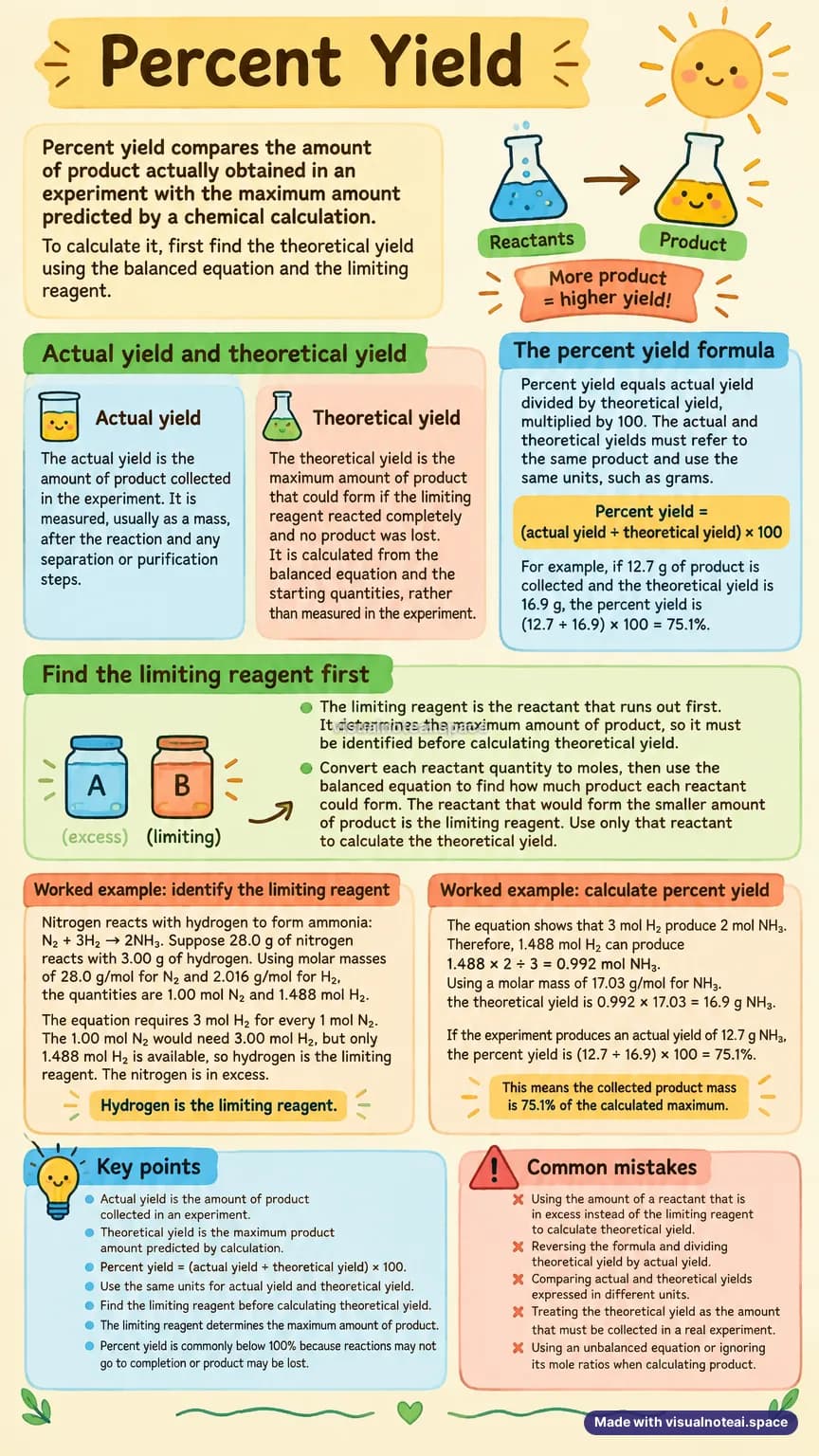
The whole topic on one page. Made with VisualNote.
!Common mistakes
- Using the amount of a reactant that is in excess instead of the limiting reagent to calculate theoretical yield.
- Reversing the formula and dividing theoretical yield by actual yield.
- Comparing actual and theoretical yields expressed in different units.
- Treating the theoretical yield as the amount that must be collected in a real experiment.
- Using an unbalanced equation or ignoring its mole ratios when calculating product.
🧠Explore the map28 ideas
The mind map VisualNote made for this topic. Drag to pan, scroll to zoom.
- Percent Yield
- Yield Concepts
- Actual yield: product collected
- Measured after reaction and separation
- Theoretical yield: calculated maximum product
- Based on balanced equation and starting quantities
- Percent Yield Formula
- (Actual yield ÷ theoretical yield) × 100
- Use the same product and units
- Example: 12.7 g ÷ 16.9 g × 100 = 75.1%
- Limiting Reagent
- Reactant that runs out first
- Determines maximum product amount
- Convert reactants to moles
- Use balanced-equation mole ratios
- Reactant forming less product is limiting
- Worked Example: Ammonia
- N₂ + 3H₂ → 2NH₃
- 1.00 mol N₂ and 1.488 mol H₂
- H₂ is limiting; N₂ is in excess
- Theoretical yield: 0.992 mol NH₃ = 16.9 g
- Actual yield: 12.7 g NH₃; percent yield: 75.1%
- Interpretation and Common Errors
- Often below 100%: incomplete reaction or product loss
- Do not calculate from the excess reagent
- Do not reverse the formula
- Do not mix units or use an unbalanced equation
- Theoretical yield is a maximum, not a guaranteed collection
- Yield Concepts
🃏Flashcards14 cards
- What does percent yield compare?
- It compares the amount of product actually collected with the maximum amount predicted by calculation.
- What is actual yield?
- The amount of product collected in an experiment, usually measured as a mass after reaction and separation or purification.
- What is theoretical yield?
- The maximum amount of product predicted if the limiting reagent reacts completely and no product is lost.
- What is the percent yield formula?
- Percent yield = (actual yield ÷ theoretical yield) × 100.
- What units should be used in the percent yield calculation?
- Actual yield and theoretical yield must refer to the same product and use the same units.
- What is the limiting reagent?
- The reactant that runs out first. It determines the maximum amount of product that can form.
- How do you identify the limiting reagent?
- Convert each reactant quantity to moles and use the balanced equation to calculate how much product each could form. The reactant that forms less product is limiting.
- Which reactant should be used to calculate theoretical yield?
- Use the limiting reagent, not the reactant that is in excess.
- For N₂ + 3H₂ → 2NH₃, which reactant is limiting with 1.00 mol N₂ and 1.488 mol H₂?
- Hydrogen is limiting: 1.00 mol N₂ would require 3.00 mol H₂, but only 1.488 mol H₂ is available.
- How many moles of NH₃ can form from 1.488 mol H₂?
- Using the 3:2 H₂-to-NH₃ mole ratio: 1.488 × 2 ÷ 3 = 0.992 mol NH₃.
- What is the theoretical yield of NH₃ if 0.992 mol forms and its molar mass is 17.03 g/mol?
- 0.992 × 17.03 = 16.9 g NH₃.
- What is the percent yield for 12.7 g actual NH₃ and 16.9 g theoretical NH₃?
- (12.7 ÷ 16.9) × 100 = 75.1%.
- Why is percent yield commonly below 100%?
- The reaction may not go to completion, or some product may be lost during collection or processing.
- What are common errors in percent yield problems?
- Using the excess reagent, reversing the formula, mixing units, treating theoretical yield as a guaranteed collected amount, or ignoring the balanced equation’s mole ratios.
✅Test yourself5 questions
Which statement best describes the theoretical yield?
The theoretical yield is the calculated maximum product amount if the limiting reagent reacts completely and no product is lost.
A reaction has an actual yield of 12.0 g and a theoretical yield of 15.0 g. What is its percent yield?
Percent yield is actual yield divided by theoretical yield, multiplied by 100, so (12.0 ÷ 15.0) × 100 = 80.0%.
Why must the limiting reagent be identified before calculating theoretical yield?
The limiting reagent runs out first and therefore sets the maximum possible product amount.
For N₂ + 3H₂ → 2NH₃, 1.00 mol N₂ is mixed with 1.488 mol H₂. Which reactant is limiting?
The balanced equation requires 3 mol H₂ per 1 mol N₂, so the available 1.488 mol H₂ is insufficient and runs out first.
Before calculating percent yield, what should you check about the actual and theoretical yields?
The actual and theoretical yields must refer to the same product and use matching units so their ratio is meaningful.
📝The notes
Actual yield and theoretical yield
The actual yield is the amount of product collected in the experiment. It is measured, usually as a mass, after the reaction and any separation or purification steps.
The theoretical yield is the maximum amount of product that could form if the limiting reagent reacted completely and no product was lost. It is calculated from the balanced equation and the starting quantities, rather than measured in the experiment.
The percent yield formula
Percent yield equals actual yield divided by theoretical yield, multiplied by 100. The actual and theoretical yields must refer to the same product and use the same units, such as grams.
Percent yield = (actual yield ÷ theoretical yield) × 100. For example, if 12.7 g of product is collected and the theoretical yield is 16.9 g, the percent yield is (12.7 ÷ 16.9) × 100 = 75.1%.
Find the limiting reagent first
The limiting reagent is the reactant that runs out first. It determines the maximum amount of product, so it must be identified before calculating theoretical yield.
Convert each reactant quantity to moles, then use the balanced equation to find how much product each reactant could form. The reactant that would form the smaller amount of product is the limiting reagent. Use only that reactant to calculate the theoretical yield.
Worked example: identify the limiting reagent
Nitrogen reacts with hydrogen to form ammonia: N₂ + 3H₂ → 2NH₃. Suppose 28.0 g of nitrogen reacts with 3.00 g of hydrogen. Using molar masses of 28.0 g/mol for N₂ and 2.016 g/mol for H₂, the quantities are 1.00 mol N₂ and 1.488 mol H₂.
The equation requires 3 mol H₂ for every 1 mol N₂. The 1.00 mol N₂ would need 3.00 mol H₂, but only 1.488 mol H₂ is available, so hydrogen is the limiting reagent. The nitrogen is in excess.
Worked example: calculate percent yield
The equation shows that 3 mol H₂ produce 2 mol NH₃. Therefore, 1.488 mol H₂ can produce 1.488 × 2 ÷ 3 = 0.992 mol NH₃. Using a molar mass of 17.03 g/mol for NH₃, the theoretical yield is 0.992 × 17.03 = 16.9 g NH₃.
If the experiment produces an actual yield of 12.7 g NH₃, the percent yield is (12.7 ÷ 16.9) × 100 = 75.1%. This means the collected product mass is 75.1% of the calculated maximum.
Make this for your own notes
Paste a chapter or a PDF and get the sheet, map, cards, quiz and episode back in about a minute. No credit card.