
Molarity, also called concentration in moles per litre, tells you how many moles of solute are present in each litre of solution. You can calculate it from the amount of solute and the solution volume, prepare a solution by measuring the required solute, or use the dilution equation to make a weaker solution from a stronger one.
★What to remember
- Molarity is calculated using C = n ÷ V.
- Use moles for n and litres for V when C is in mol L⁻¹.
- The volume in the concentration formula is the final volume of the solution.
- To find the mass of solid needed, calculate n = C × V and then use m = n × Mᵣ.
- A solution made from a solid is made up to the final volume after the solid has dissolved.
- For dilution, C₁V₁ = C₂V₂ because the amount of solute stays constant.
- Keep volume units consistent when using the dilution equation.
🎧Listen3:19 · transcript
AnnaWhen people hear “molarity,” what are we actually measuring?
MarcoThe number of moles of solute in each litre of solution. The key word is solution, not just the water you started with. We calculate concentration by dividing moles by the final volume in litres.
AnnaSo the formula is concentration equals moles divided by volume. What if we need to find the moles or the volume instead?
MarcoRearrange it. Moles equal concentration times volume, and volume equals moles divided by concentration. If the concentration is in moles per litre, volume has to be in litres. So two hundred and fifty millilitres becomes zero point two five zero litres.
AnnaLet’s try the basic calculation. Say we dissolve zero point two zero moles and make a total of zero point five zero litres of solution. What concentration do we get?
MarcoZero point two zero divided by zero point five zero, which is zero point four zero moles per litre. And “make a total” matters. The volume is measured after the solution is made up, not just the water poured in at the beginning.
AnnaHow does that work if we’re starting with a solid and want to prepare a solution at a chosen concentration?
MarcoFirst find the moles you need: target concentration times final volume. Then convert moles to grams by multiplying by the substance’s molar mass. For two hundred and fifty millilitres of zero point two zero moles per litre sodium chloride, use zero point two five zero litres. That gives zero point zero five zero moles. Multiply by its molar mass, about fifty-eight point five grams per mole, and you need about two point nine three grams.
AnnaAnd after weighing it, we don’t just add two hundred and fifty millilitres of water, right?
MarcoRight. Dissolve it in a smaller amount of distilled water, transfer it to a suitable volumetric flask, and rinse the container into the flask so the solute is transferred. Then add distilled water to the calibration mark and mix. That mark sets the final volume.
AnnaNow suppose we already have a stronger solution and want a weaker one. Why does the dilution equation work?
MarcoAdding solvent lowers concentration, but the amount of dissolved solute stays the same, as long as none is lost. So the moles before and after are equal: starting concentration times starting volume equals final concentration times final volume. Keep the volume units consistent on both sides, and the concentration units consistent too.
AnnaIf we need one hundred millilitres of zero point five zero molar solution from a two point zero molar stock, how much stock do we take?
MarcoRearrange to get stock volume: final concentration times final volume, divided by starting concentration. That is zero point five zero times one hundred, divided by two point zero: twenty-five millilitres. Add water until the total volume is one hundred millilitres. Don’t add one hundred millilitres of water to the stock.
AnnaAnd if fifteen millilitres of three point zero molar solution is diluted to ninety millilitres?
MarcoFinal concentration is three point zero times fifteen, divided by ninety: zero point five zero moles per litre. That’s lower than the starting concentration, as a dilution should be. The common traps are mixing up starting and final values, using millilitres in a molarity calculation without converting, or thinking dilution changes the moles of solute. It changes volume and concentration instead.
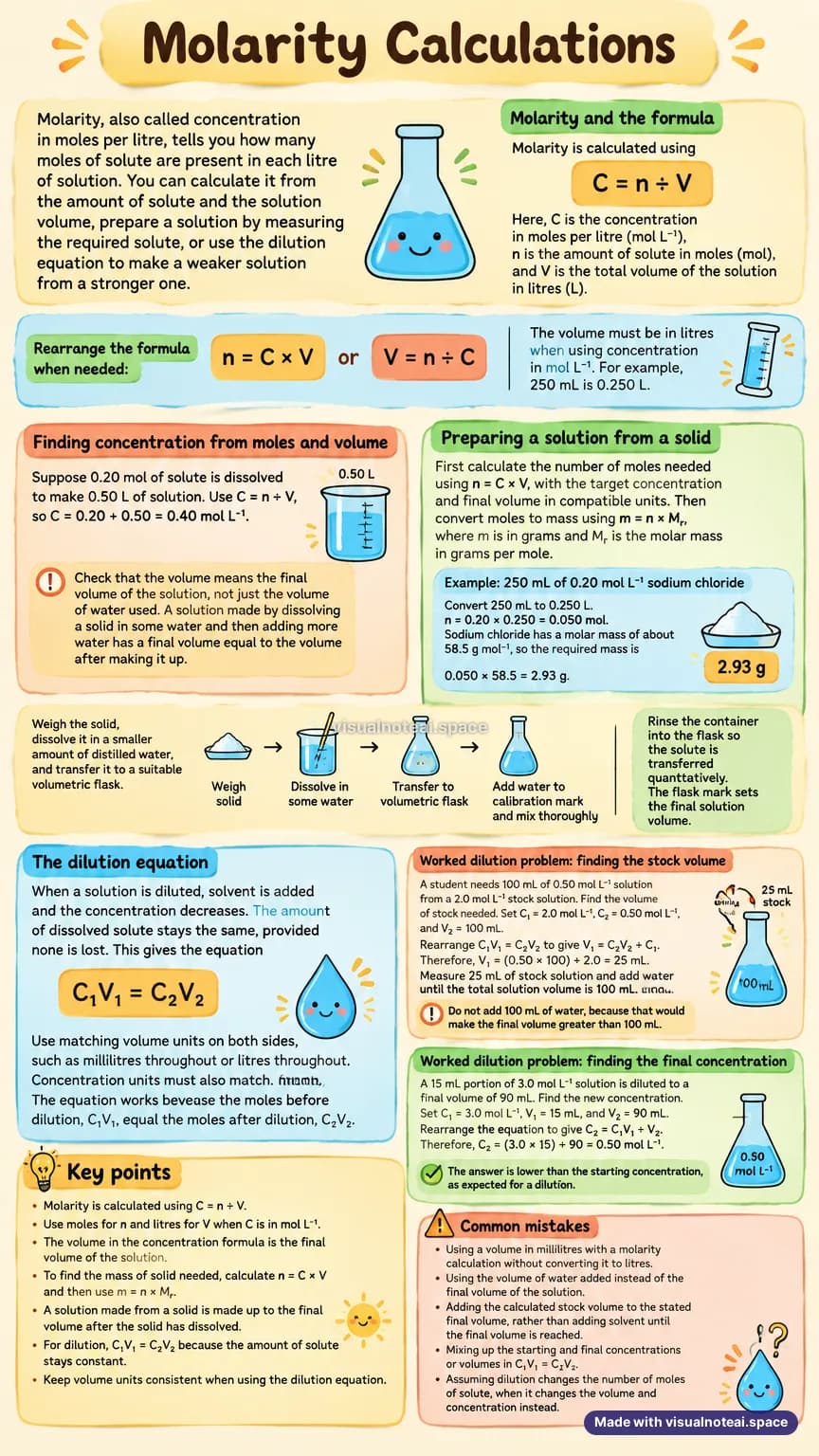
The whole topic on one page. Made with VisualNote.
!Common mistakes
- Using a volume in millilitres with a molarity calculation without converting it to litres.
- Using the volume of water added instead of the final volume of the solution.
- Adding the calculated stock volume to the stated final volume, rather than adding solvent until the final volume is reached.
- Mixing up the starting and final concentrations or volumes in C₁V₁ = C₂V₂.
- Assuming dilution changes the number of moles of solute, when it changes the volume and concentration instead.
🧠Explore the map35 ideas
The mind map VisualNote made for this topic. Drag to pan, scroll to zoom.
- Molarity Calculations
- Molarity Fundamentals
- Concentration in moles per litre
- C = n ÷ V
- C: mol L⁻¹; n: mol; V: L
- Rearrangements: n = C × V; V = n ÷ C
- Use final solution volume
- Convert millilitres to litres
- Finding Concentration
- Divide moles by final volume
- Example: 0.20 mol in 0.50 L
- Concentration: 0.40 mol L⁻¹
- Preparing a Solution from a Solid
- Calculate moles: n = C × V
- Calculate mass: m = n × Mᵣ
- Weigh and dissolve in distilled water
- Transfer quantitatively to volumetric flask
- Make up to calibration mark and mix
- Example: 2.93 g NaCl for 250 mL of 0.20 mol L⁻¹
- Dilution Principles
- Add solvent; concentration decreases
- Moles of solute remain constant
- C₁V₁ = C₂V₂
- Match volume and concentration units
- Dilution Calculations
- Stock volume: V₁ = C₂V₂ ÷ C₁
- Example: 25 mL stock, dilute to 100 mL
- Final concentration: C₂ = C₁V₁ ÷ V₂
- Example: 15 mL of 3.0 M to 90 mL gives 0.50 M
- Add solvent until final volume; do not add that volume of water
- Common Errors
- Using millilitres instead of litres in molarity calculations
- Using water volume instead of final solution volume
- Mixing up starting and final values
- Assuming dilution changes solute moles
- Molarity Fundamentals
🃏Flashcards14 cards
- What does molarity measure?
- Molarity is the number of moles of solute per litre of solution, usually expressed in mol L⁻¹.
- What is the formula for molarity?
- C = n ÷ V, where C is concentration, n is moles of solute, and V is the total solution volume in litres.
- How can the molarity formula be rearranged to find moles or volume?
- Use n = C × V to find moles, or V = n ÷ C to find volume.
- What volume should be used in a molarity calculation?
- Use the final volume of the solution, not just the volume of water used. Convert the volume to litres when using mol L⁻¹.
- How do you convert millilitres to litres?
- Divide millilitres by 1,000; for example, 250 mL = 0.250 L.
- How do you calculate the mass of solid needed to prepare a solution?
- First calculate moles using n = C × V, then calculate mass using m = n × Mᵣ.
- How should a solution be prepared from a solid?
- Dissolve the weighed solid in some distilled water, transfer it quantitatively to a volumetric flask, then add water to the calibration mark and mix.
- What does the calibration mark on a volumetric flask set?
- It sets the final volume of the solution.
- What is the dilution equation, and why does it work?
- C₁V₁ = C₂V₂. It works because the amount of dissolved solute stays constant during dilution, if none is lost.
- What do the symbols in C₁V₁ = C₂V₂ represent?
- C₁ and V₁ are the starting concentration and volume; C₂ and V₂ are the final concentration and volume.
- What units should be used in the dilution equation?
- Use matching volume units on both sides, such as millilitres throughout or litres throughout, and keep concentration units consistent.
- A 2.0 mol L⁻¹ stock is used to make 100 mL of 0.50 mol L⁻¹ solution. What stock volume is needed?
- V₁ = C₂V₂ ÷ C₁ = (0.50 × 100) ÷ 2.0 = 25 mL. Add water until the total volume reaches 100 mL.
- A 15 mL portion of 3.0 mol L⁻¹ solution is diluted to 90 mL. What is the final concentration?
- C₂ = C₁V₁ ÷ V₂ = (3.0 × 15) ÷ 90 = 0.50 mol L⁻¹.
- What changes, and what stays constant, during dilution?
- The solution volume increases and its concentration decreases, while the moles of solute stay constant if none is lost.
✅Test yourself5 questions
What volume should be used in C = n ÷ V when 0.12 mol of solute is made up to 300 mL of solution?
A volume of 300 mL is 0.300 L, and molarity in mol L⁻¹ requires volume in litres.
A solid is dissolved in 80 mL of water, then more water is added until the solution reaches 200 mL. Which volume belongs in the molarity calculation?
The volume in the molarity formula is the final volume of the solution, not the volume of water initially used.
What mass of sodium chloride (Mᵣ = 58.5 g mol⁻¹) is needed to prepare 100 mL of 0.20 mol L⁻¹ solution?
The required amount is 0.20 × 0.100 = 0.020 mol, which corresponds to 0.020 × 58.5 = 1.17 g.
How should a student prepare 100 mL of 0.50 mol L⁻¹ solution from a 2.0 mol L⁻¹ stock solution?
Using C₁V₁ = C₂V₂ gives V₁ = 25 mL, and solvent must be added until the final volume is 100 mL.
During a dilution, what happens to the amount of dissolved solute if none is spilled or otherwise lost?
Dilution adds solvent, so the solute amount remains constant while its concentration decreases.
📝The notes
Molarity and the formula
Molarity is calculated using the formula C = n ÷ V. Here, C is the concentration in moles per litre (mol L⁻¹), n is the amount of solute in moles (mol), and V is the total volume of the solution in litres (L).
Rearrange the formula when needed: n = C × V, or V = n ÷ C. The volume must be in litres when using concentration in mol L⁻¹. For example, 250 mL is 0.250 L.
Finding concentration from moles and volume
Suppose 0.20 mol of solute is dissolved to make 0.50 L of solution. Use C = n ÷ V, so C = 0.20 ÷ 0.50 = 0.40 mol L⁻¹.
Check that the volume means the final volume of the solution, not just the volume of water used. A solution made by dissolving a solid in some water and then adding more water has a final volume equal to the volume after making it up.
Preparing a solution from a solid
First calculate the number of moles needed using n = C × V, with the target concentration and final volume in compatible units. Then convert moles to mass using m = n × Mᵣ, where m is in grams and Mᵣ is the molar mass in grams per mole.
For example, to prepare 250 mL of 0.20 mol L⁻¹ sodium chloride solution, convert 250 mL to 0.250 L. The required amount is n = 0.20 × 0.250 = 0.050 mol. Sodium chloride has a molar mass of about 58.5 g mol⁻¹, so the required mass is 0.050 × 58.5 = 2.93 g.
Weigh the solid, dissolve it in a smaller amount of distilled water, and transfer it to a suitable volumetric flask. Rinse the container into the flask so the solute is transferred quantitatively, then add distilled water to the calibration mark and mix thoroughly. The flask mark sets the final solution volume.
The dilution equation
When a solution is diluted, solvent is added and the concentration decreases. The amount of dissolved solute stays the same, provided none is lost. This gives the equation C₁V₁ = C₂V₂, where C₁ and V₁ are the concentration and volume of the starting solution, and C₂ and V₂ are the concentration and final volume after dilution.
Use matching volume units on both sides, such as millilitres throughout or litres throughout. Concentration units must also match. The equation works because the moles before dilution, C₁V₁, equal the moles after dilution, C₂V₂.
Worked dilution problem: finding the stock volume
A student needs 100 mL of 0.50 mol L⁻¹ solution from a 2.0 mol L⁻¹ stock solution. Find the volume of stock needed. Set C₁ = 2.0 mol L⁻¹, C₂ = 0.50 mol L⁻¹, and V₂ = 100 mL.
Rearrange C₁V₁ = C₂V₂ to give V₁ = C₂V₂ ÷ C₁. Therefore, V₁ = (0.50 × 100) ÷ 2.0 = 25 mL. Measure 25 mL of stock solution and add water until the total solution volume is 100 mL. Do not add 100 mL of water, because that would make the final volume greater than 100 mL.
Worked dilution problem: finding the final concentration
A 15 mL portion of 3.0 mol L⁻¹ solution is diluted to a final volume of 90 mL. Find the new concentration. Set C₁ = 3.0 mol L⁻¹, V₁ = 15 mL, and V₂ = 90 mL.
Rearrange the equation to give C₂ = C₁V₁ ÷ V₂. Therefore, C₂ = (3.0 × 15) ÷ 90 = 0.50 mol L⁻¹. The answer is lower than the starting concentration, as expected for a dilution.
Make this for your own notes
Paste a chapter or a PDF and get the sheet, map, cards, quiz and episode back in about a minute. No credit card.