
The limiting reagent is the reactant that is used up first in a chemical reaction. It determines the greatest amount of product that can form, while any other reactant may remain in excess.
★What to remember
- Balance the chemical equation before comparing reactant amounts.
- Use amounts in moles when applying the equation’s coefficients.
- Divide each reactant’s available moles by its coefficient to identify the limiting reagent.
- The smallest moles-to-coefficient result belongs to the limiting reagent.
- The limiting reagent determines the maximum amount of product that can form.
- Calculate product from the limiting reagent, not from an excess reagent.
- Find leftover excess by subtracting the amount consumed from the amount initially available.
🎧Listen2:53 · transcript
AnnaWhen people hear “limiting reagent,” they sometimes assume it means the reactant there’s least of. Is that actually right?
MarcoNot necessarily. It’s the reactant that gets used up first when the reaction follows the proportions in the balanced chemical equation. That’s what limits how much product can form.
AnnaSo the equation’s coefficients matter. And the other reactants might not run out?
MarcoExactly. Those are called excess reagents. There’s more of them than needed to react completely with the limiting reagent. Once the limiting reagent is gone, the reaction can’t keep going, even if excess reactant remains.
AnnaHow do we find the limiting reagent without guessing?
MarcoFirst, balance the equation. Then express each reactant amount in moles. If an amount is given in another unit, convert it. For each reactant, divide its available moles by its coefficient in the balanced equation. The smallest result identifies the limiting reagent.
AnnaWhy divide by the coefficient instead of just comparing the mole amounts?
MarcoBecause the coefficients show the proportions the reaction needs. A smaller number of moles isn’t automatically limiting if that reactant also has a smaller coefficient. The division accounts for how much of each reactant the equation requires.
AnnaCan we try the nitrogen and hydrogen example?
MarcoSure. The balanced equation is N two plus three H two yields two N H three. Suppose we have two point zero moles of N two and five point zero moles of H two. The equation says one mole of N two reacts with three moles of H two.
AnnaThen for nitrogen, two point zero divided by one is two point zero. For hydrogen, five point zero divided by three is about one point six seven. So hydrogen is limiting, because its result is smaller?
MarcoThat’s right. And since the limiting reagent determines the maximum product, we calculate ammonia from the hydrogen, not from the nitrogen.
AnnaHow much ammonia can form?
MarcoThe equation says three moles of hydrogen produce two moles of ammonia. So five point zero times two divided by three gives three point three three moles of ammonia, to three significant figures.
AnnaAnd what happens to the nitrogen that doesn’t react?
MarcoFive point zero moles of hydrogen consume five point zero divided by three, or about one point six seven moles of nitrogen. Starting with two point zero leaves zero point three three moles of nitrogen in excess. All the hydrogen is used up.
AnnaWhat mistakes should we watch for?
MarcoDon’t pick the smallest mole amount without checking the coefficients. Don’t compare masses directly; convert to moles first. And don’t use an excess reagent to predict the maximum product. Use the balanced equation’s ratios to work out product and leftover reactant.
AnnaSo the key question isn’t just, “Which amount is smallest?” It’s, “Which reactant runs out first according to the balanced equation?”
MarcoExactly. That reactant sets the product limit. And a reactant isn’t limiting just because some of it remains. Check the proportions, then see which one is used up first.
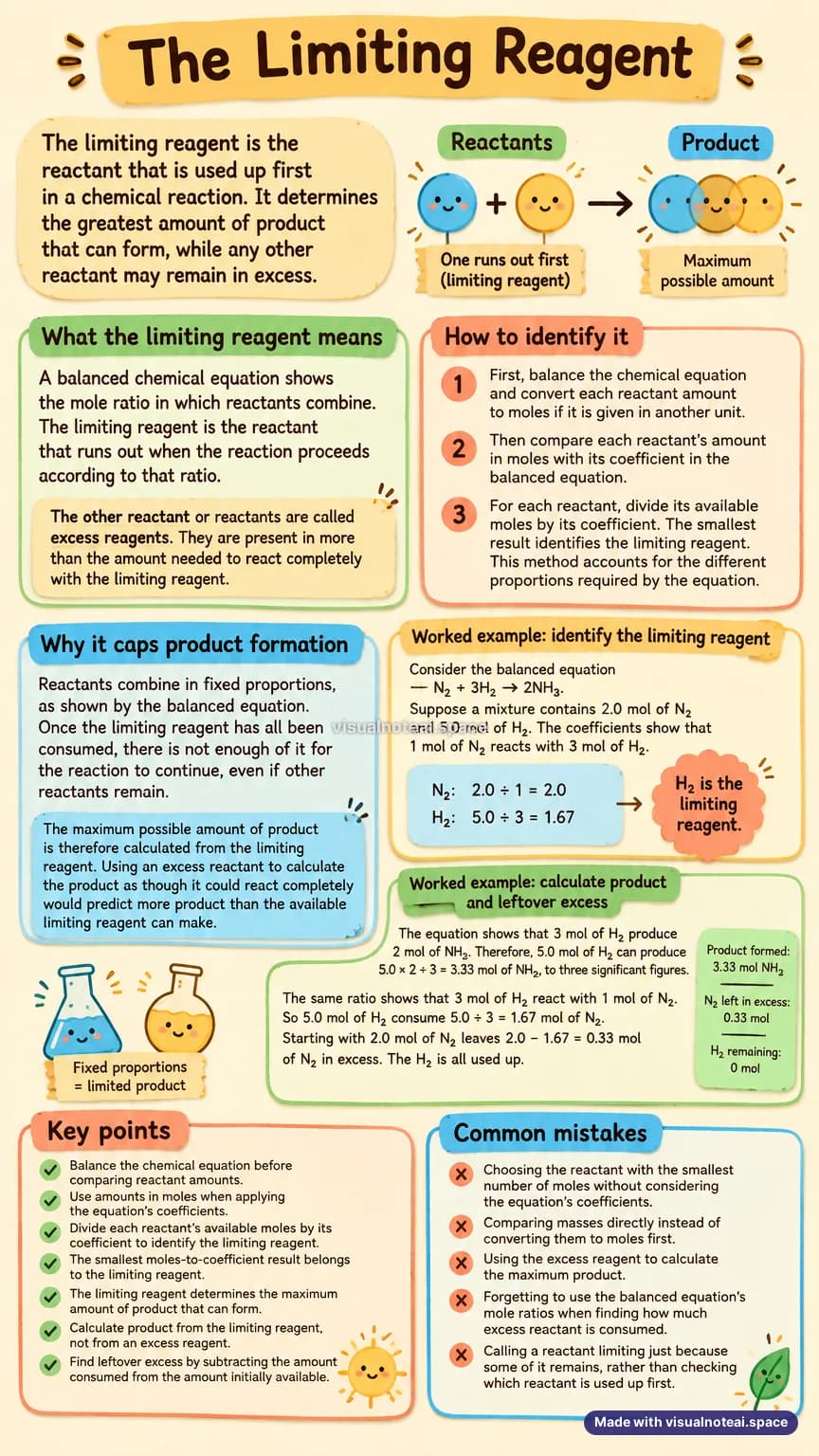
The whole topic on one page. Made with VisualNote.
!Common mistakes
- Choosing the reactant with the smallest number of moles without considering the equation’s coefficients.
- Comparing masses directly instead of converting them to moles first.
- Using the excess reagent to calculate the maximum product.
- Forgetting to use the balanced equation’s mole ratios when finding how much excess reactant is consumed.
- Calling a reactant limiting just because some of it remains, rather than checking which reactant is used up first.
🧠Explore the map28 ideas
The mind map VisualNote made for this topic. Drag to pan, scroll to zoom.
- Limiting Reagent
- Meaning
- Used up first
- Determines maximum product
- Excess reagents remain
- How to Identify
- Balance the equation
- Convert amounts to moles
- Divide available moles by coefficient
- Smallest result is limiting reagent
- Product and Excess Calculations
- Calculate product from limiting reagent
- Use balanced-equation mole ratios
- Leftover excess = initial amount − consumed amount
- Worked Example: N₂ + 3H₂ → 2NH₃
- Starting amounts: 2.0 mol N₂ and 5.0 mol H₂
- N₂ ratio: 2.0 ÷ 1 = 2.0
- H₂ ratio: 5.0 ÷ 3 ≈ 1.67
- H₂ is limiting
- NH₃ produced: 5.0 × 2 ÷ 3 = 3.33 mol
- N₂ consumed: 5.0 ÷ 3 ≈ 1.67 mol
- N₂ left over: 2.0 − 1.67 = 0.33 mol
- Common Mistakes
- Choosing the fewest moles without coefficients
- Comparing masses instead of moles
- Calculating product from an excess reagent
- Ignoring mole ratios when calculating excess consumed
- Assuming leftover reagent must be limiting
- Meaning
🃏Flashcards12 cards
- What is the limiting reagent?
- The reactant that is used up first when reactants combine in the balanced equation’s proportions.
- What determines the maximum amount of product?
- The limiting reagent, because the reaction cannot continue once it is consumed.
- What is an excess reagent?
- A reactant present in more than the amount needed to react completely with the limiting reagent.
- How do you identify the limiting reagent?
- Balance the equation, convert reactant amounts to moles, and divide each reactant’s available moles by its coefficient. The smallest result identifies the limiting reagent.
- Why can’t you identify the limiting reagent by choosing the fewest moles?
- Reactants are required in the proportions shown by their coefficients, so compare moles relative to coefficients rather than raw mole amounts.
- Why must masses be converted before comparing reactants?
- Balanced equation coefficients represent mole ratios, not mass ratios. Convert each reactant amount to moles first.
- What is the limiting reagent in N₂ + 3H₂ → 2NH₃ with 2.0 mol N₂ and 5.0 mol H₂?
- H₂ is limiting: 2.0 ÷ 1 = 2.0 for N₂, while 5.0 ÷ 3 ≈ 1.67 for H₂; the smaller value belongs to H₂.
- How much NH₃ can form from 5.0 mol H₂ in N₂ + 3H₂ → 2NH₃?
- 5.0 × 2 ÷ 3 = 3.33 mol NH₃, to three significant figures.
- How much N₂ does 5.0 mol H₂ consume in N₂ + 3H₂ → 2NH₃?
- The ratio is 3 mol H₂ to 1 mol N₂, so 5.0 mol H₂ consumes 5.0 ÷ 3 ≈ 1.67 mol N₂.
- How much N₂ remains from an initial 2.0 mol when 5.0 mol H₂ reacts?
- About 0.33 mol N₂ remains: 2.0 − 1.67 = 0.33 mol.
- How do you calculate leftover excess reagent?
- Use the balanced equation’s mole ratio to find the amount consumed, then subtract that amount from the initial amount.
- Why is calculating product from an excess reagent a mistake?
- It can predict more product than the limiting reagent can produce, because the excess reagent cannot react without enough limiting reagent.
✅Test yourself5 questions
For the reaction N₂ + 3H₂ → 2NH₃, a mixture has 2.0 mol N₂ and 5.0 mol H₂. Which reactant is limiting?
Dividing by coefficients gives 2.0 for N₂ and about 1.67 for H₂, so H₂ is limiting.
Why should reactant amounts be divided by their coefficients when identifying the limiting reagent?
Dividing by coefficients compares each available amount against the proportion required by the balanced equation.
When calculating the maximum amount of product, which reactant should be used as the basis for the calculation?
The limiting reagent is consumed first and therefore sets the maximum amount of product that can form.
In N₂ + 3H₂ → 2NH₃, 5.0 mol H₂ reacts with 2.0 mol N₂. How much N₂ remains after the H₂ is used up?
Five moles of H₂ consume 5.0 ÷ 3 = 1.67 mol N₂, leaving 2.0 − 1.67 = 0.33 mol.
A reaction gives reactant quantities in grams. What should be done before comparing those quantities with the balanced equation's coefficients?
Balanced-equation coefficients express mole ratios, so reactant quantities must first be converted to moles.
📝The notes
What the limiting reagent means
A balanced chemical equation shows the mole ratio in which reactants combine. The limiting reagent is the reactant that runs out when the reaction proceeds according to that ratio.
The other reactant or reactants are called excess reagents. They are present in more than the amount needed to react completely with the limiting reagent.
How to identify it
First, balance the chemical equation and convert each reactant amount to moles if it is given in another unit. Then compare each reactant’s amount in moles with its coefficient in the balanced equation.
For each reactant, divide its available moles by its coefficient. The smallest result identifies the limiting reagent. This method accounts for the different proportions required by the equation.
Why it caps product formation
Reactants combine in fixed proportions, as shown by the balanced equation. Once the limiting reagent has all been consumed, there is not enough of it for the reaction to continue, even if other reactants remain.
The maximum possible amount of product is therefore calculated from the limiting reagent. Using an excess reactant to calculate the product as though it could react completely would predict more product than the available limiting reagent can make.
Worked example: identify the limiting reagent
Consider the balanced equation N₂ + 3H₂ → 2NH₃. Suppose a mixture contains 2.0 mol of N₂ and 5.0 mol of H₂. The coefficients show that 1 mol of N₂ reacts with 3 mol of H₂.
For N₂, divide 2.0 mol by its coefficient, 1, to get 2.0. For H₂, divide 5.0 mol by its coefficient, 3, to get about 1.67. Since 1.67 is smaller, H₂ is the limiting reagent.
Worked example: calculate product and leftover excess
The equation shows that 3 mol of H₂ produce 2 mol of NH₃. Therefore, 5.0 mol of H₂ can produce 5.0 × 2 ÷ 3 = 3.33 mol of NH₃, to three significant figures.
The same ratio shows that 3 mol of H₂ react with 1 mol of N₂. So 5.0 mol of H₂ consume 5.0 ÷ 3 = 1.67 mol of N₂. Starting with 2.0 mol of N₂ leaves 2.0 − 1.67 = 0.33 mol of N₂ in excess. The H₂ is all used up.
Make this for your own notes
Paste a chapter or a PDF and get the sheet, map, cards, quiz and episode back in about a minute. No credit card.