
First ionization energy is the energy needed to remove one electron from each atom in a mole of gaseous atoms. It generally increases from left to right across a period and decreases down a group, although small exceptions occur within periods.
★What to remember
- First ionization energy is the energy needed to remove one electron from each atom in a mole of gaseous atoms.
- First ionization energy generally increases across a period because nuclear charge increases while shielding changes little.
- Across a period, the stronger attraction usually pulls electrons closer to the nucleus.
- First ionization energy generally decreases down a group because the outer electron is farther from the nucleus and more shielded.
- Boron has a lower first ionization energy than beryllium because its removed electron is in a higher-energy 2p subshell.
- Oxygen has a lower first ionization energy than nitrogen because one of its 2p orbitals contains a pair of repelling electrons.
- The same subshell and pairing exceptions occur from magnesium to aluminium and from phosphorus to sulfur.
🎧Listen2:54 · transcript
AnnaLet’s start with the phrase itself. What is first ionization energy?
MarcoIt’s the energy needed to remove one electron from each atom in a mole of gaseous atoms. Each atom becomes a positive ion. And “first” matters: removing another electron from that ion takes a different amount of energy.
AnnaSo the trend depends on how tightly the atom holds that first electron. What’s the broad pattern on the periodic table?
MarcoFirst ionization energy generally rises from left to right across a period, and falls as you go down a group. But those are trends, not rules for every neighboring pair.
AnnaWhy does it usually rise across a period?
MarcoThe number of protons increases as you move right. Added electrons usually enter the same main shell, so shielding changes relatively little. The stronger nuclear charge attracts the electrons more strongly. They’re generally held closer, the atomic radius tends to shrink, and removing an electron takes more energy.
AnnaAnd down a group, the nucleus has more protons too. Why doesn’t that make the energy rise?
MarcoBecause the electron being removed is in a shell farther from the nucleus. There are also more inner-shell electrons shielding it. The extra distance and shielding usually outweigh the increased nuclear charge, so the outer electron is less strongly attracted and easier to remove.
AnnaLet’s look at the first important exception. Boron is to the right of beryllium, yet its first ionization energy is a little lower. What changes?
MarcoThe electron configurations end differently. Beryllium ends in two s two, while boron ends in two s two, two p one. The electron removed from boron is in a two p subshell. That subshell is higher in energy, and the electron is less strongly held than the two s electron removed from beryllium.
AnnaSo that dip is about subshells, not electron pairing. Does the same kind of exception show up elsewhere?
MarcoYes. From magnesium to aluminium, the electron removed from aluminium is in a three p subshell rather than a three s subshell. That gives a similar dip.
AnnaWhat about the dip from nitrogen to oxygen? That sounds like a different explanation.
MarcoIt is. Nitrogen has three two p electrons in separate orbitals. Oxygen has four, so one orbital contains a pair. Those paired electrons repel each other, making one slightly easier to remove from oxygen than an electron from nitrogen. The same pattern occurs from phosphorus to sulfur.
AnnaSo oxygen’s lower value isn’t because it has fewer protons.
MarcoRight. Oxygen has more protons. The key detail is repulsion between the paired two p electrons.
AnnaWhen we compare two elements, what should we check first?
MarcoConsider distance from the nucleus, shielding, and nuclear charge. For neighboring elements, also check whether the electron comes from a different subshell or a paired orbital. That helps explain why the broad trend has exceptions.
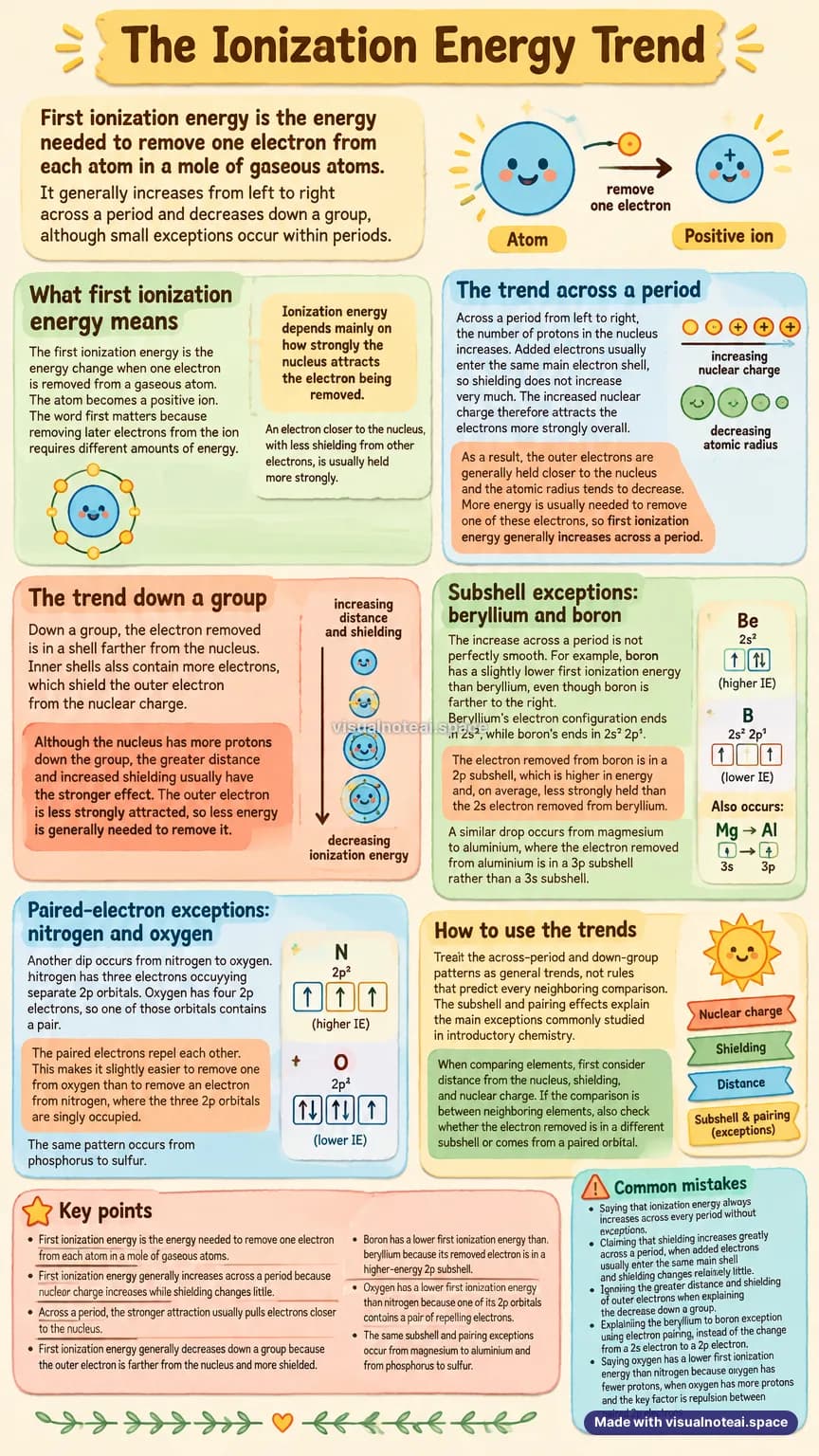
The whole topic on one page. Made with VisualNote.
!Common mistakes
- Saying that ionization energy always increases across every period without exceptions.
- Claiming that shielding increases greatly across a period, when added electrons usually enter the same main shell and shielding changes relatively little.
- Ignoring the greater distance and shielding of outer electrons when explaining the decrease down a group.
- Explaining the beryllium to boron exception using electron pairing, instead of the change from a 2s electron to a 2p electron.
- Saying oxygen has a lower first ionization energy than nitrogen because oxygen has fewer protons, when oxygen has more protons and the key factor is repulsion between paired 2p electrons.
🧠Explore the map33 ideas
The mind map VisualNote made for this topic. Drag to pan, scroll to zoom.
- First Ionization Energy
- Definition
- Energy to remove one electron from a gaseous atom
- Forms a positive ion
- First removal; later removals differ
- Factors Affecting Attraction
- Nuclear charge
- Distance from nucleus
- Electron shielding
- Greater attraction requires more energy
- Periodic Trends
- Across a period: generally increases
- Proton number increases
- Electrons enter the same main shell
- Shielding changes little
- Stronger attraction; smaller atomic radius
- Down a group: generally decreases
- Outer electron is farther from nucleus
- More inner-shell shielding
- Distance and shielding outweigh added protons
- Across a period: generally increases
- Subshell Exceptions
- Boron lower than beryllium
- Boron electron removed from higher-energy 2p subshell
- Magnesium to aluminium: 3s to 3p subshell
- Boron lower than beryllium
- Paired-Electron Exceptions
- Oxygen lower than nitrogen
- Oxygen has a paired 2p orbital
- Repulsion makes an electron easier to remove
- Phosphorus to sulfur: same pattern
- Oxygen lower than nitrogen
- Applying the Trends
- Treat trends as general, not absolute
- Compare nuclear charge, distance, and shielding
- For neighbors, check subshell and electron pairing
- Definition
🃏Flashcards12 cards
- What is first ionization energy?
- The energy required to remove one electron from each atom in a mole of gaseous atoms, forming positive ions.
- Why does “first” matter in first ionization energy?
- It refers specifically to removing one electron from a neutral gaseous atom. Removing later electrons from the resulting ion requires different energies.
- What mainly determines how strongly an electron is held?
- Its attraction to the nucleus, influenced especially by its distance from the nucleus and shielding by other electrons.
- How does first ionization energy generally change across a period?
- It generally increases from left to right, though there are exceptions.
- Why does ionization energy generally increase across a period?
- Nuclear charge increases while added electrons usually enter the same main shell, so shielding changes relatively little. The stronger attraction generally holds electrons closer and more tightly.
- How does first ionization energy generally change down a group?
- It generally decreases because the outer electron is farther from the nucleus and more shielded by inner electrons.
- Why can an electron be easier to remove from boron than from beryllium?
- Boron’s removed electron is in the higher-energy 2p subshell, while beryllium’s is in 2s. The 2p electron is less strongly held.
- What similar subshell exception occurs from magnesium to aluminium?
- Aluminium has a lower first ionization energy than magnesium because the electron removed from aluminium is in a 3p subshell rather than a 3s subshell.
- Why is oxygen’s first ionization energy lower than nitrogen’s?
- Oxygen has a pair of electrons in one 2p orbital; their repulsion makes one easier to remove. Nitrogen’s three 2p electrons occupy separate orbitals.
- What similar paired-electron exception occurs from phosphorus to sulfur?
- Sulfur has a lower first ionization energy than phosphorus because sulfur has a paired 3p orbital whose electrons repel each other.
- What should you check when comparing neighboring elements’ ionization energies?
- Consider nuclear charge, distance, and shielding, then check whether the removed electron is in a different subshell or comes from a paired orbital.
- What are two common mistakes about ionization-energy trends?
- Treating the increase across a period as exceptionless, and claiming shielding increases greatly across a period. Added electrons usually enter the same main shell, so shielding changes relatively little.
✅Test yourself5 questions
What does the first ionization energy describe?
First ionization energy is the energy change for removing one electron from each atom in a mole of gaseous atoms.
Why does first ionization energy generally increase from left to right across a period?
Across a period, proton number increases while added electrons usually enter the same main shell, so nuclear attraction generally strengthens.
Why does first ionization energy generally decrease down a group despite the increasing number of protons?
Greater distance and increased shielding usually outweigh the increase in nuclear charge down a group.
Why is boron's first ionization energy slightly lower than beryllium's?
Boron’s removed electron is in the higher-energy 2p subshell and is less strongly held than beryllium’s 2s electron.
Why is oxygen's first ionization energy slightly lower than nitrogen's?
Oxygen has a pair of electrons in one 2p orbital, and their repulsion makes removing one slightly easier.
📝The notes
What first ionization energy means
The first ionization energy is the energy change when one electron is removed from a gaseous atom. The atom becomes a positive ion. The word first matters because removing later electrons from the ion requires different amounts of energy.
Ionization energy depends mainly on how strongly the nucleus attracts the electron being removed. An electron closer to the nucleus, with less shielding from other electrons, is usually held more strongly.
The trend across a period
Across a period from left to right, the number of protons in the nucleus increases. Added electrons usually enter the same main electron shell, so shielding does not increase very much. The increased nuclear charge therefore attracts the electrons more strongly overall.
As a result, the outer electrons are generally held closer to the nucleus and the atomic radius tends to decrease. More energy is usually needed to remove one of these electrons, so first ionization energy generally increases across a period.
The trend down a group
Down a group, the electron removed is in a shell farther from the nucleus. Inner shells also contain more electrons, which shield the outer electron from the nuclear charge.
Although the nucleus has more protons down the group, the greater distance and increased shielding usually have the stronger effect. The outer electron is less strongly attracted, so less energy is generally needed to remove it.
Subshell exceptions: beryllium and boron
The increase across a period is not perfectly smooth. For example, boron has a slightly lower first ionization energy than beryllium, even though boron is farther to the right. Beryllium's electron configuration ends in 2s2, while boron's ends in 2s2 2p1.
The electron removed from boron is in a 2p subshell, which is higher in energy and, on average, less strongly held than the 2s electron removed from beryllium. A similar drop occurs from magnesium to aluminium, where the electron removed from aluminium is in a 3p subshell rather than a 3s subshell.
Paired-electron exceptions: nitrogen and oxygen
Another dip occurs from nitrogen to oxygen. Nitrogen has three electrons occupying separate 2p orbitals. Oxygen has four 2p electrons, so one of those orbitals contains a pair.
The paired electrons repel each other. This makes it slightly easier to remove one from oxygen than to remove an electron from nitrogen, where the three 2p orbitals are singly occupied. The same pattern occurs from phosphorus to sulfur.
How to use the trends
Treat the across-period and down-group patterns as general trends, not rules that predict every neighboring comparison. The subshell and pairing effects explain the main exceptions commonly studied in introductory chemistry.
When comparing elements, first consider distance from the nucleus, shielding, and nuclear charge. If the comparison is between neighboring elements, also check whether the electron removed is in a different subshell or comes from a paired orbital.
Make this for your own notes
Paste a chapter or a PDF and get the sheet, map, cards, quiz and episode back in about a minute. No credit card.