
Electronegativity describes how strongly an atom attracts the shared electrons in a covalent bond. It generally increases from left to right across a period and decreases from top to bottom down a group, which helps predict which end of a bond will be slightly negative.
★What to remember
- Electronegativity is an atom's ability to attract shared electrons in a bond.
- Across a period, electronegativity generally increases from left to right.
- Across a period, increasing effective nuclear attraction and decreasing atomic size help explain the rise.
- Down a group, electronegativity generally decreases because bonding electrons are farther from the nucleus and more shielded.
- In a polar bond, the more electronegative atom is partially negative.
- A larger electronegativity difference usually means a more polar bond, but there is no single universal cutoff for ionic bonding.
- Equal electronegativities give equal sharing in a bond between identical atoms.
🎧Listen3:11 · transcript
AnnaLet’s start with the basic idea. What does electronegativity actually describe?
MarcoIt describes how strongly an atom attracts the shared electrons in a chemical bond. The word “shared” matters. It is not simply how eager an isolated atom is to gain an electron.
AnnaAnd it’s a relative value, often given on the Pauling scale, rather than a direct measurement with units. So how do we make sense of the trend across a period?
MarcoElectronegativity generally rises from left to right. The nucleus gains protons, while added electrons go into the same main shell. So shielding does not increase very much. The effective pull on electrons gets stronger, and the atom generally gets smaller.
AnnaSo it’s not enough to say, “There are more protons.” We also need to notice that shielding changes little, and that the stronger attraction pulls electrons closer. What does that mean for a bond?
MarcoAn atom on the right side of a period tends to attract a shared pair more strongly. Carbon is less electronegative than oxygen, and oxygen is less electronegative than fluorine.
AnnaWhat about moving down a group? The nucleus has more protons there too. Why doesn’t electronegativity rise?
MarcoEach step down adds an occupied electron shell. Bonding electrons are farther from the nucleus, and inner electrons shield them. Those effects usually outweigh the increase in nuclear charge, so electronegativity generally falls. Fluorine attracts shared electrons more strongly than chlorine, and chlorine more strongly than bromine.
AnnaThat helps explain why fluorine beats chlorine. They’re in the same group, but fluorine is higher up. Its smaller size and less shielding mean a stronger attraction for bonding electrons. How do we use these comparisons to predict polarity?
MarcoCompare the two atoms. If their electronegativities are the same or close, the electrons are shared nearly equally, so the bond is nonpolar or only weakly polar. If one atom is more electronegative, it pulls the shared electrons closer. That atom becomes partially negative, written delta minus. The other becomes partially positive, delta plus.
AnnaLet’s put numbers to that. What happens in a carbon to fluorine bond?
MarcoOn the Pauling scale, carbon is about two point five five, and fluorine is about three point nine eight. The difference is about one point four three, so it’s a strongly polar covalent bond. Fluorine is delta minus, and carbon is delta plus.
AnnaAnd carbon to hydrogen is a smaller difference, about zero point three five. Carbon is slightly delta minus, so that bond is only weakly polar. What about chlorine to chlorine?
MarcoThe atoms have the same electronegativity, so they share the electrons equally. The bond is nonpolar.
AnnaOne important caution: a bigger difference usually means a more polar bond, but there isn’t one universal cutoff that neatly separates covalent from ionic bonding. Bonding character changes gradually. And noble gases often don’t appear in basic trend diagrams, since many don’t commonly form bonds and may not be assigned values in the same way.
MarcoRight. And when comparing oxygen with carbon, they’re in the same period. Oxygen is farther right, so greater nuclear charge, with little extra shielding, gives it a stronger attraction for shared electrons.
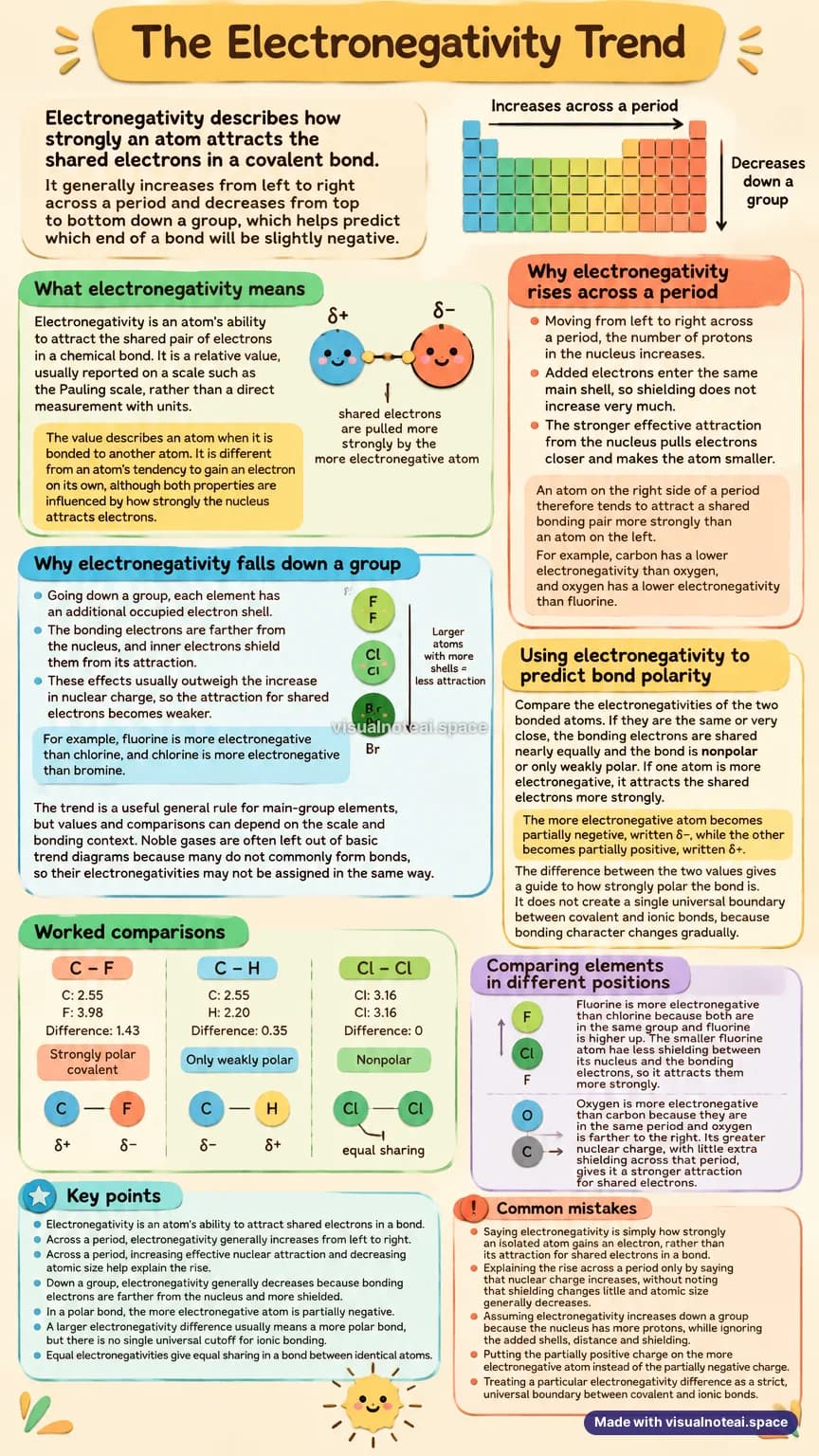
The whole topic on one page. Made with VisualNote.
!Common mistakes
- Saying electronegativity is simply how strongly an isolated atom gains an electron, rather than its attraction for shared electrons in a bond.
- Explaining the rise across a period only by saying that nuclear charge increases, without noting that shielding changes little and atomic size generally decreases.
- Assuming electronegativity increases down a group because the nucleus has more protons, while ignoring the added shells, distance, and shielding.
- Putting the partially positive charge on the more electronegative atom instead of the partially negative charge.
- Treating a particular electronegativity difference as a strict, universal boundary between covalent and ionic bonds.
🧠Explore the map31 ideas
The mind map VisualNote made for this topic. Drag to pan, scroll to zoom.
- Electronegativity
- Meaning and Measurement
- Attraction for shared bonding electrons
- Relative value; often Pauling scale
- Bond property, not isolated electron gain
- Periodic Trends
- Across a period: increases left to right
- More protons; little added shielding
- Stronger effective nuclear attraction; smaller atoms
- Down a group: generally decreases
- Additional shells increase distance and shielding
- Examples: F > Cl > Br; O > C
- Across a period: increases left to right
- Bond Polarity
- Compare bonded atoms' electronegativities
- Similar values: equal sharing; nonpolar or weakly polar
- Greater value: atom attracts electrons more strongly
- More electronegative atom: δ−; other atom: δ+
- Larger difference usually means greater polarity
- No universal covalent-ionic cutoff
- Bond Examples
- C-F: difference ~1.43; strongly polar covalent
- F is δ−; C is δ+
- C-H: difference ~0.35; weakly polar
- C is slightly δ−
- Cl-Cl: equal sharing; nonpolar
- C-F: difference ~1.43; strongly polar covalent
- Applications and Caveats
- Use position and shielding to compare elements
- Fluorine exceeds chlorine: higher in same group
- Oxygen exceeds carbon: farther right in same period
- Trend is a general rule; scale and bonding context matter
- Noble gases often omitted from basic trend diagrams
- Use position and shielding to compare elements
- Meaning and Measurement
🃏Flashcards14 cards
- What is electronegativity?
- An atom’s ability to attract the shared pair of electrons in a chemical bond. It is a relative value, often reported on the Pauling scale.
- How is electronegativity different from an atom’s tendency to gain an electron?
- Electronegativity describes attraction for shared electrons in a bond, not an isolated atom’s tendency to gain an electron.
- What is the general electronegativity trend across a period?
- It generally increases from left to right.
- Why does electronegativity generally increase across a period?
- Nuclear charge increases while shielding changes little because added electrons enter the same main shell. The stronger effective attraction pulls electrons closer and generally decreases atomic size.
- What is the general electronegativity trend down a group?
- Electronegativity generally decreases from top to bottom.
- Why does electronegativity generally decrease down a group?
- Added electron shells place bonding electrons farther from the nucleus and increase shielding. These effects usually outweigh the increase in nuclear charge.
- How do carbon, oxygen, and fluorine compare in electronegativity?
- Carbon is less electronegative than oxygen, and oxygen is less electronegative than fluorine.
- How do fluorine, chlorine, and bromine compare in electronegativity?
- Fluorine is more electronegative than chlorine, which is more electronegative than bromine.
- How does electronegativity predict bond polarity?
- Compare the bonded atoms’ electronegativities: a greater difference usually means more unequal sharing and a more polar bond.
- In a polar bond, which atom is δ− and which is δ+?
- The more electronegative atom attracts the shared electrons more strongly and is partially negative (δ−); the other atom is partially positive (δ+).
- What is the polarity of a carbon-fluorine bond?
- It is strongly polar covalent: fluorine (about 3.98) is more electronegative than carbon (about 2.55), so fluorine is δ− and carbon is δ+.
- What are the polarities of carbon-hydrogen and chlorine-chlorine bonds?
- Carbon-hydrogen is weakly polar, with carbon slightly δ−. Chlorine-chlorine is nonpolar because identical atoms share electrons equally.
- Does a specific electronegativity difference create a universal boundary between covalent and ionic bonds?
- No. Bonding character changes gradually, so there is no single universal cutoff.
- Why are noble gases often omitted from basic electronegativity trend diagrams?
- Many noble gases do not commonly form bonds, so their electronegativities may not be assigned in the same way.
✅Test yourself5 questions
What does electronegativity describe?
Electronegativity is an atom’s ability to attract the shared electron pair in a chemical bond.
Why does electronegativity generally increase from left to right across a period?
Across a period, proton number increases while added electrons enter the same main shell, so effective nuclear attraction generally grows.
Why is fluorine more electronegative than chlorine?
Fluorine is higher in the group, so its bonding electrons are closer to the nucleus and experience less shielding.
In a carbon-fluorine bond, which atom is partially negative?
The more electronegative atom attracts the shared electrons more strongly and becomes partially negative, so fluorine is δ−.
Which statement about electronegativity differences and bond types is correct?
A larger electronegativity difference generally indicates a more polar bond, but bonding character changes gradually rather than at one universal boundary.
📝The notes
What electronegativity means
Electronegativity is an atom's ability to attract the shared pair of electrons in a chemical bond. It is a relative value, usually reported on a scale such as the Pauling scale, rather than a direct measurement with units.
The value describes an atom when it is bonded to another atom. It is different from an atom's tendency to gain an electron on its own, although both properties are influenced by how strongly the nucleus attracts electrons.
Why electronegativity rises across a period
Moving from left to right across a period, the number of protons in the nucleus increases. Added electrons enter the same main shell, so shielding does not increase very much. The stronger effective attraction from the nucleus pulls electrons closer and makes the atom smaller.
An atom on the right side of a period therefore tends to attract a shared bonding pair more strongly than an atom on the left. For example, carbon has a lower electronegativity than oxygen, and oxygen has a lower electronegativity than fluorine.
Why electronegativity falls down a group
Going down a group, each element has an additional occupied electron shell. The bonding electrons are farther from the nucleus, and inner electrons shield them from its attraction. These effects usually outweigh the increase in nuclear charge, so the attraction for shared electrons becomes weaker.
For example, fluorine is more electronegative than chlorine, and chlorine is more electronegative than bromine. The trend is a useful general rule for main-group elements, but values and comparisons can depend on the scale and bonding context. Noble gases are often left out of basic trend diagrams because many do not commonly form bonds, so their electronegativities may not be assigned in the same way.
Using electronegativity to predict bond polarity
Compare the electronegativities of the two bonded atoms. If they are the same or very close, the bonding electrons are shared nearly equally and the bond is nonpolar or only weakly polar. If one atom is more electronegative, it attracts the shared electrons more strongly.
The more electronegative atom becomes partially negative, written δ−, while the other becomes partially positive, written δ+. The difference between the two values gives a guide to how strongly polar the bond is. It does not create a single universal boundary between covalent and ionic bonds, because bonding character changes gradually.
Worked comparisons
In a carbon to fluorine bond, carbon has a Pauling electronegativity of about 2.55 and fluorine about 3.98. The difference is about 1.43, so the bond is strongly polar covalent. Fluorine attracts the bonding electrons more strongly and is δ−; carbon is δ+.
In a carbon to hydrogen bond, carbon is about 2.55 and hydrogen about 2.20. The difference is about 0.35, so the bond is only weakly polar, with carbon slightly δ−. In a chlorine to chlorine bond, both atoms have the same electronegativity, so the electrons are shared equally and the bond is nonpolar.
Comparing elements in different positions
Fluorine is more electronegative than chlorine because both are in the same group and fluorine is higher up. The smaller fluorine atom has less shielding between its nucleus and the bonding electrons, so it attracts them more strongly.
Oxygen is more electronegative than carbon because they are in the same period and oxygen is farther to the right. Its greater nuclear charge, with little extra shielding across that period, gives it a stronger attraction for shared electrons.
Make this for your own notes
Paste a chapter or a PDF and get the sheet, map, cards, quiz and episode back in about a minute. No credit card.