
Atomic radius generally decreases from left to right across a period and increases from top to bottom down a group. These trends reflect how strongly the nucleus attracts the outer electrons and how far those electrons are from the nucleus.
★What to remember
- Atomic radius generally decreases from left to right across a period.
- Across a period, proton number rises while added electrons usually enter the same main shell.
- Across a period, the stronger effective nuclear attraction pulls the outer electrons closer.
- Atomic radius generally increases down a group because each step adds an occupied electron shell.
- Down a group, extra distance and shielding outweigh the increase in nuclear charge.
- Shielding is the reduction in nuclear attraction felt by outer electrons because of other electrons.
- Within one period, the element farther right is generally smaller; within one group, the element farther down is generally larger.
🎧Listen3:06 · transcript
AnnaWhen we say an atom has a radius, are we talking about a clear outer edge?
MarcoNot quite. An atom’s electrons form a cloud, and its density fades gradually. So atomic radius is a measured estimate of size, not a distance to a sharp boundary. One common measure is the covalent radius: measure between the nuclei of two identical atoms joined by a covalent bond, then take half that distance.
AnnaSo different measurements might give different numbers. Do they still show the same overall pattern?
MarcoUsually, yes. The broad periodic trends are generally the same. Across a period, from left to right, atomic radius tends to decrease. Down a group, from top to bottom, it tends to increase.
AnnaLet’s unpack the first one. Why does an atom usually get smaller across a period?
MarcoEach step adds a proton to the nucleus and usually adds an electron to the same main shell. The extra electrons can increase shielding, but usually not enough to cancel the stronger positive charge. The outer electrons feel greater effective attraction from the nucleus, so they’re pulled closer.
AnnaWhen you say shielding, you mean other electrons reduce the pull that the outer electrons feel?
MarcoExactly, especially inner-shell electrons. But shielding doesn’t switch off the nucleus. The balance between nuclear charge and shielding helps determine how tightly the outer electrons are held. And across a period, the number of occupied shells usually stays the same. So the atom doesn’t shrink because it loses a shell.
AnnaThen why does the radius generally grow as we move down a group?
MarcoEach step adds another occupied electron shell, putting the outer electrons farther from the nucleus. There are more protons too, which would strengthen attraction by itself. But the added inner shells increase shielding, and the outer shell is farther away. Those effects outweigh the increased nuclear charge, so the atom is larger overall.
AnnaHow should someone compare two elements without getting lost in the details?
MarcoFirst find them on the periodic table. In the same period, the one farther right is generally smaller. In the same group, the one farther down is generally larger. Those simple rules are most reliable for comparisons within a period or within a group.
AnnaAnd if they’re in different periods and different groups?
MarcoThen the trends may point in different directions, so position alone might not settle it. Consider the number of occupied shells and the effective attraction on the outer electrons, or check measured radius data if you need an exact comparison.
AnnaAre there any important limits to keep in mind?
MarcoYes. These are broad trends, not perfectly smooth rules. Radius depends partly on how it’s defined and on the atom’s chemical environment. The trend describes neutral atoms; ions can have different sizes, so account for their charge. And comparisons among transition elements can be less straightforward than the simple main-group pattern.
AnnaSo the short version is: right across, generally smaller; down, generally larger. And the reasons are attraction, shielding, and shells.
MarcoThat’s it. More protons alone don’t explain why atoms grow down a group. The added shells and shielding matter, while across a period the stronger effective attraction usually pulls the outer electrons closer.
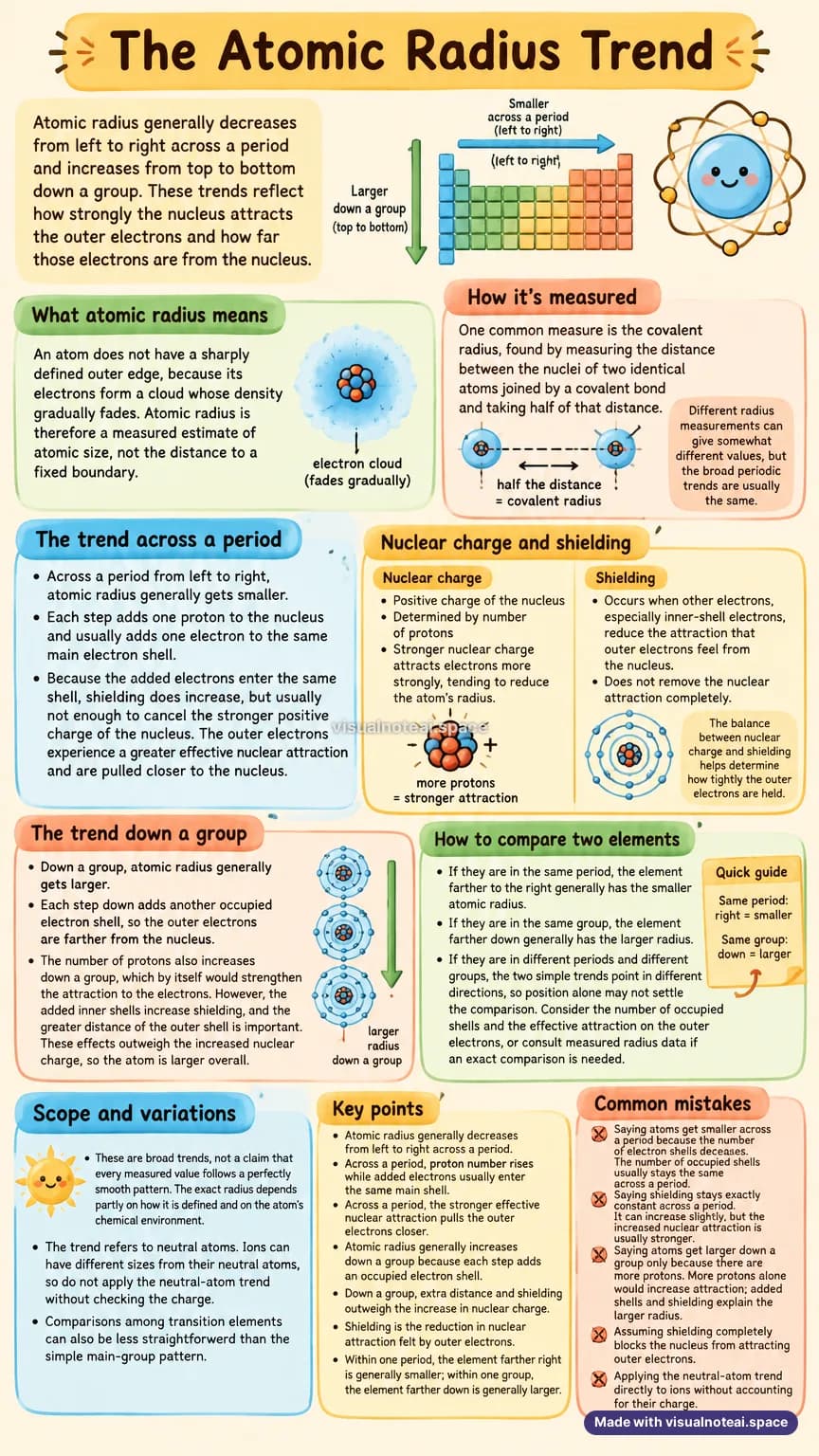
The whole topic on one page. Made with VisualNote.
!Common mistakes
- Saying atoms get smaller across a period because the number of electron shells decreases. The number of occupied shells usually stays the same across a period.
- Saying shielding stays exactly constant across a period. It can increase slightly, but the increased nuclear attraction is usually stronger.
- Saying atoms get larger down a group only because there are more protons. More protons alone would increase attraction; added shells and shielding explain the larger radius.
- Assuming shielding completely blocks the nucleus from attracting outer electrons.
- Applying the neutral-atom trend directly to ions without accounting for their charge.
🧠Explore the map32 ideas
The mind map VisualNote made for this topic. Drag to pan, scroll to zoom.
- Atomic Radius Trends
- Meaning and Measurement
- Estimated measure of atomic size
- Electron cloud has no sharp outer edge
- Covalent radius: half the distance between bonded identical nuclei
- Across a Period
- Radius generally decreases from left to right
- Proton number rises; electrons enter the same main shell
- Stronger effective nuclear attraction pulls outer electrons closer
- Shielding may increase slightly, but usually does not offset attraction
- Down a Group
- Radius generally increases from top to bottom
- Each step adds an occupied electron shell
- Outer electrons are farther from the nucleus
- Added shells and shielding outweigh increased nuclear charge
- Nuclear Charge and Shielding
- Nuclear charge depends on proton number
- Greater nuclear charge attracts electrons more strongly
- Shielding reduces nuclear attraction felt by outer electrons
- Shielding does not completely block nuclear attraction
- Comparing Elements
- Same period: farther right is generally smaller
- Same group: farther down is generally larger
- Different periods and groups: consider shells and effective attraction
- Use measured data when an exact comparison is needed
- Scope and Common Pitfalls
- Trends are broad, not perfectly smooth
- Radius depends on its definition and chemical environment
- Neutral-atom trends do not directly apply to ions
- Transition-element comparisons can be less straightforward
- Occupied shells usually stay the same across a period
- More protons alone do not explain larger atoms down a group
- Meaning and Measurement
🃏Flashcards13 cards
- What does atomic radius describe?
- Atomic radius is a measured estimate of an atom’s size, not the distance to a sharply defined outer boundary, because an electron cloud gradually fades.
- How is covalent radius commonly determined?
- Measure the distance between the nuclei of two identical atoms joined by a covalent bond, then take half that distance.
- What is the general atomic-radius trend across a period?
- Atomic radius generally decreases from left to right across a period.
- Why does atomic radius generally decrease across a period?
- Proton number increases while added electrons usually enter the same main shell. The stronger effective nuclear attraction pulls the outer electrons closer.
- What is nuclear charge?
- Nuclear charge is the positive charge of the nucleus, determined by its number of protons. Greater nuclear charge tends to attract electrons more strongly and reduce atomic radius.
- What is electron shielding?
- Shielding is the reduction in nuclear attraction felt by outer electrons because of other electrons, especially those in inner shells. It does not completely block the nucleus’s attraction.
- Does shielding stay exactly constant across a period?
- No. Shielding can increase slightly as electrons are added, but the increased nuclear attraction usually outweighs that change.
- What is the general atomic-radius trend down a group?
- Atomic radius generally increases down a group.
- Why do atoms generally get larger down a group?
- Each step down adds an occupied electron shell, placing outer electrons farther from the nucleus. Increased distance and shielding outweigh the increase in nuclear charge.
- How do you compare atomic radii within the same period?
- The element farther to the right generally has the smaller atomic radius.
- How do you compare atomic radii within the same group?
- The element farther down generally has the larger atomic radius.
- What should you consider when comparing elements in different periods and groups?
- The simple trends may point in different directions, so consider occupied shells and effective nuclear attraction, or consult measured data for an exact comparison.
- Do periodic atomic-radius trends apply equally to ions and transition elements?
- The trends describe neutral atoms and are broad guidelines; ions can differ in size because of their charge, and transition-element comparisons may be less straightforward.
✅Test yourself5 questions
How is covalent radius commonly estimated for two identical atoms joined by a covalent bond?
Covalent radius is half the distance between the nuclei of two identical bonded atoms.
Why does atomic radius generally decrease from left to right across a period?
Across a period, nuclear charge increases while added electrons usually enter the same shell, strengthening the effective attraction on outer electrons.
What does shielding do to the attraction experienced by an atom's outer electrons?
Other electrons, especially inner-shell electrons, reduce but do not eliminate the nucleus's attraction to outer electrons.
Why does atomic radius generally increase down a group despite the increase in proton number?
Each step down adds an occupied shell, and the greater distance and shielding outweigh the increased nuclear charge.
Which comparison is most reliably predicted by the simple atomic-radius trends?
The simple trend reliably predicts that within the same period, the element farther to the right generally has the smaller radius.
📝The notes
What atomic radius means
An atom does not have a sharply defined outer edge, because its electrons form a cloud whose density gradually fades. Atomic radius is therefore a measured estimate of atomic size, not the distance to a fixed boundary.
One common measure is the covalent radius, found by measuring the distance between the nuclei of two identical atoms joined by a covalent bond and taking half of that distance. Different radius measurements can give somewhat different values, but the broad periodic trends are usually the same.
The trend across a period
Across a period from left to right, atomic radius generally gets smaller. Each step adds one proton to the nucleus and usually adds one electron to the same main electron shell.
Because the added electrons enter the same shell, shielding does increase, but usually not enough to cancel the stronger positive charge of the nucleus. The outer electrons experience a greater effective nuclear attraction and are pulled closer to the nucleus.
Nuclear charge and shielding
Nuclear charge is the positive charge of the nucleus, determined by its number of protons. A stronger nuclear charge attracts electrons more strongly, tending to reduce the atom's radius.
Shielding occurs when other electrons, especially inner-shell electrons, reduce the attraction that outer electrons feel from the nucleus. Shielding does not remove the nuclear attraction completely. The balance between nuclear charge and shielding helps determine how tightly the outer electrons are held.
The trend down a group
Down a group, atomic radius generally gets larger. Each step down adds another occupied electron shell, so the outer electrons are farther from the nucleus.
The number of protons also increases down a group, which by itself would strengthen the attraction to the electrons. However, the added inner shells increase shielding, and the greater distance of the outer shell is important. These effects outweigh the increased nuclear charge, so the atom is larger overall.
How to compare two elements
First locate both elements on the periodic table. If they are in the same period, the element farther to the right generally has the smaller atomic radius. If they are in the same group, the element farther down generally has the larger radius.
If the elements are in different periods and different groups, the two simple trends point in different directions, so position alone may not settle the comparison. Consider the number of occupied shells and the effective attraction on the outer electrons, or consult measured radius data if an exact comparison is needed. General trends are most reliable for comparisons within a period or within a group.
Scope and variations
These are broad trends, not a claim that every measured value follows a perfectly smooth pattern. The exact radius depends partly on how it is defined and on the atom's chemical environment.
The trend refers to neutral atoms. Ions can have different sizes from their neutral atoms, so do not apply the neutral-atom trend without checking the charge. Comparisons among transition elements can also be less straightforward than the simple main-group pattern.
Make this for your own notes
Paste a chapter or a PDF and get the sheet, map, cards, quiz and episode back in about a minute. No credit card.